Thanks for submitting!
You will be contacted as soon as possible


QUICK LINKS


PROFILES
PUBLICATIONS
EXPOSURE
VULNERABILTY
SOFTWARE
EQ MODELS
Search Results
Search this site
1172 results found with an empty search
- Strain partitioning in the Southeastern Tibetan Plateau from kinematic modeling of high-resolution Sentinel-1 InSAR and GNSS | GEM Foundation
Publications Strain partitioning in the Southeastern Tibetan Plateau from kinematic modeling of high-resolution Sentinel-1 InSAR and GNSS Share Facebook LinkedIn Download 2024 | Peer-reviewed Fault slip rates estimated from geodetic data are being integrated into seismic hazard models. The standard approach requires modeling velocities and relative (micro-)plate motions, which is challenging for fault-based models. We present a new approach to directly invert strain rates to solve for slip rates and distributed strain simultaneously. We generate velocity and strain rate fields over the southeastern Tibetan Plateau, utilizing Sentinel-1 Interferometric Synthetic Aperture Radar data spanning 2014–2023. We derive slip rates using block modeling and by inverting strain rates. Our results show a partitioning between localized strain on faults and distributed deformation. The direct inversion of strain rates matches the geodetic data best when incorporating distributed moment sources, accounting for a similar proportion to on-fault sources. The direct strain methodology also aligns best with the independent geological slip rates, especially near fault tips. As high-resolution strain rate fields become increasingly available, we recommend direct inversion as the preferred practice.
- METIS Summer School on Seismic Hazard Analysis - GEM Foundation
News METIS Summer School on Seismic Hazard Analysis By: Mar 1, 2022 Share Facebook LinkedIn Applications are now being accepted for the METIS Summer School on Seismic Hazard Analysis, to be held at in Pavia (Italy) from 20th to 23rd June 2022. The Global Earthquake Model Foundation (GEM; www.globalquakemodel.org) and the University School for Advanced Studies (IUSS; www.iusspavia.it) will host a summer school on probabilistic seismic hazard analysis. The school, organized under the auspices of the METIS project (EU Euratom research and training program 2014-2018, grant agreement n°94512 - metis-h2020.eu), will be held in person1 and will consist of a series of lectures and hands-on laboratories. The goal of the school is to introduce the participants to the calculation of probabilistic seismic hazard and to recent methodologies developed in the framework of the METIS project. The topics offered will include an introduction to the main functionalities of the OpenQuake Engine (see www.globalquakemodel.org/openquake) and, GEM's tools for building components of a hazard input model, aftershock PSHA (Probabilistic Seismic Hazard Analysis), vector-valued PSHA and the conditional spectrum approach, and time-histories selection for engineering applications. The School targets PhD/Master students and other early-career researchers. Participation to the school is free. Participants are expected to cover their travel and accommodation costs. The maximum number of participants is 20. Applications to the summer school can be submitted by filling the form available at the following link: . The application deadline is April 15, 2022.* More about the call at . ____________________ *We are monitoring the Covid-19 situation and will adapt accordingly. No images found. GALLERY 1/0 Gallery VIDEO RELATED CONTENTS
- GEM Governing Board reviews progress and confirms new and renewed partners - GEM Foundation
News GEM Governing Board reviews progress and confirms new and renewed partners By: Dec 16, 2025 Dec 5, 2025 Share Facebook LinkedIn The Global Earthquake Model (GEM) Foundation held its Governing Board meeting on 4–5 December 2025, with the Advisory Board convening on 3 December. The meeting brought together Board members, advisors and the GEM Secretariat to review progress across the Foundation’s activities and to discuss priorities for the coming period. The first day focused on Secretariat reporting, with updates from the hazard, risk, information technology and communications teams, alongside reviews of ongoing partner activities. Discussions highlighted recent developments across GEM’s scientific programmes and operational platforms. Key governance decisions were taken during the second day of the meeting. The Board confirmed the appointment of NBRB Uganda as a new Public Governor, approved the joint Public Governor agreement (pending signature) of two bodies of the Croatian Centre for Earthquake Engineering, and welcomed Liberty Mutual as a new Private Advisor. Renewals of existing Governors were also approved, including Aon, NIED Japan, and NERC UK. The Advisory Board report was presented by its Chair, Laurie Johnson, whose term was renewed for a further two years, ensuring continuity in scientific and strategic advice to the Foundation. The meeting also featured a series of live demonstrations showcasing recent developments in GEM’s tools and platforms. These included updates to the PAPERS, AELO and oq-impact web platforms, demonstrations of RUBIC-AI, GEM’s algorithm for classifying buildings from images, and applications of augmented reality for earthquake risk communication. The meeting provided an opportunity to reflect on progress and to look ahead, as GEM continues to advance its scientific agenda and collaborations in support of improved seismic risk understanding and resilience worldwide. ## No images found. GALLERY 3.1.png 1 (10).png 2 (10).png 3.1.png 1/3 VIDEO RELATED CONTENTS
- GEM launches collaboration with innovative disaster resilience company, One Concern, to advance understanding of seismic risks - GEM Foundation
News GEM launches collaboration with innovative disaster resilience company, One Concern, to advance understanding of seismic risks By: Mar 17, 2020 Share Facebook LinkedIn GEM recently finalized an agreement to collaborate with One Concern ( ), a resilience as a service company, that combines disaster science and machine learning to help business and government leaders measure and mitigate risks. The focus of the joint initiative is to enhance One Concern’s ability to help the public sector, as well as commercial and insurance entities identify, quantify, and manage earthquake risk exposure. As part of the collaboration, GEM will provide One Concern with access to its OpenQuake software and its seismic hazard and vulnerability models for Japan, allowing the company to refine its earthquake scenario impact assessments, as well as its modeling of cascading failures to infrastructure systems in the country. Dr. Abhineet Gupta, Director of Research at One Concern, explained, “Our technology is helping to improve the understanding of disaster impacts on the built and the natural environments globally. Our work with GEM will add value to the AI-based multi-hazard platform that we’ve developed for earthquakes and floods, so that communities can better prepare for and respond to these disasters.” One Concern is joining GEM as an Advisor for three years and will work closely with GEM Hazard, Risk and IT teams toward improving GEM models and risk analysis tools. On collaborating with One Concern, John Schneider, Secretary General of GEM, added, “We’re excited to work with One Concern to contribute to developing detailed earthquake impact scenarios using One Concern’s artificial intelligence and machine learning algorithms, which in turn will advance our understanding of and preparation for earthquake impacts at global scale.” No images found. GALLERY 1/0 VIDEO RELATED CONTENTS
- GEM reaching out in Addis Ababa - GEM Foundation
News GEM reaching out in Addis Ababa By: Jul 2, 2018 Share Facebook LinkedIn Risk Coordinator Vitor Silva was invited to deliver a presentation on our work and participated in one of the panel sessions. Our team were very active in the many official forums, as well as promoting GEM through social media and face-to-face discussion with delegates at our display booth. In a standing-room-only interactive event led by Carlos Villacis, Chris Burton, and Vitor Silva, our work in Disaster Risk Reduction in Africa was enthusiastically attended, drawing the highest number of participants of all the sessions on the conference’s closing day. While in the Ethiopian capital, our new Fund-raiser, Chris Wardle and Socioeconomic-Vulnerabilities Coordinator Chris Burton met with senior staff from the USAID’s Regional Office, with Chris Burton’s overview of GEM being very well received. The GEM team were also able to establish a working relationship with the Fire Emergency Prevention and Rescue Agency (FEPRA), as one of the key building blocks for a city-level risk assessment for Addis Ababa, planned under our USAID-funded SSAHARA programme. No images found. GALLERY 1/0 VIDEO RELATED CONTENTS
- Critical Issues in Earthquake Scenario Loss Modeling | GEM Foundation
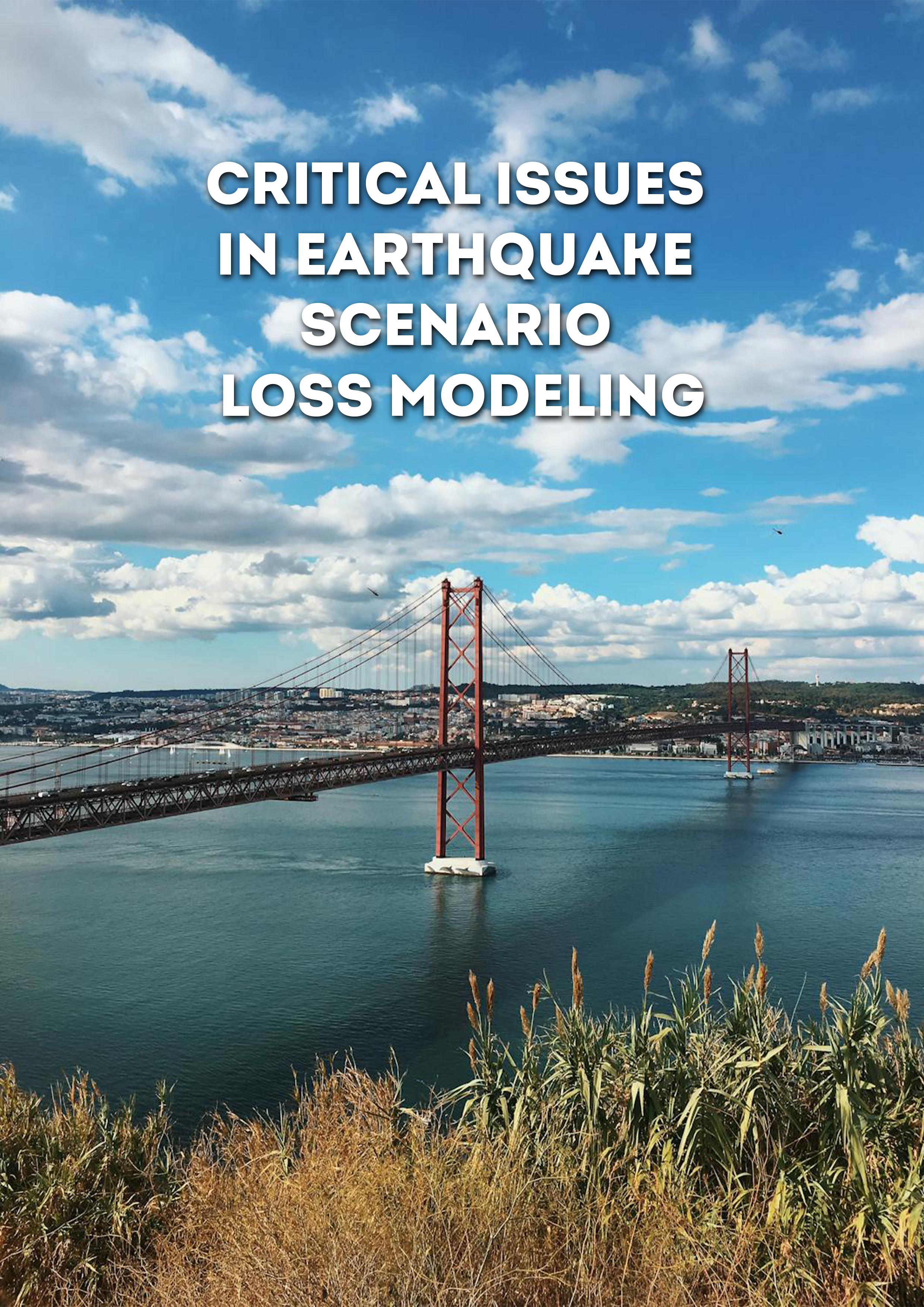
Publications Critical Issues in Earthquake Scenario Loss Modeling Share Facebook LinkedIn Download 2016 | Peer-reviewed The assessment of human or economic losses due to single events (scenario) may effectively support decision makers in the development of important risk mitigation actions. The study presented herein sheds light on several problems and limitations in the current practice of scenario loss modeling, such as: the number of simulations required to achieve convergence; epistemic and aleatory uncertainty in the ground motion prediction and vulnerability models; and consideration of the earthquake rupture geometry. These issues are investigated using the Metropolitan Area of Lisbon (Portugal), and it has been observed that distinct assumptions in the loss modeling can lead to considerably different results. The findings of this study are also pertinent for probabilistic seismic risk analyses in which a large number of stochastically generated events are employed to assess probabilistic losses.
- OpenQuake Engine | GEM Foundation
License Request Form You have chosen to get more information about: OpenQuake Engine All Please check the link below to see if this product already meets your your requirements before submitting your request for a license. Thank you. DOWNLOAD THE OPEN VERSION Summary of steps to obtain a license for the requested product. Fill in the application form below. Click Submit. Please check your email Inbox or Spam folder for the summary of your request. You will then be contacted by the GEM Product Manager with either a request for more information, or a request to sign the license. If you do not hear from us within 2 weeks, please send an email to product@globalquakemodel.org . REQUEST DETAILS A. Requesting party information First Name Last Name Role/Job Email Business type Business type Other business Sector Sector Other sector B. License agreement signatory information The signatory must be someone who is authorised to sign license agreements on your behalf such as your immediate supervisor, manager or legal officer. If you’re a PhD student, the signatory must be your adviser or a university officer in charge of license agreements or similar legal documents. Full Name of Signatory Position Company Email of Signatory Organisation name Complete Address C. Purpose of request GEM is able to offer products for free because of the support of our project partners, national collaborators and institutional sponsors. All of GEM’s products are freely available for public good, non-commercial use, but with different license restrictions. In most cases we release products under an open license (e.g., CC BY-SA or CC BY-NC-SA), which permits (re)distribution. In this case, we are granting access under a more restricted license that forbids distribution or disclosure and requires signing by GEM and the licensee in order to better assure accountability for the confidentiality of the information. In order for GEM to properly assess your request, please answer the following questions below. 1. Explain briefly how will the GEM product be used e.g. project, research including the expected results and the foreseen public benefit. Minimum 60 words. 2. Will you be able to share the results of your work with GEM? YES NO 3. Will you be able to provide feedback to GEM on the quality and usefulness of this product via a survey? YES NO D. Privacy Policy By submitting this form, you consent to the processing of your personal data in accordance with our Privacy Policy and the EU General Data Protection Regulation (GDPR). We are committed to safeguarding your information and ensuring it is only used for the purpose outlined in this form. You have the right to access, rectify, or delete your data at any time. For more information, please refer to our Privacy Policy. I agree Words: 0 Email us at product@globalquakemodel.org if you're experiencing problems submitting your application. Thank you. Submit Thanks for submitting! You will be contacted as soon as possible Incomplete data. Please fill in all required fields. Thank you.
- Japan Hazard | GEM Foundation
License Request Form You have chosen to get more information about: Japan Hazard Hazard Please check the link below to see if this product already meets your your requirements before submitting your request for a license. Thank you. DOWNLOAD THE OPEN VERSION Summary of steps to obtain a license for the requested product. Fill in the application form below. Click Submit. Please check your email Inbox or Spam folder for the summary of your request. You will then be contacted by the GEM Product Manager with either a request for more information, or a request to sign the license. If you do not hear from us within 2 weeks, please send an email to product@globalquakemodel.org . REQUEST DETAILS A. Requesting party information First Name Last Name Role/Job Email Business type Business type Other business Sector Sector Other sector B. License agreement signatory information The signatory must be someone who is authorised to sign license agreements on your behalf such as your immediate supervisor, manager or legal officer. If you’re a PhD student, the signatory must be your adviser or a university officer in charge of license agreements or similar legal documents. Full Name of Signatory Position Company Email of Signatory Organisation name Complete Address C. Purpose of request GEM is able to offer products for free because of the support of our project partners, national collaborators and institutional sponsors. All of GEM’s products are freely available for public good, non-commercial use, but with different license restrictions. In most cases we release products under an open license (e.g., CC BY-SA or CC BY-NC-SA), which permits (re)distribution. In this case, we are granting access under a more restricted license that forbids distribution or disclosure and requires signing by GEM and the licensee in order to better assure accountability for the confidentiality of the information. In order for GEM to properly assess your request, please answer the following questions below. 1. Explain briefly how will the GEM product be used e.g. project, research including the expected results and the foreseen public benefit. Minimum 60 words. 2. Will you be able to share the results of your work with GEM? YES NO 3. Will you be able to provide feedback to GEM on the quality and usefulness of this product via a survey? YES NO D. Privacy Policy By submitting this form, you consent to the processing of your personal data in accordance with our Privacy Policy and the EU General Data Protection Regulation (GDPR). We are committed to safeguarding your information and ensuring it is only used for the purpose outlined in this form. You have the right to access, rectify, or delete your data at any time. For more information, please refer to our Privacy Policy. I agree Words: 0 Email us at product@globalquakemodel.org if you're experiencing problems submitting your application. Thank you. Submit Thanks for submitting! You will be contacted as soon as possible Incomplete data. Please fill in all required fields. Thank you.
- User Needs Assessment for the Global Earthquake Model (GEM) | GEM Foundation
Publications User Needs Assessment for the Global Earthquake Model (GEM) Share Facebook LinkedIn Download 2010 | Report Successful development of software such as the Global Earthquake Model (GEM) requires a structured process involving defining the product requirements, based on which the software requirements are specified, actual software is constructed and a number of subsequent steps up to and including deployment and maintenance are implemented. A key part of developing the product requirements document is a User Needs Assessment – that is, defining Who the users of GEM will be, and What their needs are. In order to address these questions, a User Survey was conducted, consisting of 17 questions each in English, Spanish, Chinese, Hindi and Japanese. The survey was accessed over 800 times from over 74 countries, with over 400 completed responses, which are summarized in Section 2 of this report.
- scientific collaboration a vital element for productivity
Scientific Collaboration, a vital element for productivity GEM Impact Story Series Early beginnings Early in my career, I spent several years as a postdoctoral and research fellow at the ANU’s Research School of Earth Sciences researching deep earth structure. My seismology really didn't involve earthquakes. It involved earth structure which people aren't that interested in. Inspired in Japan In 1997, I worked as a research scientist at the Japan Agency for Marine- Earth Science and Technology, where I eventually led a research program in earthquake and tsunami science. That’s when I started working on earthquakes. In Japan, people were very interested in earthquakes. Every time I talked to anyone, friends or people I met on the street or at the bus station, they were very interested in earthquakes and so that really got me excited and I just became much more interested in the earthquakes themselves. GEM and Geoscience Australia partnership In 2001 I moved back to Australia to lead Geoscience Australia’s (GA) Earthquake and Tsunami Hazard Project, where I became the Principal Scientist in GA’s Regional Development Section. We have been involved in earthquake hazard assessment in Australia for a very long time. GA provides expert geo scientific information to the Australian government and to the public and that includes earthquake hazard information. GA joined GEM in 2010 as a public sponsor to contribute to this knowledge. I represented GA from 2016 to 2019. Hazard assessment before OpenQuake We've done earthquake assessment for a very long time and we have used a variety of methods, and a software to do that. At some point, we were developing our own software and spending a lot of resources for that purpose. We realized that we were really spending so much resources just developing the software that we really didn't have much time to devote to the actual data analysis and improving the quality of information. Increased productivity with scientific collaboration When GEM came along, they were an organization that provided excellent tools and software that allowed us to focus more on the science and our data analysis. We were able then to improve greatly the information that went into the earthquake hazard assessment without having to spend lots of time just developing the software. A hub for earthquake knowledge Currently, I'd say in the world, GEM has the greatest concentration of earthquake hazard and risk expertise available anywhere. It’s a knowledge hub for earthquake hazard and risk analysis. GEM impact at Geoscience Australia Collaborating with GEM has improved the quality of our research on earthquakes because it has greatly improved the quality of our earthquake hazard assessments. It has made a dramatic difference in the quality of the outputs. From software development to quality of data and data analysis Working with GEM allowed us to focus more on the quality of our data and our data analysis rather than the software development and this has really resulted in a dramatic improvement in the Australian earthquake hazard map. Earthquake risk and world population I think that there are places in the world where earthquake risk is very much unappreciated. Over the course of the past couple of centuries, or in the people's living memory, there haven't been big earthquakes. But the population has grown dramatically and they've built lots of buildings without really thinking about the earthquake risk. GEM and public good At the moment the world faces, at least in some places, very pronounced earthquake risk and people don't really know how to deal with this. Having an organization like GEM where they have expertise, they have a place they can go to benefit from this kind of expertise in earthquake hazard and risk assessment. It is really important for those places in order to try to reduce future fatalities. About the GEM Impact Stories Earthquake risk remains abstract and highly technical, and there are significant risks that due to poor or limited understanding of it, policymakers and the public at large may not be able to fully take advantage of existing and future information that can either help create better or enhance existing earthquake risk reduction and management strategies, especially at the local and national level. Specifically, the GEM Impact Stories project aims to: Collect and document stories where GEM or its partners have contributed to positive change; Encourage policy and decision makers to use science- and evidence- based information to formulate earthquake DRR strategy at the national level through positive stories of change; and Increase awareness of the public at large on earthquake risk and preparedness. About Prof. Phil R. Cummins Phil Cummins received his PhD in Geophysics from U. California Berkeley in 1988. He spent several years as a postdoctoral and research fellow at the ANU’s Research School of Earth Sciences researching deep earth structure. Since 2010 he has also held a position as Prof. Natural Hazards at ANU’s Research School of Earth Sciences. (source: ANU website ) Acknowledgement Our heartfelt thanks goes to: Prof. Phil Cummins for contributing his story and valuable time with us; Simona Confalonieri and her team at videografiaitaliana.it for the video interview; and Jill Schneider for the support provided during the interview. Related Contents Scientific collaboration a vital element for productivity Prof. Phil Cummins' full interview transcript in PDF format. Title: Scientific collaboration a vital element for productivity Video: Prof. Phil Cummins' interview Duration: 3mins 04secs