Thanks for submitting!
You will be contacted as soon as possible


QUICK LINKS


PROFILES
PUBLICATIONS
EXPOSURE
VULNERABILTY
SOFTWARE
EQ MODELS
Search Results
Search this site
1170 results found with an empty search
- GEM METEOR project releases exposure datasets for more than 40 countries - GEM Foundation
News GEM METEOR project releases exposure datasets for more than 40 countries By: Nov 25, 2020 Share Facebook LinkedIn The METEOR Project celebrated UNDRR’s recent International Day for Disaster Risk Reduction by releasing exposure data for 44 Official Development Assistance (ODA) recipient countries, including the corresponding interactive maps. The objective of the project is to formulate an innovative methodology of creating exposure data through the use of Earth Observation (EO)-based imagery to identify development patterns throughout a country. The METEOR protocols and standards for combining traditional land use interpretation methods with EO and in-field building characteristics to capture the distribution of building types have been pilot tested in Nepal and Tanzania. Specifically, the project aims to deliver exposure data for 47 of the least developed ODA countries, ; to create hazard footprints for the pilot countries Nepal and Tanzania; to create open protocols showing how to collect data and apply techniques in other countries; and to build capacity of local stakeholders to apply data and assess hazard exposure. The project is expected to benefit a wide spectrum of stakeholders such as governments, NGOs, affected communities and businesses, seeking to bolster resilience and growth. To download the data visit, . To view interactive maps of the data, visit . No images found. GALLERY 1/3 Gallery VIDEO RELATED CONTENTS
- Technology transfer in the Middle East - GEM Foundation
News Technology transfer in the Middle East By: Jul 2, 2018 Share Facebook LinkedIn The four-day workshop organized by GEM in collaboration with the Kandilli Observatory and Earthquake Research Institute (KOERI) on March 14-18 continues the work carried out by the partners in the region and lays the foundation for long-term collaboration. In the framework of the USAID/OFDA-funded project, the workshop was implemented as part of the process to develop tools and procedures needed to establish a global network of GEM implementing partners. They will have the capacity to perform risk analyses and provide technical support and training in their regions, while coordinating with the GEM Secretariat in the improvement of methodologies and models according to local needs.Participants came from eight countries in the Middle East area (including Turkey), which had already contributed to the Earthquake Model for the Middle East (EMME) project under KOERI’s leadership. This time they were guided on the use of the OpenQuake-engine to perform urban risk assessments. The impact of the training was immediate: by the end of the workshop all participants managed to run a large number of hazard and risk calculations and visualize the resulting hazard, damage and loss estimates. Thanks to the training, participants had the opportunity to perform scenario calculations for their own regions and obtain damage and loss statistics for their cities. “This was one of the most successful workshops we have ever organized – said Vitor Silva, Risk Coordinator at GEM – “and I was impressed by the rapid learning ability on the use of the GEM tools”. This is certainly also a testimony to the improved computational efficiency and usability of the OpenQuake-engine interface and shows that GEM is on the right path in the development of its tools and methodologies, as well as in the adoption of appropriate technology-transfer mechanisms. Moreover, participants were impressed by the wide range of data and models available in the OpenQuake Platform and provided positive feedback on its potential contribution to the reduction of disaster risk around the world. The workshop ended with a short introduction to socio-economic vulnerability and integrated risk assessment and a dedicated session on the way forward. The participants decided to create a GEM-EMME community to promote long-term collaboration under KOERI‘s and GEM’s leadership. A corresponding proposal was submitted by the participants immediately after the workshop. No images found. GALLERY 1/0 VIDEO RELATED CONTENTS
- Request demo for Australia Hazard | GEM Foundation
You have chosen to request a demo on: Australia Hazard First Name Last Name Email Company or Institution Name Country Sector Provide Details I accept the license terms and the conditions of products use. Email us at product@globalquakemodel.org if you're experiencing problems submitting this form or if you have any inquiries. Thank you. Request Thanks for submitting! You will be contacted as soon as possible Add answer here
- Request demo for Southeast Asia Exposure | GEM Foundation
You have chosen to request a demo on: Southeast Asia Exposure First Name Last Name Email Company or Institution Name Country Sector Provide Details I accept the license terms and the conditions of products use. Email us at product@globalquakemodel.org if you're experiencing problems submitting this form or if you have any inquiries. Thank you. Request Thanks for submitting! You will be contacted as soon as possible Add answer here
- Hands-on with the OpenQuake engine at the 4th GEM Annual Risk Workshop - GEM Foundation
News Hands-on with the OpenQuake engine at the 4th GEM Annual Risk Workshop By: Jul 2, 2018 Share Facebook LinkedIn From November 20th to 22nd, the GEM Foundation hosted the fourth edition of the Risk Workshop. The annual event brings together GEM partners from both the private and public sectors around the world to foster collaboration and knowledge sharing. It provides an opportunity to demonstrate new features and improvements on the OpenQuake suite of tools, as well as the latest developments in the hazard and risk models and datasets. This year, the workshop had the following specific goals: Explore GEM's risk datasets, models and tools Present GEM’s Risk Modeler’s Toolkit to derive fragility and vulnerability models Prepare exposure and vulnerability models for the OpenQuake-engine using the Input Preparation Toolkit (https://platform.openquake.org/ipt/) Perform seismic risk analysis and scenario loss estimations using the OpenQuake-engine Contribute to GEM’s Global Risk Modeling effort The event featured presentations from the GEM team, and several scenario risk calculations using the OpenQuake engine. The exercises allowed participants to experiment first hand how the engine works with the GEM Risk Team verifying and checking the results. Participants from ARUP (United Kingdom) demonstrated how some of the GEM tools were employed in the assessment of earthquake risk in Kyrgyzstan as part of a World Bank project. The partners from NSET (Nepal) presented how Nepal is recovering from the 2015 Gorkha earthquake, and preparing other towns for future events by collecting detailed information regarding the built up environment. Aspen Re (Switzerland/UK) shared how GEM tools and models can be used to better understand the drivers of uncertainty in CAT modeling. Finally, Dr. Christopher Burton from Auburn University (USA) highlighted the need to go beyond the physical risk, and to incorporate the social aspects in the evaluation of earthquake threat. The workshop also had the participation of other experts from ETH, INGV, EUCENTRE, Zurich, CICESE, SCOR, AXA, PartnerRe, OYO, Pacific Disaster Center and NKUA. On the last day the participants enjoyed a guided tour of the EUCENTRE Foundation laboratories led by Dr. Filippo Dacarro, Lab Director. The tour included a visit to the old and new shake table, inaugurated in September 2017. The outcomes of the training were positive: for instance, Suman Pradhan and Kirty Tiwari from NSET, Nepal, mentioned the importance of the GEM Taxonomy for their work, and complimented the GEM Staff for the success of the event. They committed to returning to Nepal and train their colleagues on how to use OpenQuake. Katherine Coates, from ARUP, affirmed the discussions and presentations were excellent, and appreciated the hands-on practice and the activities offered by GEM. No images found. GALLERY 1/0 VIDEO RELATED CONTENTS
- Executive summary Urban seismic risk assessment for the cities of Quito, Cali and Santiago de los Caballeros | GEM Foundation
Publications Executive summary Urban seismic risk assessment for the cities of Quito, Cali and Santiago de los Caballeros Share Facebook LinkedIn Download 2022 | Report This seismic risk component at urban level covers the development of uniform, open and transparent datasets for the urban building inventory (exposure model), the physical response of the infrastructure under seismic loads (vulnerability model), and the assessment of the impact from earthquakes, along with risk metrics required for the development of risk reduction plans.
- Vision to 2030 | GEM Foundation
VISION TO 2030 Since 2009, GEM has led a global effort to improve the state of practice of earthquake hazard and risk assessment. GEM has developed open global databases, models and the OpenQuake software, and developed capacity for risk assessment worldwide. What role will GEM play as the risk landscape and associated demand evolve between now and 2030? Share Facebook LinkedIn Our Goal Integrated risk and resilience solutions With loss from natural catastrophic events projected to reach up to $2trn by 2030 (RMS, 2022) due to increasing global population, rapid urbanisation and extreme weather events, GEM’s strategic plan roadmap to 2030 aims to develop capabilities that serve the broader need for integrated risk assessment for resilience and sustainability due to globally increasing vulnerability and exposure of populations to natural hazards, including from climate change. DRIVING PRINCIPLES Credibility, Openness, Collaboration, Public Good Three core strategic objectives that are driving the next 5 years leading up to 2030 are as follows: Provide: continue to develop global standards for risk modelling for all earthquake-related hazards. GEM will maintain expertise and global leadership in earthquake hazard and risk modelling and its applications to disaster risk reduction, in particular, the continuous development and user support for GEM’s flagship programmes and products: the OpenQuake Engine and the global earthquake hazard and risk models. INITIATIVES Global improvement and harmonisation of seismic hazard and risk models Global time-dependent seismic hazard and risk models Global impact assessment due to (all) earthquake-triggered hazards Advancing Science in PSHA and PSRA Support: be a global partner to local, regional and global disaster risk reduction communities for earthquakes and other natural hazards. Driven by global drivers such as the Sendai Framework, Sustainable Development Goals, and Paris Climate Agreement, and guided by its core values, GEM will expand its organizational, technical and scientific relationships and diversify its risk products and services to engage with stakeholders in the broader disaster risk reduction community. INITIATIVES Multi-hazard risk assessment - software and services Hazard-agnostic global exposure Disaster preparedness, response and recovery - software and services Global partnerships with other hazards and climate change communities Strengthen: strengthen the capacity of developing countries and the Global South. GEM will invest in strengthening the capacity of developing countries and the Global South to assess their risk to earthquakes and other natural hazards through public partnerships, training and collaborative projects. INITIATIVES Improve national seismic hazard and risk modelling, assessment and communication around the world Strengthen public partnerships Education, training, capacity building HOW TO SUPPORT OUR WORK various ways to support our work GEM offers flexible mechanisms to enable potential partners to contribute to its ongoing and future work programs. Partners and collaborators can enter into sponsorships, project partnerships and service agreements, and can select the level of engagement based on their needs and requirements. GEM’s sponsorship structure and fees have been designed to incentivize the participation of public and private organizations. Get Involved Sponsorship Projects & Technical Cooperation Publications & Research Bespoke Products & Services STRATEGIC PLAN AND ROADMAP TO 2030 Download GEM’s overall objective to 2030 is to develop capabilities and to serve the broader need for integrated risk assessment for resilience and sustainability due to globally increasing vulnerability and exposure of populations to natural hazards, including from climate change. To get a complete view of our future programs, download our brochure.
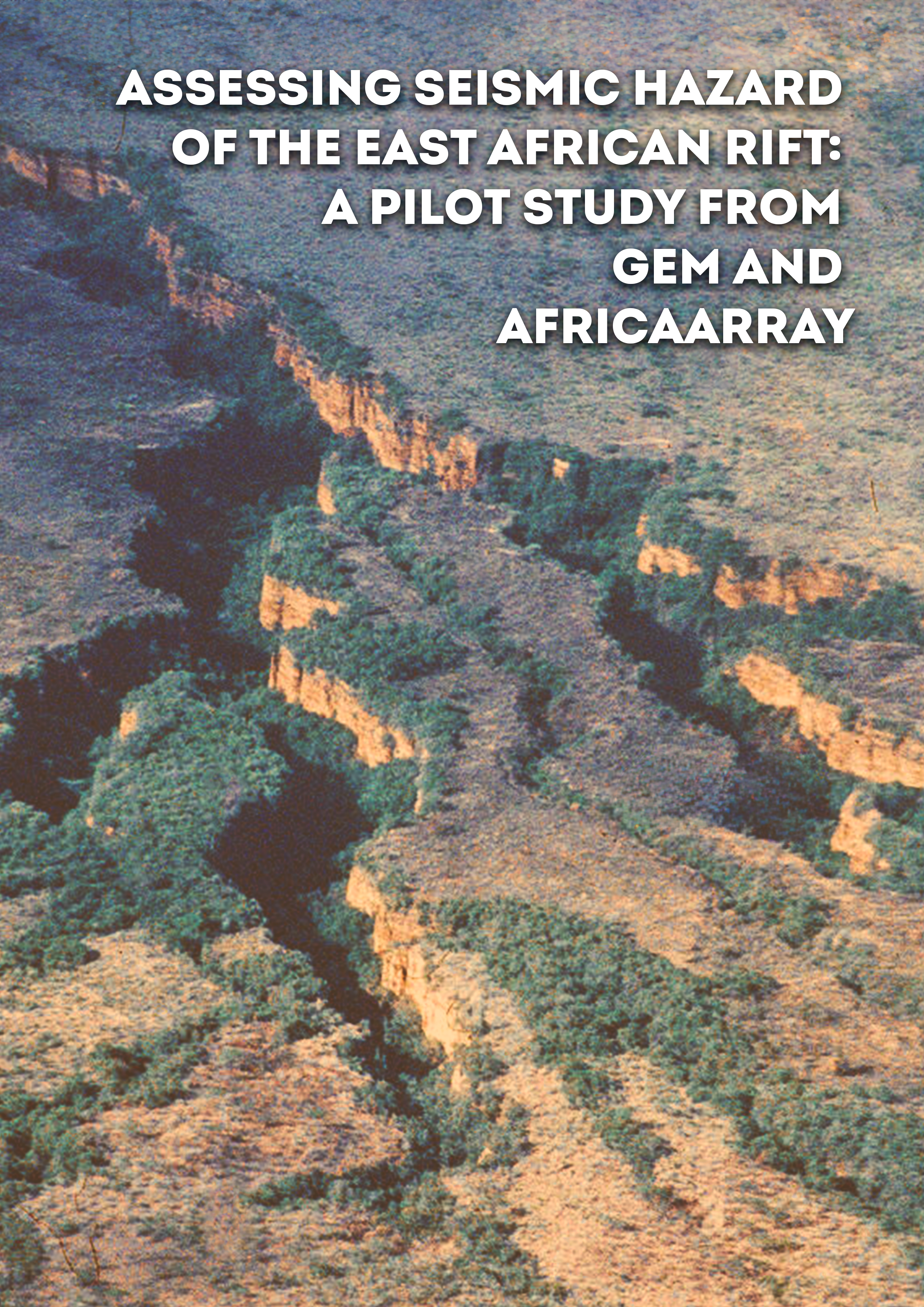
- Assessing seismic hazard of the East African Rift: a pilot study from GEM and AfricaArray | GEM Foundation
Publications Assessing seismic hazard of the East African Rift: a pilot study from GEM and AfricaArray Share Facebook LinkedIn Download 2017 | Peer-reviewed The East African Rift System is the major active tectonic feature of the Sub-Saharan Africa region. Although the seismicity level of this divergent plate boundary can be described as moderate, several damaging earthquakes have been reported in historical times, and the seismic risk is exacerbated by the high vulnerability of the local buildings and structures. Formulation and enforcement of national seismic codes is therefore an essential future risk mitigation strategy. Nonetheless, a reliable risk assessment cannot be done without the calibration of an updated seismic hazard model for the region. A major limitation affecting the assessment of seismic hazard in Sub-Saharan Africa is the lack of basic information needed to construct source and ground motion models. The historical earthquake record is sparse, with significant variation in completeness over time across different regions. The instrumental catalogue is complete down to sufficient magnitude only for a relatively short time span. In addition, mapping of seismogenically active faults is still an on-going task, and few faults in the region are sufficiently constrained as to allow them to be directly represented within the seismic hazard model. Recent studies have identified major seismogenic lineaments, but there is substantial lack of kinematic information for intermediate-to-small scale tectonic features, information that is essential for the proper calibration of earthquake recurrence models. In this study, we use new data and Global Earthquake Model (GEM) computational tools such as the Hazard Modeller’s Toolkit and the OpenQuake engine to perform a pilot study of the seismic hazard associated with the East African Rift. The hazard model obtained has been created using the most recent information available from scientific literature, global bulletins and local earthquake catalogues, including those from AfricaArray projects. In this report, in accordance with the GEM philosophy, we describe in detail all working assumptions, main processing steps, data analyses and interpretations used for the model setup.
- Request demo for South America Hazard | GEM Foundation
You have chosen to request a demo on: South America Hazard First Name Last Name Email Company or Institution Name Country Sector Provide Details I accept the license terms and the conditions of products use. Email us at product@globalquakemodel.org if you're experiencing problems submitting this form or if you have any inquiries. Thank you. Request Thanks for submitting! You will be contacted as soon as possible Add answer here
- Successful GEM Industry Event at Zurich Insurance’s Quai Zurich Campus - GEM Foundation
News Successful GEM Industry Event at Zurich Insurance’s Quai Zurich Campus By: Oct 9, 2024 Sep 5, 2024 Share Facebook LinkedIn On September 5th, 2024, over 30 participants from Zurich-based companies and academic institutions gathered for the Global Earthquake Model (GEM) Foundation’s industry event, hosted by Zurich Insurance at its Quai Zurich campus. The agenda featured presentations from leading experts, including GEM's Secretary General Helen Crowley, Vitor Silva, Head of Risk Engineering, Marco Pagani, Head of Seismic Hazards, and Andrés Abarca, Product Manager. Their discussions highlighted the scientific work behind GEM's models, focusing on how the findings can be applied to products and services of importance to both humanitarian efforts and commercial initiatives. Attendees gained valuable insights into GEM's cutting-edge tools and data, which are designed to inform risk assessment practices across various sectors. GEM expresses gratitude to all attendees for their participation and contributions, which were instrumental in making the event a success. The organization looks forward to continued collaboration in advancing the field of earthquake risk assessment in Switzerland and beyond. ## No images found. GALLERY 1/8 VIDEO RELATED CONTENTS