Thanks for submitting!
You will be contacted as soon as possible


OVERVIEW
This course, part of the Doctoral Programme in Earthquake Engineering at IUSS Pavia, is organised by the Global Earthquake Model (GEM) Foundation, and aims to provide a comprehensive overview of state-of-the-art methods and models for seismic hazard, exposure, vulnerability and risk assessment, and their implementation within the OpenQuake Engine under a number of different use cases. The course will include both theoretical lectures and training sessions on how to use the OpenQuake Engine, from basic scenario analysis to advanced modelling of probabilistic seismic hazard and risk.
Speakers & Panelists
Session Title

Azdine Kay Ysulan*
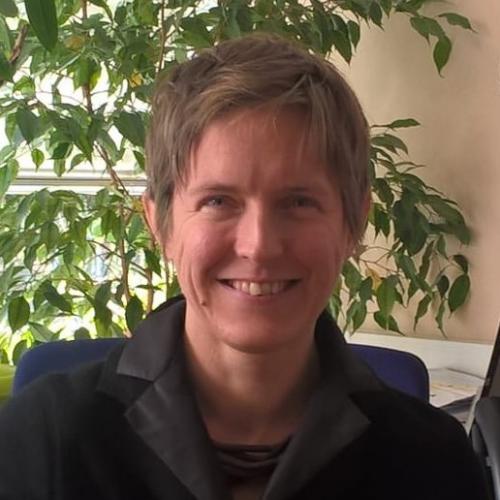
Marzia Santini

David Wald

Helen Crowley
Kishor Jaiswal


Finn Løvholt
More invited speakers coming soon!
AGENDA
Session Title
Collapsible text is great for longer section titles and descriptions. It gives people access to all the info they need, while keeping your layout clean. Link your text to anything, or set your text box to expand on click. Write your text here...
Auditorium
Time | Title | Speaker | Organisation |
|---|---|---|---|
16:25-16:40 | Using GEM products to support rapid loss assessment | Alberto Michelini | Istituto Nazionale di Geofisica e Vulcanologia (INGV) ARISTOTLE |
16:55-17:25 | Closing Discussion Panel: The role of GEM to 2030 | Closing Panel Moderator:
John Schneider (GEM)
Panelists:: Laurie Johnson, Sibylle Steimen, Kishor Jaiswal, Jenty Kirsch-Wood, Matthias Schmid, Sangeeta Singh | |
16:10-16:25 | Systemic or cascading infrastructure risk | Astha Poudel | Aristotle
University of Thessaloniki |
14:20-15:00 | Intro Discussion Panel: Lessons learned regarding post-earthquake impact assessment | Intro Panel Moderator:
Michael Ewald (SwissRe)
Panelists: Nilesh Shome, Jay Guin, Mustafa Erdik,
Sinan Akkar,
Jaime Abad
Perez | |
17:30-18:00 | Discussion Panel 1: Development and use of the Global earthquake models | Panel 1 Moderator:
Helen Crowley (Eucentre)
Panelists: Vitor Silva, Marco Pagani, Chung-Han Chan, Paul Della Marta,
Daniela
Di Bucci | |
Session 3: Where are we going? (June 14th, afternoon) | |||
13:20-13:50 | Lessons learned from the 2023 Kahramanmara?, T�rkiye earthquakes: Modeling aspects of insured portfolio losses | Sinan Akkar | Turk Reinsurance Inc.,
Principal Catastrophe Modeler (keynote speaker) |
15:10-15:40 | Coffee break - Posters and demonstrations | ||
14:05-14:20 | Triggered or secondary effects: Tsunami | Stefano Lorito | Istituto Nazionale di Geofisica e Vulcanologia (INGV) |
13:00-13:10 | Introductory remarks | John Schneider | GEM |
17:25-17:30 | Final Wrap/Closing | Jorg Steffensen | Hannover Re |
11:25-11:40 | Site-specific seismic hazard assessment for nuclear and hydropower facilities in France | Paola Traversa | Electricit�
de France (EdF) |
Agenda
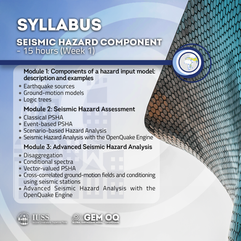
Seismic Hazard Component - 15 hours (Week 1)
Module 1: Components of a hazard input model: description and examples
Earthquake sources
Ground-motion models
Logic trees
Module 2: Seismic Hazard Assessment
Classical PSHA
Event-based PSHA
Scenario-based Hazard Analysis
Seismic Hazard Analysis with the OpenQuake Engine
Module 3: Advanced Seismic Hazard Analysis
Disaggregation
Conditional spectra
Vector-valued PSHA
Cross-correlated ground-motion fields and conditioning using seismic stations
Advanced Seismic Hazard Analysis with the OpenQuake Engine
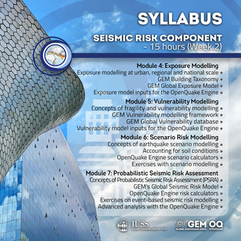
Seismic Risk Component - 15 hours (Week 2)
Module 4: Exposure Modelling
Exposure modelling at urban, regional and national scale
GEM Building Taxonomy
GEM Global Exposure Model
Exposure model inputs for the OpenQuake Engine
Module 5: Vulnerability Modelling
Concepts of fragility and vulnerability modelling
GEM Vulnerability modelling framework
GEM Global Vulnerability database
Vulnerability model inputs for the OpenQuake Engine
Module 6: Scenario Risk Modelling
Concepts of earthquake scenario modelling
Accounting for soil conditions
OpenQuake Engine scenario calculators
Exercises with scenario modelling
Module 7: Probabilistic Seismic Risk Assessment
Concepts of Probabilistic Seismic Risk Assessment (PSRA)
GEM’s Global Seismic Risk Model
OpenQuake Engine risk calculators
Exercises on event-based seismic risk modelling
Advanced analysis with the OpenQuake Engine






POSTERS & DEMOS
Showcasing GEM Integration, Innovative Tools, and Advanced Data for Enhanced Hazard and Risk Assessment
REGISTRATION
This course is currently full. Please sign up to our newsletter or social media channels to stay informed about future GEM training events.
LOCATION
HOTEL
TRANSPORTATION
RESOURCES
Videos
Gallery
Recording
Videos

Gallery


Recording