Thanks for submitting!
You will be contacted as soon as possible


QUICK LINKS


PROFILES
PUBLICATIONS
EXPOSURE
VULNERABILTY
SOFTWARE
EQ MODELS
Search Results
1079 results found with an empty search
- GEM-CCARA Project trains participants from Central America on using OpenQuake to assess seismic hazard and risk - GEM Foundation
News GEM-CCARA Project trains participants from Central America on using OpenQuake to assess seismic hazard and risk By: Jul 2, 2018 Share Facebook LinkedIn “OpenQuake is vast, like a new world, so many options, you have to go deep to take advantage of it, “Jose Carlos Gil from the Mariano Galvez University, Guatemala said at the conclusion of the 3-week CCARA training workshop on seismic hazard and risk assessment held in Pavia, Italy from April 20th - May 12th. The CCARA project hosted four participants from South America to introduce seismic hazard and risk assessment using tools developed by GEM – specifically the OpenQuake engine. Other participants shared the same opinion about the OpenQuake engine saying that it’s now very user friendly but to fully benefit from it, they recognized the need to continue using it after the training workshop. They also see further applications of OQ in rural and urban seismic risk assessment citing that improvement in data collection must go hand in hand with the sophisticated software. “I found seismic risk analysis the most interesting topic because you can see the physical and economic results immediately,” a student participant shared. However, all participants agreed that social vulnerability is as important as assessing physical risk and exposure and they are keen to see GEM giving more attention to this area in the future. The workshop culminated with partners from Costa Rica, Nicaragua, Guatemala and El Salvador presenting their respective exposure models using GEM tools in calculating seismic risk. Overall, participants said they had a wonderful experience, gaining not just new knowledge and skills but also new friends. The Assessing and Mitigating Earthquake Risk in the Caribbean and Central America (CCARA) Project aims to develop capacity in the region of Central America and the Caribbean for earthquake risk assessment by leveraging GEM tools and resources, to enhance the understanding of earthquake risk, and to bridge the gap between risk assessment and disaster risk reduction. The CCARA project, which runs from 2016-2018 is made possible through the support of USAID (From the American people). No images found. GALLERY 1/0 VIDEO RELATED CONTENTS FACT BOX
- News Briefs: May-August 2021 - GEM Foundation
News News Briefs: May-August 2021 By: Aug 30, 2021 Share Facebook LinkedIn IDF Summit 2021 https://idfsummit.insdevforum.org/ GEM joined its partners, the Insurance Development Forum for the inaugural IDF Summit 2021, held on June 7-8. The theme was Building resilience in a riskier world. Global leaders and hundreds of participants from around the world participated in the event. In case you missed it, you can still visit GEM’s dedicated booth @ Knowledge Hub bit.ly/3ghuJph . Governing Board meeting, June 2021 GEM would like to thank all the sponsors and partners for making the first virtual Governing Board meeting of 2021 a great success. The bi-annual meeting was attended by sponsors from public and private sponsors, as well associate and project partners. The meeting featured the usual (and highly appreciated) progress reports on GEM Secretariat activities, advances in the development of GEM products, including commercial risk models, and initial progress on the development of a new GEM Strategic Plan for 2021 to 2030. European Commission and World Bank Dialogue - Economics for Disaster Prevention and Preparedness https://ec.europa.eu/echo/field-blogs/videos/economics-disaster-prevention-and-preparedness_en https://www.worldbank.org/en/news/feature/2021/06/04/economics-for-disaster-prevention-and-preparedness-in-europe The European Commission and World Bank held a Dialogue on June 7th for the release of reports providing an in-depth look at the economics for disaster, prevention and preparedness in Europe. GEM provided research and analytics support on earthquake risk, exposure and vulnerability. Vitor Silva represented GEM in the dialogue. COMPDYN: 8th International Conference on Computational Methods in Structural Dynamics and Earthquake Engineering https://2021.compdyn.org/ GEM’s Vitor Silva participated as a panelist in the round table on fragility curves for existing buildings: open challenges in their definition and use for seismic risk analyses. Vitor presented the Global Risk Assessment: mistakes from the past and promises for the future. GEM at GAGE SAGE 2021 Community Science Workshop https://gage-sage-2021.us2.pathable.com/meetings/virtual/ToWA2isYjG7gxhAhF GEM joined the virtual GAGE SAGE 2021 Community Science Workshop on August 16th. GEM’s Catalina Yepes shared GEM’s experiences on the challenges and strategies in training and local collaborations in the International Panel for the Americas. GAGE, the Geodetic Facility for the Advancement of Geosciences, is a facility funded by the US National Science Foundation and NASA and operated by UNAVCO. SAGE is operated by the Incorporated Research Institutions for Seismology (IRIS). South Africa Model release GEM has completed the development of its earthquake risk model for South Africa into the Oasis Loss Modelling Framework and the AIR Touchstone formats. The model will be available soon for licensing from the Nasdaq Risk Modelling for Catastrophes Service (contact Nasdaq ) and the AIR Touchstone platforms (contact AIR ). The risk model may be used to assess potential financial losses to commercial, industrial and residential buildings due to earthquake ground shaking. GEM’s South Africa earthquake risk model was generated using the hazard model for South Africa developed by the South Africa Council for Geoscience as the national hazard model, and for input to South Africa building design regulations. The vulnerability and exposure models and data were developed by GEM and cover the residential, commercial and industrial building stock. In the commercial models, OpenQuake is used to generate a stochastic set of hazard footprints (i.e., the spatial distribution of ground motion for each scenario event in the stochastic set). The suite of hazard footprints is translated into the Oasis or Touchstone formats, together with the building vulnerability curves to produce ground up losses, which are then fed into the financial module to compute (re)insured losses. Portfolio analyses may be conducted using industry standard occupancy classes. The original OpenQuake (OQ) version of the South Africa model (hazard, vulnerability and exposure components) is available from GEM under a Creative Commons open license (CC BY-SA). See https://www.globalquakemodel.org/product/south-africa-model for licensing and access to the models and data, as well as model documentation. The OQ version provides a much more detailed view of hazard and risk than the commercial models, but provides risk in terms of ground-up losses (i.e., cost of direct physical damage), not insured losses. No images found. GALLERY 1/0 Gallery VIDEO RELATED CONTENTS FACT BOX
- GEM and 100RC partnership to boost earthquake resilience - GEM Foundation
News GEM and 100RC partnership to boost earthquake resilience By: Mar 1, 2019 Share Facebook LinkedIn Cities at risk to earthquakes are expected to directly benefit from the partnership between GEM and 100 Resilient Cities – Pioneered by The Rockefeller Foundation (100RC), which is dedicated to helping cities around the world become more resilient to the physical, social and economic shocks and stresses of the 21st century. (source: http://www.100resilientcities.org) The agreement signed in August provides an opportunity for 100RC member cities to understand and address their earthquake risk by working with GEM to incorporate earthquake risk reduction in their resilience strategies and capturing lessons learned to inform other cities. The Global Earthquake Model (GEM) will partner with motivated cities to build their capacity for long-term risk mitigation planning using GEM’s open source OpenQuake software and GEM’s other tools and services. “Our partnership with the 100RC is a great opportunity to share GEM’s open tools, data and technical expertise at the city level. Working together with 100RC is an important step toward achieving GEM’s vision of a world that is resilient to earthquakes.” John Schneider, GEM Secretary General. Cities will receive an ‘Earthquake Risk Thumbnail’, a report providing OpenQuake maps of the city’s or region’s seismic risk comprised of the hazard, and the physical, social and economic risk to the exposed assets and population. 'Thumbnail’ report will propose options for deeper engagement which may include collaboration on data collection, raining local city staff or partners to use GEM’s products and tools, and stakeholder engagement workshops including the Resilience Performance Scorecard (RPS) exercise. Rebecca Laberenne, Associate Director on the Solution Development and Innovation Team at 100RC, underscores the value of partnering with GEM saying, "We are delighted to have GEM Foundation as a 100RC Platform Partner to provide much needed information and technical advice to cities whose buildings and infrastructure are at risk to earthquakes. GEM's approach to collaboration and technical assistance will be very welcomed by cities to gain an understanding of their risks, as well as to assist in identifying appropriate and cost-effective mitigation and risk reduction measures as part of their resilience strategies." No images found. GALLERY 1/0 VIDEO RELATED CONTENTS FACT BOX
- GEM stakeholder survey preliminary results, new batch of survey invitations coming in September - GEM Foundation
News GEM stakeholder survey preliminary results, new batch of survey invitations coming in September By: Jul 25, 2020 Share Facebook LinkedIn GEM completed the first leg of its stakeholder survey conducted from May 29th to June 11th 2020. GEM received a total of 80 responses (OQ, 22 and Global Maps, 58) from at least 28 countries. Most respondents work as engineers, professors or researchers. Results are preliminary and no definitive conclusions can be made yet. However, the trends point to positive feedback for the OpenQuake engine and the Global Earthquake Hazard and Risk maps. 8 out of 10 said they were satisfied with their experience with OQ, and would recommend it to others. Most respondents also said that OQ is the best software out there or better than most hazard and risk analysis software. For the Global Maps, 7 out of 10 said the products they downloaded helped provide a solution to their research, studies, project or work. Respondents also said they trust GEM products because of the strong scientific and open approach, and the global, international collaborative process. The survey forms are currently being revised to make the questions clearer especially on the subject of ‘products for a fee’. A second batch of email invitations to participate in the survey will be sent to a selected group of GEM collaborators and product users not captured in the first batch of questionnaires. The objectives of the GEM survey are: to understand how GEM global maps and other products have been used by different stakeholders; and to feed the results into GEM’s strategy for developing, improving and disseminating products. The survey also aims to understand what’s in demand and what products are being sought after by GEM stakeholders. The next survey is scheduled in September 2020. No images found. GALLERY 1/0 Gallery VIDEO RELATED CONTENTS FACT BOX
- Public-private insurance project underway to protect Peruvian public schools from natural hazards - GEM Foundation
News Public-private insurance project underway to protect Peruvian public schools from natural hazards By: Sep 21, 2020 Share Facebook LinkedIn GEM is set to provide risk modelling services to a landmark insurance project coordinated by the Insurance Development Forum and funded by a grant agreement from Germany’s InsuResilience Solutions Fund (ISF). The project aims to protect more than 50,000 public schools in Peru against the impact of natural disasters, and to improve continuity for children’s education by accelerating reconstruction and strengthening the country’s resilience through an innovative insurance program. The project will kick off with the IDF project consortium led by AXA XL and Munich Re, including the Peruvian Association of Insurance Companies (APESEG) as initiator of the project, as well as JBA Risk Management and InsurTech Picsure. GEM will specifically contribute to the development of earthquake risk models for the project. The start of the Peruvian Public Schools project marks the first country execution under the Tripartite Agreement between the IDF, the German Federal Ministry for Economic Cooperation and Development (BMZ) and United Nations Development Programme (UNDP), officially signed in September 2019, during the United Nations Secretary General’s Climate Action Summit. This ground-breaking tripartite partnership will provide funding, technical assistance and risk solutions to 20 climate vulnerable countries by 2025, through leveraging the risk management expertise and capacities that the private sector and insurance markets can offer, in close collaboration with the public sector, to address the increasing impacts from climate change. “GEM is proud to be part of this first project under the tripartite agreement, which is a great opportunity to demonstrate how a public-private collaboration approach can assess and mitigate multi-hazard risks. We are happy to contribute our expertise in the earthquake hazard and risk modelling toward achieving disaster resilience in the public schools of Peru.” GEM Secretary General, John Schneider. For the full press release, click . No images found. GALLERY 1/0 Gallery VIDEO RELATED CONTENTS FACT BOX
- GEM Launches New Public Sponsorship Scheme to Strengthen Public Engagement - GEM Foundation
News GEM Launches New Public Sponsorship Scheme to Strengthen Public Engagement By: Apr 5, 2025 Mar 12, 2025 Share Facebook LinkedIn In December 2024, the GEM Governing Board approved a new public sponsorship scheme aimed at increasing public sector involvement in the foundation’s governance. This refreshed approach broadens the range of public institutions that can join GEM’s Governing Board as Public Governors, reflecting GEM's commitment to balanced public and private representation within its Board. "The new scheme is a significant step forward in our ongoing efforts to strengthen collaboration with public institutions globally," said Helen Crowley, GEM Secretary General. "We want to encourage more public sector partners to join us in advancing earthquake risk reduction efforts worldwide." To support this goal, the new scheme is structured to accommodate different levels of involvement through three sponsorship tiers, all of which provide full involvement in strategic initiatives and project support, but are designed to suit different levels of engagement and resources. Two of these tiers involve financial contributions, while the third offers a pathway through the new Partnership Opportunity Application. Open to all public institutions, this tier follows a competitive selection process based on the merits of the institution's strategic alignment with GEM’s mission and contributions to earthquake risk reduction efforts, with the objective of engaging with more countries, especially those in the Global South. To ensure that public institutions are well-informed about the new scheme and the application process, GEM launched a campaign to reach a broader audience. GEM’s Get Involved page was updated to outline the scheme and explain how public institutions can apply for the Public Governor role under the new pathway. Following this, GEM scheduled a webinar on April 10th, 2025 to further discuss these changes and officially launch the call for applications to the merit-based tier. Through this initiative, GEM aims to enhance its outreach to public sector partners while reinforcing its commitment to balanced governance. Public institutions interested in applying are encouraged to visit GEM’s Get Involved page and participate in the upcoming webinar for further guidance. To gain a deeper understanding of the initiative and its potential impact, Helen shares the vision behind the new sponsorship scheme, its financial sustainability, and the benefits for public institutions looking to get involved in this Q&A. No images found. GALLERY 1/3 VIDEO RELATED CONTENTS FACT BOX
- OpenQuake Engine 10 Year Anniversary Webinar: collaboration, open source approach - keys to OQ engine's success - GEM Foundation
News OpenQuake Engine 10 Year Anniversary Webinar: collaboration, open source approach - keys to OQ engine's success By: Nov 25, 2020 Share Facebook LinkedIn Almost 250 attendees participated in the webinar held on October 22nd to celebrate a decade of the OpenQuake Engine. Most of the attendees came from the academic and private sectors who have used the OpenQuake engine mainly for hazard and risk analysis, and academic research. The presentations were divided into two sections. The hazard part focused on the OQ history, future outlook and examples of how the OQ engine was used for site-specific, national and regional hazard assessment; and seismic hazard analysis for engineering-based insurance applications. The risk part focused on the use of the OQ engine for risk analysis as well as future outlook, and examples of how the OQ engine was used in Canada to build their national risk model; and how it was used for urban risk assessment in Colombia. The panelists composed of Laurentiu Danciu of ETH Zurich, Yufang Rong of FM Global, Murray Journeay of NRCan and Ana Beatriz Acevedo of EATFIT University Colombia as well as John Schneider, Marco Pagani and Vitor Silva of GEM, all agree that the open source approach in the development of the OQ engine over the past decade has not just led to a cutting-edge software for seismic hazard and risk analysis, but more importantly, to a community of dedicated scientists, researchers, modelers and risk professionals who share the same aspiration: to , and to reduce seismic risk in order to improve humanity’s resilience to disaster. If you missed the webinar, visit the event page here: to watch the video and to download the presentations. To read the press release, visit . GEM is currently conducting an OpenQuake Engine user survey to help us improve the engine in future releases. If you are currently using the OQ engine or have used it in the past, please take the survey . No images found. GALLERY 1/7 Gallery VIDEO RELATED CONTENTS FACT BOX
- GEM at UR24: Advancing Global Resilience through Collaborative Efforts - GEM Foundation
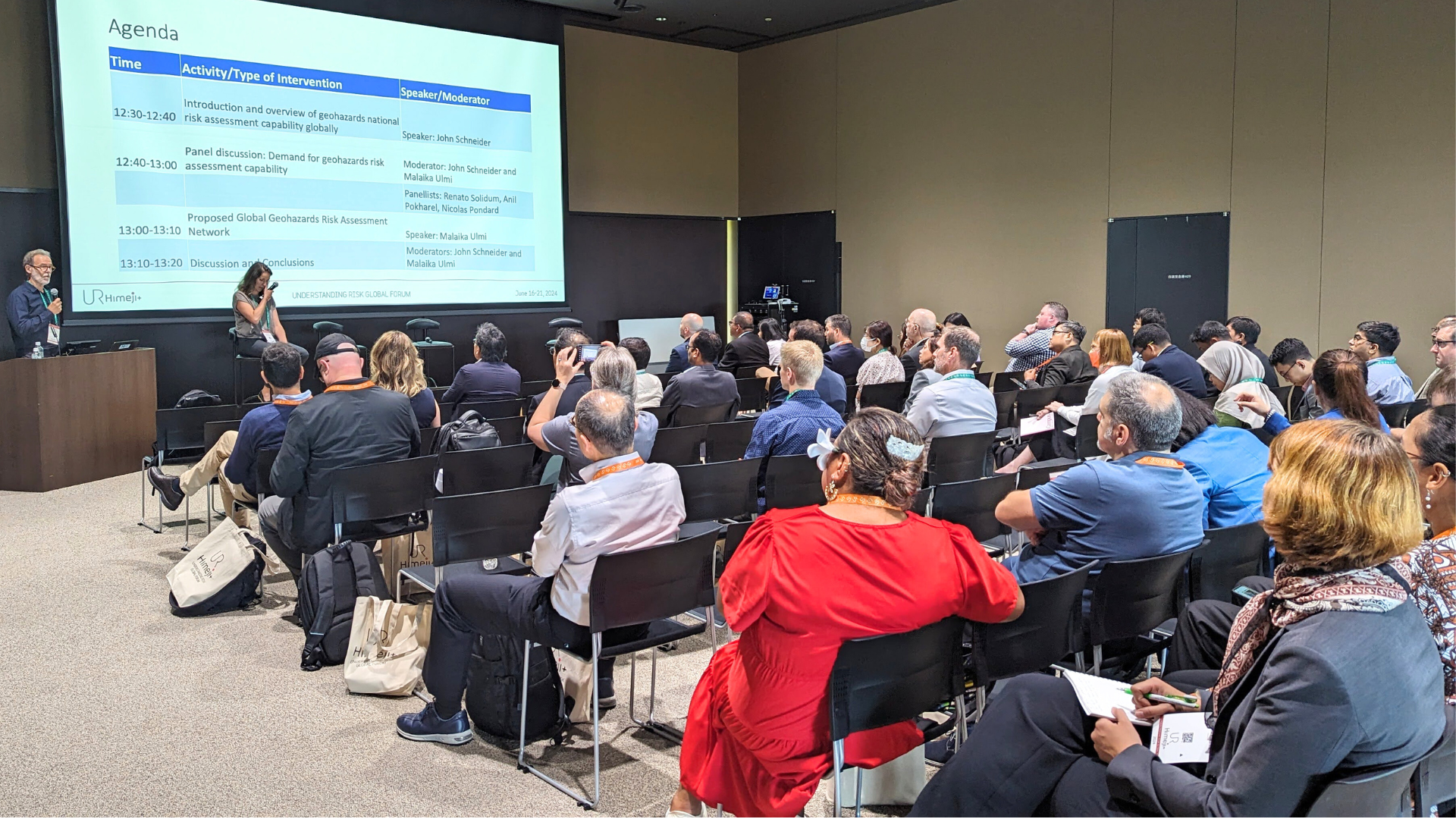
News GEM at UR24: Advancing Global Resilience through Collaborative Efforts By: Jun 25, 2024 Jun 25, 2024 Share Facebook LinkedIn The Global Earthquake Model (GEM) Foundation showcased its leadership in seismic hazard and risk assessment at the Understanding Risk Global Forum 2024 (UR24) held in Himeji, Japan from June 16-21, and organised by the Global Facility for Disaster Reduction and Recovery (GFDRR). This event provided an invaluable platform for GEM to share insights, promote collaboration, and reinforce global resilience against geohazards. Building a Global Community for Geohazards Risk Assessment On June 20, GEM concluded its activities with a successful focus day session titled "What about Geohazards? Building a Global Community for Hazard and Risk Assessment." Convened by John Schneider, Senior Advisor, GEM; Malaika Ulmi, Geological Survey of Canada; and Gill Jolly, GNS Science NZ, this session brought together experts from organisations such as USAID, USGS, GNS Science, PHIVOLCS, and NASA. It built upon the discussions from the June 18th session, "What About Geohazards? The State of Practice in Risk Assessment and Needs for Improvement at National to Sub-National Level," where contributions from Nicolas Pondard (The World Bank) and Renato Solidum (Secretary of the Department of Science and Technology, Philippines) were crucial. The June 20th session focused on establishing a globally coordinated network to improve access to information and expertise in geohazards risk assessment and promote collaboration to strengthen capacities in developing countries. There was widespread interest from attendees for such an initiative, highlighting the importance of a committed community of experts working together to drive significant advancements in understanding and mitigating natural hazard risks. Exploring Future Directions for Disaster Scenarios Another key session, "Can ‘Seeing’ the Future Help us Change it?", organised by GeoHazards International and featuring GEM’s Helen Crowley, underscored the power of disaster scenarios. The session demonstrated how co-producing scenarios with stakeholders can help connect technical understanding of risk with locally sustainable actions, including new policies, mitigation, and preparedness. Key takeaways included the importance of effective co-creation with communities, leveraging recent research insights, and transforming scenarios into practical and actionable mitigation strategies. First Day Success and Continued Engagement On the first day of UR24, GEM Secretary General Helen Crowley played a key role in two significant sessions: the plenary session "Richter Resilience: Advancing Seismic Protection Worldwide" and "Symphony of Tradition and Innovation: Orchestrating Global Resilience in Diverse Communities", organised by ImageCat. Both sessions addressed crucial aspects of earthquake resilience, combining tradition with modern advancements to foster a resilient future. Watch Helen’s plenary presentation below. https://www.youtube.com/watch?v=EbhmnmeWuMc Engagement at the Exhibition Booth Throughout the forum, GEM maintained a strong presence at booth S7, where attendees could engage with GEM's Product Manager, Andres Abarca, and earthquake experts, including Marco Pagani, Head of Seismic Hazards. The booth showcased GEM’s latest tools and methodologies for earthquake hazard and risk assessment, providing valuable insights into driving global earthquake preparedness and resilience. From left: Marco Pagani, Helen Crowley, Andres Abarca and John Schneider UR24 has underscored GEM's commitment to global collaboration and innovation in geohazards risk assessment. Through its active participation and leadership, GEM continues to pave the way for a more resilient future against seismic threats. For updated information on GEM's activities at UR24 - photos, available videos, and other resources - visit the GEM UR24 event page or contact GEM directly: communication@globalquakemodel.org . No images found. GALLERY 1/17 VIDEO RELATED CONTENTS FACT BOX
- GEM offsets 2025 carbon footprint through blue carbon projects in Kenya - GEM Foundation
News GEM offsets 2025 carbon footprint through blue carbon projects in Kenya By: Dec 17, 2025 Nov 20, 2025 Share Facebook LinkedIn In 2025, the Global Earthquake Model (GEM) Foundation offset approximately 100 tonnes of carbon dioxide equivalent (CO₂e) generated through its operations, including staff travel and the organisation of meetings and events. The offsetting was achieved through the purchase of carbon credits from the Mikoko Pamoja and Vanga Blue Forest projects in Kenya. The credits were purchased via the Association for Coastal Ecosystem Services (ACES) , a Scotland-based charity that supports community-led conservation initiatives focused on coastal and marine ecosystems. Through this approach, GEM contributed to projects that combine verified carbon sequestration with locally led environmental management. Both Mikoko Pamoja and Vanga Blue Forest focus on the protection and restoration of mangrove ecosystems, which play a recognised role in long-term carbon storage. In addition to their climate benefits, the projects support coastal resilience and provide economic opportunities for local communities through sustainable management practices. A short video introducing the mangrove restoration work supported by these initiatives is available online: https://youtu.be/qWNdg-sHnvo https://www.youtube.com/watch?v=qWNdg-sHnvo This activity forms part of GEM’s broader efforts to manage the environmental footprint associated with its work, while continuing to deliver global scientific products, capacity building, and international collaboration. The Foundation recognises that travel and in-person engagement remain important for effective partnership and knowledge exchange, and views carbon offsetting as one practical measure to address associated emissions. GEM will continue to review and refine its approach to environmental responsibility alongside its core mission of advancing earthquake risk understanding and reduction worldwide. ## No images found. GALLERY 1/0 VIDEO RELATED CONTENTS FACT BOX
- Mapping COVID19 cases against earthquake risk - GEM Foundation
News Mapping COVID19 cases against earthquake risk By: May 21, 2020 Share Facebook LinkedIn GEM has been making contributions to COVID-19 disaster management as well as seeking ways to leverage GEM's work to benefit the disaster management community. To this date, GEM has provided social vulnerability data on the availability of hospital facilities and beds in Latin America (based on SARA and CCARA projects) at the request of the USAID office in Ecuador; and provided a (prepared by Helen Crowley-EUCENTRE and Vitor Silva-GEM) to support the World Bank assistance to Croatia following the Zagreb earthquake in March this year. “The COVID-19 emergency is a problem that affects most of the countries in the world and will continue, unfortunately, for many months. Many of these countries are also affected by seismic hazard and risk. There is a high probability that a seismic event will occur before the COVID-19 emergency is over,” says Mauro Dolce, GEM Governing Board Chair and General Scientific Advisor of the Italian Department of Civil Protection. He further adds that “This is a real case for which a multirisk approach is fundamental in addressing risk as demonstrated by a case in Europe, in Zagreb, Croatia, where a moderate earthquake resulted in a problematic management of COVID-19 cases and emergencies. Fortunately, the COVID-19 situation there was not severe.” “The combined risk of earthquakes and COVID-19 and the opportunity for GEM to contribute is very much in line with GEM’s current and ongoing programs.” John Schneider, GEM Secretary General shares GEM’s potential role in the initiative. The overlay of COVID-19 statistics over the GEM global earthquake risk map (2018) provides . “GEM is also working with the UNDRR Global Risk Assessment Framework to promote the development of methodologies to assess systemic and cascading risk to COVID-19, and to partner with developing countries to improve their ability to manage and reduce the overall risk to society.” AIR Worldwide, a founding GEM sponsor, has developed a COVID-19 Dashboard freely available for producing projections to the future development of infections and number of deaths by country. AIR has expanded their Model for Pandemics to reflect the actual crises. GEM is interested to further leverage its risk modelling tools and information to provide assistance to better understand and manage the global risk to COVID-19. If you would like more information on GEM’s exposure and vulnerability data or modelling capabilities, or have an interest in collaborating with GEM, please contact . No images found. GALLERY Covid-Seismic Risk map overlay Experimental COVID-19 and Global Seismic Risk Map (2020-05-20) Covid-Seismic Risk map overlay Experimental COVID-19 and Global Seismic Risk Map (2020-05-20) Covid-Seismic Risk map overlay Experimental COVID-19 and Global Seismic Risk Map (2020-05-20) 1/2 Gallery VIDEO RELATED CONTENTS FACT BOX