Thanks for submitting!
You will be contacted as soon as possible


QUICK LINKS


PROFILES
PUBLICATIONS
EXPOSURE
VULNERABILTY
SOFTWARE
EQ MODELS
Search Results
Search this site
1170 results found with an empty search
- The Global Earthquake Model 2018: A step toward earthquake resilience - GEM Foundation
News The Global Earthquake Model 2018: A step toward earthquake resilience By: Mar 6, 2019 Share Facebook LinkedIn Since 2009, GEM has been developing collaborations around the world to assess earthquake hazard and risk. In 2015, GEM released the OpenQuake-Engine, a software program that is rapidly becoming the standard worldwide for calculating earthquake hazard and risk. Later that year, GEM committed to completing the Global Earthquake Model, leveraging its global collaborations of hundreds of experts and several regional programs using a common methodology and open analysis tools to coordinate the completion of a global mosaic of hazard and risk models. Combined, this represents the culmination of a 10-year effort to bring a comprehensive and globally complete set of information about earthquake hazard and risk together into a suite of products for use by the entire community of risk modellers, risk management professionals, and the public. On December 5th in Pavia, Italy, the GEM Event will feature: release of the global earthquake hazard and risk maps, presentations on new directions from public, private and academic perspectives panel discussions to explore development, uses, drivers and future of maps and models posters and demonstrations showing the development and application of GEM tools and models You will get an insider’s look on how the GEM2018 map was made and its applications in risk management, on interactive tools specially developed for the map, and on the strategic drivers, demands, and future directions for research and applications. You will find out what has changed in our global understanding of earthquake hazard since the release of GSHAP in 1999; you will learn how we have assembled information on the exposure and vulnerability of population and the built environment to assess the risks of economic loss and human mortality at national level globally. Further, you will see how these risks are distributed around the world and gain insights for a wide range of risk management applications and resilience planning. No images found. GALLERY 1/0 VIDEO RELATED CONTENTS
- Making Seismic Risk Information Open and Accessible: A Collaboration Between PreventionWeb and GEM Foundation - GEM Foundation
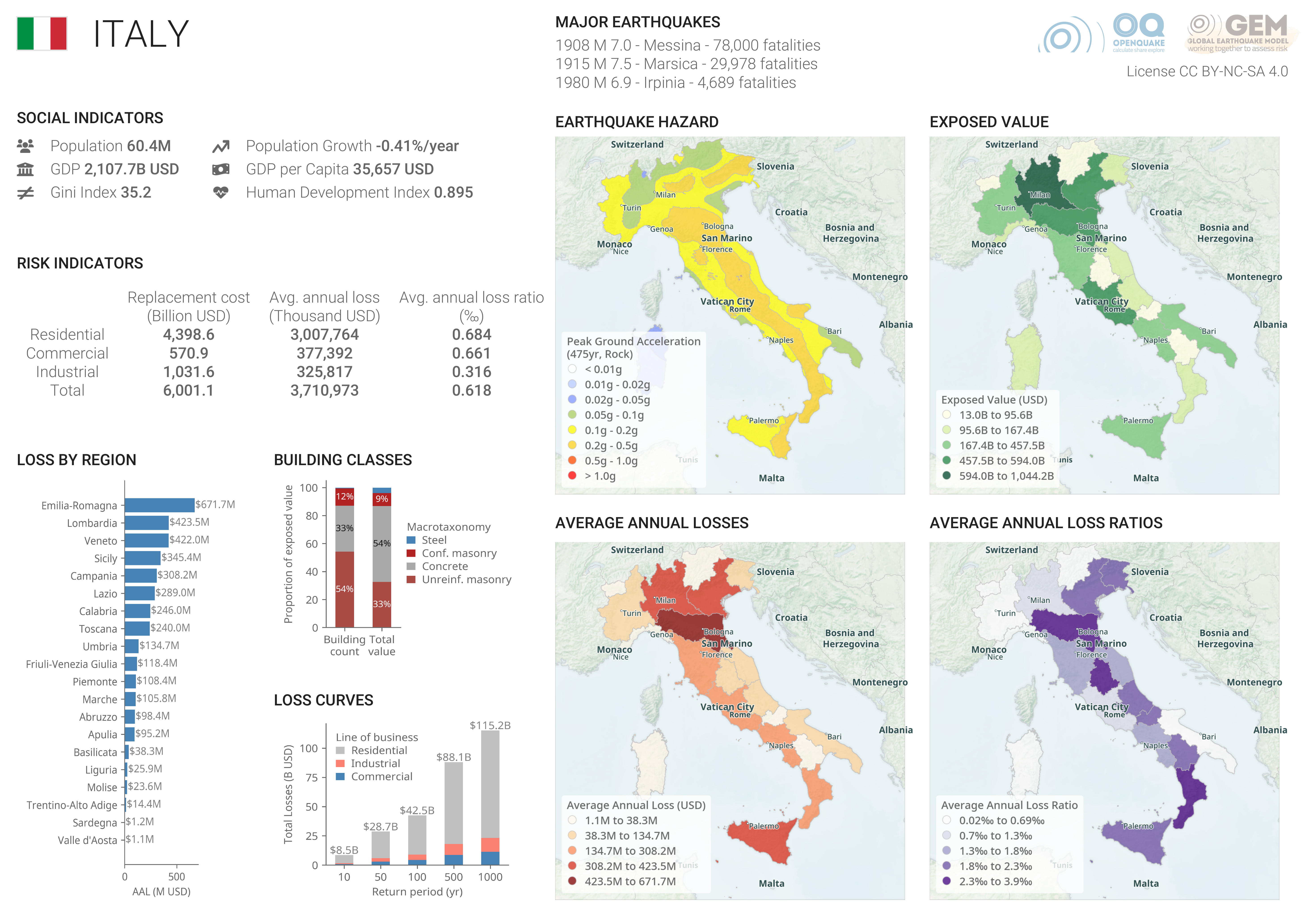
News Making Seismic Risk Information Open and Accessible: A Collaboration Between PreventionWeb and GEM Foundation By: Mar 27, 2024 Mar 20, 2024 Share Facebook LinkedIn March 20, 2024. A powerful new resource for understanding and mitigating earthquake risk at the national level is now available on the United Nations Office for Disaster Risk Reduction (UNDRR) PreventionWeb platform. This collaboration between UNDRR PreventionWeb and the Global Earthquake Model (GEM) Foundation makes over 200 country and territory seismic risk profiles accessible to a diverse global audience. These comprehensive profiles, developed by GEM , provide stakeholders in risk management with a vital overview of seismic risk in each country or territory. Each profile explores social and risk indicators, detailing factors like population density, building types, and historical earthquake impact. Additionally, loss curves depict potential losses based on different earthquake return periods, and maps visualise the geographical distribution of hazard, exposure, and potential losses. This collaboration marks a significant step forward in open access to critical disaster risk information. “Making this wealth of information readily available on PreventionWeb aligns perfectly with UNDRR’s mission to promote understanding and action on disaster risk reduction. By providing stakeholders with these insights, we can work together to better understand earthquake risk and build more resilient communities,” says Ms. Paola Albrito, Acting Special Representative of the Secretary-General for Disaster Risk Reduction and Director of UNDRR. “Open access to data and knowledge is fundamental for effective risk reduction strategies,” says Helen Crowley, GEM Secretary General. “This collaboration with UNDRR PreventionWeb ensures that our country and territory seismic risk profiles can reach the widest possible audience, informing decision-making, enhancing disaster preparedness and minimising earthquake losses.” Making these profiles available on a widely recognised platform like PreventionWeb, GEM and UNDRR enable stakeholders at various levels to make informed decisions about earthquake risk mitigation. This collaborative effort promotes a deeper understanding of seismic risk on a national scale, ultimately contributing to a safer future for communities around the world. To access the profiles, visit the following: PreventionWeb - https://www.preventionweb.net/knowledge-base/continents-countries GEM website - https://www.globalquakemodel.org/product/seismic-risk-profiles No images found. GALLERY 1/0 VIDEO RELATED CONTENTS
- Request demo for Middle East Hazard | GEM Foundation
You have chosen to request a demo on: Middle East Hazard First Name Last Name Email Company or Institution Name Country Sector Provide Details I accept the license terms and the conditions of products use. Email us at product@globalquakemodel.org if you're experiencing problems submitting this form or if you have any inquiries. Thank you. Request Thanks for submitting! You will be contacted as soon as possible Add answer here
- science for social change en
Science for Social Change GEM Impact Story Series en | esp First encounter with earthquakes I think I was about four years old when I first experienced an earthquake. We lived in a residential building at the time, so we really felt it, a strong swaying motion. I can still remember the crack it created on our wall. Life before GEM, my world in balance Before joining GEM, I was a young professor, just five years into teaching. I had done some research activities related to structural behavior. At the time I worried a lot about academics more than anything else, and I didn’t know how to apply the knowledge, the research I’ve done for improving the wellbeing of our society. I didn’t feel satisfied with just doing research. Encounters that changed my situation In 2013, I was contacted by GEM to join the SARA project. I accepted the invitation because I saw an opportunity to learn about seismic risk assessment, to participate in a project that has real life applications, and where results can be used by policy makers to improve building codes and risk mitigation strategies. Training to get better to address the challenges ahead The training workshops in Medellín, Colombia in 2014, and Lima, Peru in 2015 also marked the start of a change in my knowledge and perspective of risk. During the training in 2014, we learned about the GEM building taxonomy and general concepts about seismic risk assessment. In the Peru training, we were introduced to OpenQuake. Barriers to earthquake resilience I think that the number one barrier is being in a society that does not believe that earthquakes can happen anytime, sometimes without warning. We had a devastating earthquake 20 years ago and it seems that most people have forgotten about it. I also think that earthquake resilience is a low priority for policy makers, which makes communicating earthquake risk information vital for the improvement of public safety and protection of critical infrastructures more challenging. Change can start with oneself I think change can happen anytime, but it has to start with oneself. When the SARA project was completed in 2015, my collaboration with GEM did not stop there. Since 2016, we have been improving the exposure models of Medellín, Bogotá and Cali. We have also collaborated with GEM for the development of the Colombian exposure model that was used for the Global Earthquake Risk Map of 2018. Guiding the future stewards of earthquake resilience I have been teaching seismic risk assessment at the Seismic Engineering course at EAFIT since 2017 and tutored several students in using OpenQuake for undergrad research on seismic risk assessment of electric substations, water services in Medellín, and earthquake-induced landslides in Quito, Ecuador. This has been made possible because of the experiences I gained from the GEM SARA project. No finish line, but we have to keep moving forward Though I have achieved my goal to enhance my knowledge of seismic risk assessment, and to transmit that knowledge to my students, the engineering community, and to some extent, to the public at large; I also realized that this is not a race that has a finish line. Each time I move forward, so does the finish line. But what’s important is to keep moving forward. The power of commitment and collaboration In the academia, I think many would only get involved in projects if there’s funding, but there’s a lot that can be done without the need of funding. The people at GEM are always open to answer your questions, to give you advice… and for me, that has more value than funding. Inspiring others I hope that my learning experiences with GEM would inspire students, researchers, engineers and others to advocate for better seismic risk awareness and education to make Colombia and the world more resilient to earthquakes. About the GEM Impact Stories Earthquake risk remains abstract and highly technical, and there are significant risks that due to poor or limited understanding of it, policymakers and the public at large may not be able to fully take advantage of existing and future information that can either help create better or enhance existing earthquake risk reduction and management strategies, especially at the local and national level. Specifically, the GEM Impact Stories project aims to: Collect and document stories where GEM or its partners have contributed to positive change; Encourage policy and decision makers to use science- and evidence- based information to formulate earthquake DRR strategy at the national level through positive stories of change; and Increase awareness of the public at large on earthquake risk and preparedness. A Q&A with Prof. Ana Beatriz Acevedo Ana Beatriz Acevedo is a Civil Engineer with Master and PhD degrees on Earthquake Engineering, and currently a Professor of Civil Engineering at EAFIT University in Medellin, Colombia handling earthquake engineering and earthquake risk assessment courses. Acknowledgement This story is a collaboration between the GEM Foundation, Pavia, Italy and EAFIT University, Medellin, Colombia. Our heartfelt thanks goes to: Prof. Ana Acevedo for contributing her story and valuable time with us; EAFIT staff for the photos; GEM and EUCENTRE for the support provided during the preparation of this pilot GEM Impact Story. Related Contents Science for Social Change Prof. Ana Acevedo's full interview transcript in PDF brochure format. Title: Science for Social Change Video: Prof. Ana Acevedo's interview Duration: 3mins 25secs
- December 2020 Governing Board meeting highlights - GEM Foundation
News December 2020 Governing Board meeting highlights By: Jan 23, 2021 Share Facebook LinkedIn More than 60 individuals were in attendance in the virtual meeting held on November 27, 2020 – Secretariat reporting, and December 3-4, 2020 – core meeting. The attendees included almost all of the voting members, non-voting members, associate members, advisory board, guests and GEM Secretariat. Sponsor feedback and priorities Representatives from sponsors and partners AIR, Eucentre, PartnerRe, MunichRe, Guy Carpenter, SwissRe, Italy-DPC, USAID, Nepal-NSET, Japan-NIED and TEM gave short presentations on their priorities and feedback mainly focusing on technical support for hazard and risk modelling tasks. The Secretariat is set to incorporate the comprehensive sponsor input into the 2021 work plan and strategy development. Products and services In terms of products and services, discussions focused on the release of the social vulnerability and resilience maps, the release of the models from the global mosaic, and the release of commercial models on Nasdaq and Touchstone platforms. The Secretariat will follow up on the release of social vulnerability and resilience (SVR) maps with a virtual workshop to develop collaboration networks and potential funding for current and future SVR work. User demand for GEM products will be assessed in order to guide further development and promotion, and a schedule to release the remaining hazard and risk models from global mosaic is set for 25 January. A planning workshop will be held to assess the need and approach for financial risk model development is scheduled for 4-5 and 11 February 2021. Long term strategy The final session of the meeting focused on long-term strategy where the discussion focused on sponsor and partner perspectives on earthquake model development, inclusion of other perils and organizational sustainability. The Secretariat will convene a strategy task force to develop the long-term GEM strategy in the second quarter of 2021. New representatives The Secretariat presented the following new Sponsors and representatives, and were subsequently approved by the Board: new voting representative for Taiwan Earthquake Model (TEM), Bruce Shyu of NTU, Taiwan; new voting representative for New Zealand, Gary Wilson of GNS; new Small Business (Startup) Advisor Sponsor SafeHub with Andy Thompson as non-voting representative; and renewed sponsorship of Partner Re as Advisor Sponsor with Paul Della-Marta as non-voting representative. No images found. GALLERY 1/1 Gallery VIDEO RELATED CONTENTS
- Global Geodetic strain rate model | GEM Foundation
Publications Global Geodetic strain rate model Share Facebook LinkedIn Download 2014 | Report ThisisthefinalreportproducedinthecontextoftheGEMStrainRateProject,oneoftheglobalcomponents of the GEM Foundation. The project was charged to analyse and synthesize all available geodetic data in order tocreateaglobaldatasetofgeodeticvelocities thatcanbeused tomodelplatemotionsandstrain ratesinplateboundaryzones.To thisend,weestimated6533velocities fromposition time-series thatwe derived fromtheanalysisofRINEXdatathatwaseither freelyavailableormadeavailabletousspecifically forthisproject.Allbut 15ofthesevelocitieswereusedinthemodelling.Inaseparateanalysis,wealsoreanalysed all RINEX data in China and effectively added 1143 velocities to the data set. Finally, we added 13,318velocitiesfrom216studiesinthepublishedliterature(orfrompersonalcommunications)toachievea grandtotalof20,979velocitiesat17,491uniquelocationsusedinthemodelling.Ofallvelocities, 16,325are inplateboundaryzones(asdefinedbyus)andtheremaining4654velocitiesareforpointson,predefined, rigidtectonicplatesorblocks.Wecreatedaglobalmeshthathas144,827deformingcellsof0.2°(latitudinal) by 0.25° (longitudinal) dimension covering the plate boundary zones,with the remaining cells covering 50 rigidplatesandblocks.For36oftheseplates,weestimatedtherigid-bodyrotation fromourdataset,and the rotations of the remaining plates are taken from the literature. The rigid-body rotations are used as boundaryconditionsinthestrainratecalculations.ThestrainratefieldismodelledusingtheHainesandHolt method,whichusessplinestoobtainaninterpolatedvelocitygradienttensorfield,fromwhichstrainrates, vorticityrates,andexpectedvelocitiesarederived.Wealsoestimatedmodeluncertainties,specificforthis high-resolution mesh, which indicates that there still are many areas with large strain rate uncertainties where the data spacing is often much larger than the cell dimensions. Nevertheless, the model and data input are a tremendous improvement to the previous global strain rate model from 2004. All results are transferred to GEM and are also archived and displayed by a dedicated server hosted by UNAVCO (gsrm2.unavco.org), one of the project's partners. In addition, we created a kmz-layer of contour's of the secondinvariantofthemodelstrainrates,andwecreatedanonlinetoolthatwouldallowausertoupload hisownvelocitiesandplotthemwiththevelocitiesintheGEMdatasetin53differentreferenceframes.
- Request demo for Philippine Hazard | GEM Foundation
You have chosen to request a demo on: Philippine Hazard First Name Last Name Email Company or Institution Name Country Sector Provide Details I accept the license terms and the conditions of products use. Email us at product@globalquakemodel.org if you're experiencing problems submitting this form or if you have any inquiries. Thank you. Request Thanks for submitting! You will be contacted as soon as possible Add answer here
- RMS Joins the Global Earthquake Model Foundation - GEM Foundation
News RMS Joins the Global Earthquake Model Foundation By: Mar 16, 2022 Share Facebook LinkedIn Pavia, Italy. March 21st. – RMS , a world leading risk modeling and solutions company, has joined the Global Earthquake Model (GEM) Foundation , an international public-private partnership that develops and disseminates open-source earthquake hazard and risk assessment software, models and data. The GEM Foundation collaborates worldwide, building local and organizational capacity toward understanding and managing earthquake risk on a local to global scale. The combination of RMS’ latest scientific research and applications, and comprehensive coverage of seismically active regions across the globe; and GEM’s array of open earthquake hazard and risk models and OpenQuake software tools will further enable insurers, reinsurers, financial services organizations, and the public sector with the most informed view of earthquake risk available today. In the last 12 years, GEM has contributed substantially to the broader objectives of the disaster risk reduction community through public-private partnership, research, technical cooperation, training and distribution of open tools that have been used to build a global mosaic of earthquake hazard models and to develop a global risk model centered on the physical and financial risk to the built environment and human population. John Schneider, GEM Secretary General, said: “GEM has become widely known for its work and its contribution to improving the state of knowledge of earthquake risk. Working with RMS to advance earthquake science and open data can further strengthen our scientific insights and commitment to understand, evaluate, and manage earthquake risk especially in underserved regions of the world.” Mohsen Rahnama, Chief Risk Modeling Officer, RMS, said: “RMS started at Stanford University by developing earthquake models for California. The science around earthquakes continues to grow and develop, as does the technology that helps support even greater analysis and understanding of these catastrophic events. RMS has long admired the work of GEM and we are pleased to now be part of this prestigious foundation. We look forward to working with the other members of GEM as we move towards advancing global earthquake understanding and knowledge.” ----- About RMS Risk Management Solutions, Inc. (RMS) shapes the world’s view of risk for insurers, reinsurers, financial services organizations, and the public sector. We empower organizations to evaluate and manage global risk from natural and man-made catastrophes, including hurricanes, earthquakes, floods, climate change, cyber, and pandemics. RMS models underlie the nearly US$2 trillion Property & Casualty industry and many insurers, reinsurers, and brokers around the world rely on RMS model science. RMS helped pioneer the catastrophe risk industry, and continues to lead in innovation by offering unmatched science, technology, and 300+ catastrophe risk models. Leaders across multiple industries can address the risks of tomorrow with the RMS Intelligent Risk Platform™, the only open cloud with collaborative applications and unified analytics that can power risk management excellence across organizations and industries. Further supporting the industry's transition to modern risk management, RMS spearheaded the Risk Data Open Standard (RDOS), a modern, open-standard data schema designed to be an extensible and flexible asset within modeling/analysis systems. RMS is a trusted solutions partner, enabling effective risk management for better business decision-making across risk identification and selection, mitigation, underwriting, and portfolio management. © 2022 Risk Management Solutions, Inc. RMS, the RMS logo, and RMS Risk Intelligence are trademarks of Risk Management Solutions, Inc. All other trademarks are property of their respective owners. Visit RMS.com to learn more and follow us on LinkedIn and Twitter . RMS is a subsidiary of Moody’s Corporation (NYSE: MCO) and operates as part of the Moody’s Analytics business segment. Moody’s Analytics is operationally and legally separate from the Moody’s Investors Service credit rating agency. No images found. GALLERY 1/0 Gallery VIDEO RELATED CONTENTS
- Request demo for North and South Korea Hazard | GEM Foundation
You have chosen to request a demo on: North and South Korea Hazard First Name Last Name Email Company or Institution Name Country Sector Provide Details I accept the license terms and the conditions of products use. Email us at product@globalquakemodel.org if you're experiencing problems submitting this form or if you have any inquiries. Thank you. Request Thanks for submitting! You will be contacted as soon as possible Add answer here
- National seismic hazard workshop identifies common challenges - GEM Foundation
News National seismic hazard workshop identifies common challenges By: Jul 15, 2026 Jun 24, 2026 Share Facebook LinkedIn The National Seismic Hazard Modelling Workshop, facilitated by GEM’s Marco Pagani, Head of Seismic Hazards, was held on 24–25 June during the GEM Conference in Zagreb, showed that producing a national hazard map is only one part of the work. The data, modelling choices, review process and intended use all determine whether the model can be trusted and kept up to date. Presentations from Australia, France, New Zealand, Japan, the United States, Switzerland, Taiwan, Italy and Canada covered different tectonic settings, but many of the problems were similar. The programme also included seismic hazard assessment in data-scarce parts of the East African Rift. Earthquake catalogues remain incomplete or inconsistent, strong-motion records are uneven, and fault behaviour is often poorly constrained. Some decisions, including how models are combined and weighted, cannot be settled by observations alone. Australia and mainland France showed the difficulty of estimating hazard in areas with relatively low seismicity. New Zealand examined earthquake clustering and non-stationarity, challenging the common assumption that rates remain stable through time. Japan, Taiwan and Canada showed how new offshore faults, revised subduction sources, basin effects and updated ground-motion models can change hazard estimates, particularly for long-period shaking and rare events. How the models are organised was another part of the discussion. Italy has separate teams for seismicity, ground motion, calculations and testing, supported by an international advisory panel and a Strategic Stakeholders Group. Switzerland is developing its 2029 model through a linked, reproducible workflow. In the United States, model updates are coordinated with building-code cycles and reviewed by scientific, engineering and user groups. These experiences informed the draft guidelines for national seismic hazard programmes. The guidelines cover objectives, responsibilities, technical implementation, documentation, quality assurance and future updates, rather than prescribing one modelling method. Other presentations focused on use and data. India is developing hazard information for dams, where national zones do not replace site-specific assessment. Moody’s showed how connected faults offshore Portugal can change estimates of rare, high-loss events. Work in South America and Algeria showed why local fault and strong-motion data are needed to improve source models, test ground-motion models and identify site effects. Work will continue on the national model updates already under way and on the guidelines themselves. The main tasks remain improving catalogues and fault databases, expanding strong-motion datasets, testing model components against observations and documenting the decisions behind the final results. ## No images found. GALLERY 5H2A1788.jpg 5H2A1820.jpg 1I9A1832.jpg 5H2A1788.jpg 1/96 VIDEO RELATED CONTENTS