Thanks for submitting!
You will be contacted as soon as possible


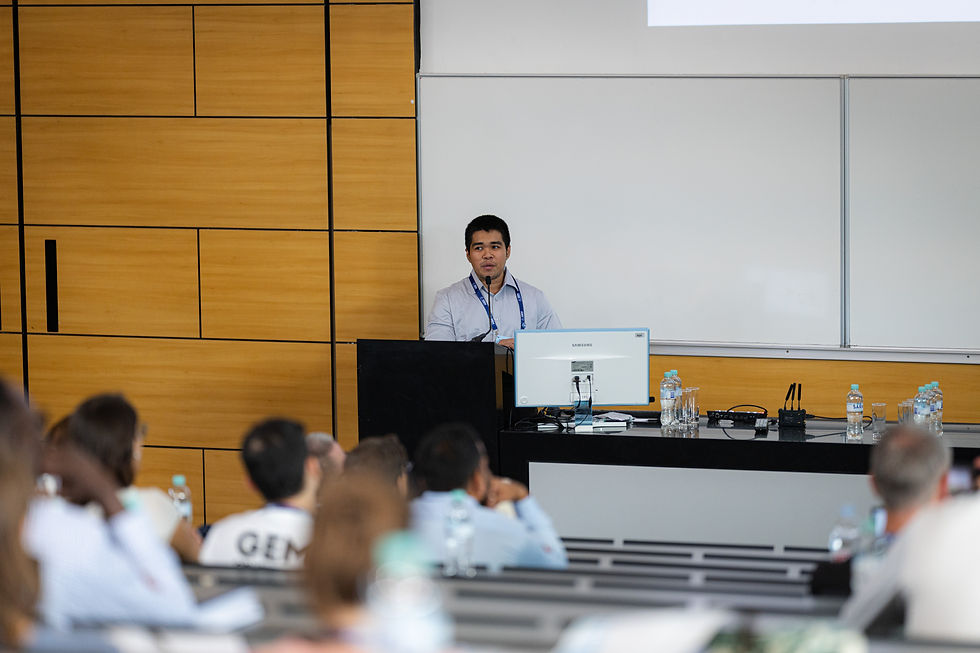
The National Seismic Hazard Modelling Workshop, facilitated by GEM’s Marco Pagani, Head of Seismic Hazards, was held on 24–25 June during the GEM Conference in Zagreb, showed that producing a national hazard map is only one part of the work. The data, modelling choices, review process and intended use all determine whether the model can be trusted and kept up to date.
Presentations from Australia, France, New Zealand, Japan, the United States, Switzerland, Taiwan, Italy and Canada covered different tectonic settings, but many of the problems were similar. The programme also included seismic hazard assessment in data-scarce parts of the East African Rift. Earthquake catalogues remain incomplete or inconsistent, strong-motion records are uneven, and fault behaviour is often poorly constrained. Some decisions, including how models are combined and weighted, cannot be settled by observations alone.
Australia and mainland France showed the difficulty of estimating hazard in areas with relatively low seismicity. New Zealand examined earthquake clustering and non-stationarity, challenging the common assumption that rates remain stable through time. Japan, Taiwan and Canada showed how new offshore faults, revised subduction sources, basin effects and updated ground-motion models can change hazard estimates, particularly for long-period shaking and rare events.
How the models are organised was another part of the discussion. Italy has separate teams for seismicity, ground motion, calculations and testing, supported by an international advisory panel and a Strategic Stakeholders Group. Switzerland is developing its 2029 model through a linked, reproducible workflow. In the United States, model updates are coordinated with building-code cycles and reviewed by scientific, engineering and user groups.
These experiences informed the draft guidelines for national seismic hazard programmes. The guidelines cover objectives, responsibilities, technical implementation, documentation, quality assurance and future updates, rather than prescribing one modelling method.
Other presentations focused on use and data. India is developing hazard information for dams, where national zones do not replace site-specific assessment. Moody’s showed how connected faults offshore Portugal can change estimates of rare, high-loss events. Work in South America and Algeria showed why local fault and strong-motion data are needed to improve source models, test ground-motion models and identify site effects.
Work will continue on the national model updates already under way and on the guidelines themselves. The main tasks remain improving catalogues and fault databases, expanding strong-motion datasets, testing model components against observations and documenting the decisions behind the final results.
##
No images found.
GALLERY


VIDEO

RELATED CONTENTS
