Thanks for submitting!
You will be contacted as soon as possible


QUICK LINKS


PROFILES
PUBLICATIONS
EXPOSURE
VULNERABILTY
SOFTWARE
EQ MODELS
Search Results
Search this site
1170 results found with an empty search
- GEM completes USAID-supported Global Vulnerability Database Project - GEM Foundation
News GEM completes USAID-supported Global Vulnerability Database Project By: Jun 27, 2018 Share Facebook LinkedIn The completion of the Global Vulnerability Database project, supported by the United States Agency for International Development (USAID) resulted in the development of vulnerability and fragility models for the most common building classes at a global scale. This has considerably addressed the lack of reliable fragility and vulnerability models for many regions of the globe, which are fundamental for seismic risk assessment at various scales (see map below). The project results also contributed significantly to our understanding of seismic risk - giving us scientific insights important for the improvement of building codes around world. "The lack of vulnerability models is undoubtedly the strongest impediment to the understanding of seismic risk at any scale. This project provides not just default functions for places where nothing exists, but also an open framework that can be used to improve existing functions, or develop completely new ones,” Vitor Silva, GEM Risk Coordinator. Within this project, GEM developed a comprehensive catalogue of the most representative building classes by conducting a worldwide survey targeted at experts in the field of structural and earthquake engineering. A supporting web-based application accessible through the OpenQuake-platform at https://platform.openquake.org/building-class/ was also created for this purpose. Currently, the app has collected over 500 entries from 50 different countries. The database is designed to be an open repository of building information, and intended to be continuously revised and improved beyond the project by the scientific community. Data collected from the global survey produced a list of building typologies comprising over 200 classes distributed between masonry (15%), concrete (51%), steel (23%) and wooden (11%) construction.GEM has extensively tested and calibrated the fragility and vulnerability models by computing seismic risk for several countries (e.g. Colombia, Guatemala, Panamá and Nicaragua), and running earthquake scenarios for different nations (e.g. Chile, Greece and Turkey). No images found. GALLERY 1/2 VIDEO RELATED CONTENTS
- Probabilistic seismic risk assessment of Africa | GEM Foundation
Publications Probabilistic seismic risk assessment of Africa Share Facebook LinkedIn Download 2025 | Peer-reviewed Several destructive earthquakes have occurred throughout the African continent over the past century. However, few comprehensive seismic risk models exist for the region. This study presents a probabilistic earthquake loss model for Africa, which is comprised of open model components and data sets that enable the calculation of a range of risk metrics useful for disaster risk management. Across the continent, Algeria faces the most significant predicted building damage, economic loss, population displacement, and fatality risks due to earthquakes. After Algeria, the order of highest risk countries depends on the considered risk metric, with countries such as Egypt, Morocco, and Uganda joining Algeria in the top three. When measured in relative terms, smaller countries that face disproportionate risks are highlighted, such as Djibouti, Burundi, Rwanda, and Malawi. These countries are exposed to moderate seismic hazard, but have limited evidence of earthquake-resistant design and construction practices that imply significant risk of damages in future earthquakes.
- GEM’s Vital Role in Advancing Seismic Hazard and Risk Assessment through TREAD Project - GEM Foundation
News GEM’s Vital Role in Advancing Seismic Hazard and Risk Assessment through TREAD Project By: Sep 29, 2023 Share Facebook LinkedIn The EU’s Marie Skłodowska-Curie Actions (MSCA) funded TREAD project (daTa and pRocesses in sEismic hAzarD - https://tread-horizon.eu/ ) is paving the way for seismic hazard scientists to tackle earthquake forecasting complexities in Europe and the Mediterranean. While earthquake prediction remains challenging, TREAD focuses on probabilistic forecasting based on probability, particularly in regions with intricate tectonic contexts. TREAD's objectives include a holistic approach in seismic hazard assessment, recognizing the unique properties of earthquake sources and tectonics in these regions. To achieve this, TREAD integrates small-scale laboratory experiments with large-scale observations and emphasizes interdisciplinary interactions to better anticipate seismic hazards. TREAD will train a new generation of seismic hazard scientists to tackle the challenges of earthquake forecasting in complex tectonic contexts such as the European and Mediterranean regions. GEM, the Global Earthquake Model Foundation, will supervise two PhD students, in collaboration with the University of Milano Bicocca and the University of Chieti-Pescara. Under Project #10 , GEM’s Head of Seismic Hazards, Marco Pagani, leads the exploration of innovative approaches to modeling distributed seismicity. This research is expected to mainly influence seismic hazard modeling in moderate and low seismicity regions. Project #11 , led by GEM's Head of Risk Engineering, Vitor Silva, assesses the impact of advanced hazard modeling approaches on earthquake risk. It investigates metrics such as collapsed structures, fatalities, and economic losses for earthquake scenarios and probabilistic seismic risk analysis. This project collaborates closely with public partners, offering insights for disaster risk management and insurance industries. GEM’s involvement in the TREAD project underscores its commitment to advancing seismic hazard and risk assessment through the training of the next generation of scientists and engineers, ultimately contributing to more resilient communities in earthquake-prone areas. No images found. GALLERY 1/0 VIDEO RELATED CONTENTS
- Global Map of Road Exposure to Ground Shaking and Liquefaction | GEM Foundation
License Request Form You have chosen to get more information about: Global Map of Road Exposure to Ground Shaking and Liquefaction Risk Please check the link below to see if this product already meets your your requirements before submitting your request for a license. Thank you. DOWNLOAD THE OPEN VERSION Summary of steps to obtain a license for the requested product. Fill in the application form below. Click Submit. Please check your email Inbox or Spam folder for the summary of your request. You will then be contacted by the GEM Product Manager with either a request for more information, or a request to sign the license. If you do not hear from us within 2 weeks, please send an email to product@globalquakemodel.org . REQUEST DETAILS A. Requesting party information First Name Last Name Role/Job Email Business type Business type Other business Sector Sector Other sector B. License agreement signatory information The signatory must be someone who is authorised to sign license agreements on your behalf such as your immediate supervisor, manager or legal officer. If you’re a PhD student, the signatory must be your adviser or a university officer in charge of license agreements or similar legal documents. Full Name of Signatory Position Company Email of Signatory Organisation name Complete Address C. Purpose of request GEM is able to offer products for free because of the support of our project partners, national collaborators and institutional sponsors. All of GEM’s products are freely available for public good, non-commercial use, but with different license restrictions. In most cases we release products under an open license (e.g., CC BY-SA or CC BY-NC-SA), which permits (re)distribution. In this case, we are granting access under a more restricted license that forbids distribution or disclosure and requires signing by GEM and the licensee in order to better assure accountability for the confidentiality of the information. In order for GEM to properly assess your request, please answer the following questions below. 1. Explain briefly how will the GEM product be used e.g. project, research including the expected results and the foreseen public benefit. Minimum 60 words. 2. Will you be able to share the results of your work with GEM? YES NO 3. Will you be able to provide feedback to GEM on the quality and usefulness of this product via a survey? YES NO D. Privacy Policy By submitting this form, you consent to the processing of your personal data in accordance with our Privacy Policy and the EU General Data Protection Regulation (GDPR). We are committed to safeguarding your information and ensuring it is only used for the purpose outlined in this form. You have the right to access, rectify, or delete your data at any time. For more information, please refer to our Privacy Policy. I agree Words: 0 Email us at product@globalquakemodel.org if you're experiencing problems submitting your application. Thank you. Submit Thanks for submitting! You will be contacted as soon as possible Incomplete data. Please fill in all required fields. Thank you.
- Quantify Your Earthquake Risk: Expert Solutions from the GEM Foundation | GEM Foundation
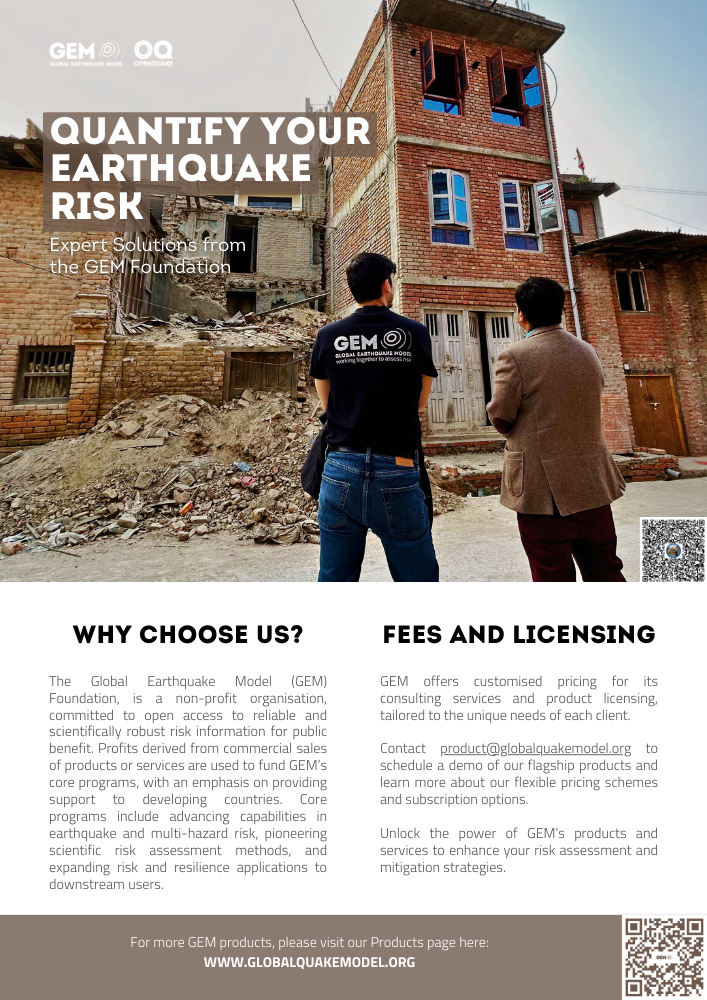
Publications Quantify Your Earthquake Risk: Expert Solutions from the GEM Foundation Share Facebook LinkedIn Download 2024 | Brochure A quick glance of GEM's commercially available scientifically robust risk information and flagship products. The brochure also highlights GEM's collaborative projects globally for public good.
- Launch of GEM Products webpage - GEM Foundation
News Launch of GEM Products webpage By: Sep 21, 2020 Share Facebook LinkedIn GEM's new Products webpage GEM is launching its new Products webpage: . We’ve made significant changes that we hope will make finding GEM products, models and tools easier and faster. The new Products webpage is part of GEM’s efforts to continue to make information freely and openly available, and to broaden its range of products and services for the benefit of the disaster risk management and reduction community. With a new Products page, GEM hopes to further strengthen its efforts to increase their availability and accessibility. The page features a full GEM product list categorized into four product types: models, software, global maps (analog and digital) and datasets. The list is searchable by title or keywords and can be downloaded as an Excel file. If you do not find what you’re looking for, we’ve added a Request button so you can contact us for a specific request. The new Products page is still a work-in-progress and we plan to add more cool stuff in the near future to further enhance your experience on data and information accessibility. At the end of September and December we will be releasing a number of additional earthquake hazard and risk models from the Global mosaic of models developed by GEM, which make up the global maps released in 2018. For earthquake hazard, by the end of the year GEM and its partners will have openly released hazard models for 75% of the land area worldwide, and will have made available for public-good, non-commercial use, hazard models for all countries except China. For risk, by the end of the year, GEM will have released vulnerability models for all residential, commercial and industrial building types (more than 600) and all exposure data to Administrative Level 1 (Provincial) that was used to develop the global risk model (2018). Country profiles with AAL (average annual loss) and PML (probable maximum loss) curves for the three building classes (residential, industrial, and commercial) will have been released for all 192 countries modelled. Finally, social vulnerability indicators will also be released under an open license at country level or Admin 1 (provincial). We are counting on your feedback to further improve the page. We will definitely be listening to what you - our stakeholders - have to say. You can send us your feedback by clicking the Feedback button or Contact Us icon. No images found. GALLERY GEM Hazard and Risk model release schedule GEM Hazard and Risk model release schedule 1/1 GEM models availability, release schedule VIDEO RELATED CONTENTS
- Unveiling the Environmental Impact of Earthquakes in Europe | GEM Foundation
Publications Unveiling the Environmental Impact of Earthquakes in Europe Share Facebook LinkedIn Download 2024 | Peer-reviewed Environmental impact assessments in the construction sector often overlook the significant effects of natural hazards, in particular earthquakes. These destructive events pose severe sustainability challenges as they frequently require large-scale repairs and replacement for damaged buildings, demanding the production and use of substantial quantities of building materials. Here, we unveil the environmental toll of earthquakes in Europe, presenting essential environmental data on the continent’s building stock. We further generate novel seismic risk maps that quantify the embodied carbon resulting from seismic-damage repair and reconstruction of residential, commercial, and industrial buildings, considering all plausible earthquake scenarios across the region. To this end, we first develop a comprehensive database of material quantities and embodied carbon factors for a broad range of construction materials and building components. This database serves as a crucial input for a continent-wide probabilistic seismic risk model, which estimates the potential environmental impacts of future earthquakes by analysing over 3 million realistic damage scenarios, each with its own probability of occurrence. Our findings reveal that Europe’s earthquake-exposed building stock embodies nearly 13.4 billion tons of carbon dioxide equivalent (CO2e), with seismic damage alone generating more than 6.4 million tons of CO2e annually; comparable to the emissions of 32,000 one-way flights from Paris to New York carrying 200 passengers. Our models not only establish critical benchmarks for the carbon footprint of the European construction sector, but also offer a versatile tool for assessing the impacts of other natural hazards, driving sustainable disaster risk mitigation and fostering more resilient, eco-friendly built environments.
- Global Exposure Database-Scientific Features | GEM Foundation
Publications Global Exposure Database-Scientific Features Share Facebook LinkedIn Download 2014 | Report TheaimofthisreportistoprovideacomprehensivedocumentationoftheGED4GEMprojectanditsresults, the Global Exposure Database (or GED). Although most (if not all) of the information provided in this document is available in the deliverables of the GED4GEM project (http://www.nexus.globalquakemodel.org/ged4gem/posts/ged4gem-deliverables/), this document offers a unique possibility to look at the various scientific aspects of the project. It also attempts to provide clear answerstothemainquestionsthatmightbeposedbypotentialusersoftheGED,specificallyaboutthedata setsused,themethodologiesemployedandthecompletenessofthedatabase.
- GEM brochure | GEM Foundation
Publications GEM brochure Share Facebook LinkedIn Download 2013 | Brochure Vulnerability to earthquakes is increasing, yet reliable risk assessment tools and data are out of reach in many areas of the world. There are few global standards that allow us to compare seismic risk, yet recent events have taught us that we need to work together globally to improve our understanding of earthquake behaviour and consequences.
- OQ Engine certified user Leonardo Mateus | GEM Foundation
OpenQuake Engine certified user page This is to certify that Leonardo Mateus has successfully completed the requirements to become a Certified OpenQuake Engine User for Scenario Assessment demonstrating the required knowledge and skills as assessed by the Global Earthquake Model (GEM) Foundation. GEM Foundation Secretary General Helen Crowley (signed) Date of Completion: Valid until: September 11, 2026 September 11, 2029