Thanks for submitting!
You will be contacted as soon as possible


QUICK LINKS


PROFILES
PUBLICATIONS
EXPOSURE
VULNERABILTY
SOFTWARE
EQ MODELS
Search Results
Search this site
1170 results found with an empty search
- Aon Joins the Global Earthquake Model Foundation as Governor Sponsor to Advance Collaborative Risk Analysis - GEM Foundation
News Aon Joins the Global Earthquake Model Foundation as Governor Sponsor to Advance Collaborative Risk Analysis By: Dec 6, 2022 Share Facebook LinkedIn LONDON, 8 December 2022 - Aon plc (NYSE: AON), a leading global professional services firm, today announced that it has joined the Global Earthquake Model (GEM) Foundation – a non-profit public-private partnership that develops and distributes models and data for a transparent assessment of earthquake risk worldwide - as Governor Sponsor. Comprising public, private, academic and non-government organizations, GEM delivers state-of-the-art earthquake risk reduction solutions through relevant data, tools and information as well as hazard and risk assessments that are designed to improve understanding of earthquake hazard and risk globally. Economic losses from catastrophic events are projected to increase exponentially by 2030 due to the increasing global population, rapid urbanisation and extreme weather events. Earthquakes, which made up only 8 percent of all disasters in the past 20 years, are the deadliest of all sudden disaster events. The peril constitutes one of the top causes of economic disruption and of disaster deaths, due to building collapse. In its new role as Governor Sponsor, Aon and its Impact Forecasting catastrophe model development team will lead the firm’s collaboration with GEM scientific teams in developing advanced tools to analyze the financial impacts of earthquakes for effective reinsurance, underwriting and exposure management strategies. Furthermore, Aon will work with GEM to bring together a range of collaborations to enhance earthquake risk understanding globally, further drive the usage and adoption of earthquake models and expand the domain of potential scientific collaborators to assist and inform model development. The collaboration will assist Aon’s clients and the wider re/insurance industry and stakeholders to make better risk decisions while navigating volatility and building operational resilience. In addition , GEM’s own earthquake modelling platform, the OpenQuake Engine , provides an opportunity for the development of standardized approaches in seismic hazard analyses, and to share the same technology within the rapidly growing society of users from across the re/insurance industry. John Schneider, GEM secretary general, said: “We welcome Aon to the GEM Governing Board as a voting member. GEM and Aon, through its Impact Forecasting team, have been collaborating for several years now on the development of earthquake loss models, and Aon’s new three-year sponsorship of GEM will allow us to work together across a broader range of topics and to share high-quality open risk information for improving risk reduction strategies worldwide.” Adam Podlaha, head of Impact Forecasting at Aon, said: “We are excited to continue our close collaboration in developing new Impact Forecasting earthquake models, as well as enabling users to access GEM-developed models in our ELEMENTS platform. Our recently released Canada Earthquake model shows the collaborative power of our community – combining the sixth-generation seismic hazard model for Canada implemented by Natural Resources Canada natively in GEM’s OpenQuake platform, with Impact Forecasting enhancements for secondary perils, including liquefaction landslides, tsunami and fire.” GEM’s collaborative efforts have been an important contributor to Impact Forecasting’s own earthquake model development, helping the firm to assist clients in their understanding and analysis of the peril and navigate associated volatility. The GEM collaboration has helped the team improve its model development processes, strengthening the local and global credibility of Impact Forecasting models and increasing the domain of potential scientific collaborators for client-based projects. For more information about Aon’s Impact Forecasting models, visit https://www.aon.com/reinsurance/impact-forecasting/default . ----- About Aon Aon plc (NYSE: AON) exists to shape decisions for the better — to protect and enrich the lives of people around the world. Our colleagues provide our clients in over 120 countries with advice and solutions that give them the clarity and confidence to make better decisions to protect and grow their business. Follow Aon on Twitter and LinkedIn . Visit the Aon Newsroom and sign up for News Alerts . ----- About GEM GEM was formed in 2009 as a non-profit foundation in Pavia, Italy, funded through a public-private sponsorship with the vision to create a world that is resilient to earthquakes. GEM is funded by public and private institutions globally, and is advised by many international organizations ( https://www.globalquakemodel.org/partners ). GEM is also recognized by the UN as an NGO, operating under UN guidelines for a humanitarian organization. GEM’s mission is to become one of the world’s most complete sources of risk resources and a globally accepted standard for earthquake risk assessment. Further, GEM aims to ensure that its products are applied broadly in disaster risk management/reduction and its services are available and accessible to public, private and academic institutions worldwide. ----- Media Contact Andrew Wragg +44 07595 217168 andrew.wragg@aon.com Aon UK Limited is authorised and regulated by the Financial Conduct Authority for the provision of regulated products and services in the UK. Aon GEM Governor Sponsor - media advisory final 071222 .pdf Download PDF • 75KB No images found. GALLERY 1/0 Gallery VIDEO RELATED CONTENTS
- Global historical earthquake archive and catalogue (1000-1903) | GEM Foundation
Publications Global historical earthquake archive and catalogue (1000-1903) Share Facebook LinkedIn Download 2013 | Report In one sense, all seismology is the study of historical earthquakes. Earthquakes are short-lived phenomena; over within a couple of minutes at most, well before the seismologist can arrive on the scene. Every earthquake is history, albeit recent history, by the time it can be studied. This inability to observe an earthquake in real time has coloured the development of seismology as a science. In lieu of direct observation, scientists have been obliged to rely on secondary phenomena, or to put it another way, on traces left by the earthquake. These can be grouped into three: permanent marks left on the landscape, written descriptions of the effects of an earthquake, and the recordings made by instruments specifically designed to register the movement of the ground during an earthquake. These three different types of data are the three pillars on which seismological knowledge rests.
- GEM and AXA partnership aims to enhance loss modelling capabilities to make better risk decisions - GEM Foundation
News GEM and AXA partnership aims to enhance loss modelling capabilities to make better risk decisions By: Mar 17, 2020 Share Facebook LinkedIn AXA joined GEM at the end of last year as a sponsor to collaborate on enhancing loss modelling efforts for seismic events through sharing of hazard and risk data, engineering expertise, and technology to proactively mitigate property loss. AXA is the property and casualty, and specialty risk division of AXA offering a complete range of insurance and reinsurance products to enterprises of every kind and size in over 200 countries and territories. AXA’s goal is to make communities better prepared for natural hazards, such as earthquakes. The partnership with GEM is expected to help AXA achieve their goal further, especially at a time when increasing intensity of natural disasters has made managing exposures more challenging than ever. GEM’s team of scientists and engineers will work with AXA on advancing more sophisticated technology and data analysis tools that can help risk managers more proactively assess and mitigate their exposures. “GEM and AXA share a common approach in reducing risk such as data transparency and teamwork that we believe are significant factors in mitigating and managing risks worldwide. We are happy to team up with AXA and we look forward to fruitful collaboration in the years ahead,” John Schneider, Secretary General, GEM Foundation. Ultimately, providing companies with critical data enables a more proactive approach to resilience, which reduces the potential severity of future losses, and helps risk managers to make better business decisions on how to improve their risks. For more information about AXA, visit No images found. GALLERY 1/0 VIDEO RELATED CONTENTS
- Northeast Asia Hazard | GEM Foundation
License Request Form You have chosen to get more information about: Northeast Asia Hazard Hazard Please check the link below to see if this product already meets your your requirements before submitting your request for a license. Thank you. DOWNLOAD THE OPEN VERSION Summary of steps to obtain a license for the requested product. Fill in the application form below. Click Submit. Please check your email Inbox or Spam folder for the summary of your request. You will then be contacted by the GEM Product Manager with either a request for more information, or a request to sign the license. If you do not hear from us within 2 weeks, please send an email to product@globalquakemodel.org . REQUEST DETAILS A. Requesting party information First Name Last Name Role/Job Email Business type Business type Other business Sector Sector Other sector B. License agreement signatory information The signatory must be someone who is authorised to sign license agreements on your behalf such as your immediate supervisor, manager or legal officer. If you’re a PhD student, the signatory must be your adviser or a university officer in charge of license agreements or similar legal documents. Full Name of Signatory Position Company Email of Signatory Organisation name Complete Address C. Purpose of request GEM is able to offer products for free because of the support of our project partners, national collaborators and institutional sponsors. All of GEM’s products are freely available for public good, non-commercial use, but with different license restrictions. In most cases we release products under an open license (e.g., CC BY-SA or CC BY-NC-SA), which permits (re)distribution. In this case, we are granting access under a more restricted license that forbids distribution or disclosure and requires signing by GEM and the licensee in order to better assure accountability for the confidentiality of the information. In order for GEM to properly assess your request, please answer the following questions below. 1. Explain briefly how will the GEM product be used e.g. project, research including the expected results and the foreseen public benefit. Minimum 60 words. 2. Will you be able to share the results of your work with GEM? YES NO 3. Will you be able to provide feedback to GEM on the quality and usefulness of this product via a survey? YES NO D. Privacy Policy By submitting this form, you consent to the processing of your personal data in accordance with our Privacy Policy and the EU General Data Protection Regulation (GDPR). We are committed to safeguarding your information and ensuring it is only used for the purpose outlined in this form. You have the right to access, rectify, or delete your data at any time. For more information, please refer to our Privacy Policy. I agree Words: 0 Email us at product@globalquakemodel.org if you're experiencing problems submitting your application. Thank you. Submit Thanks for submitting! You will be contacted as soon as possible Incomplete data. Please fill in all required fields. Thank you.
- Request demo for GEM Strain Rate Model | GEM Foundation
You have chosen to request a demo on: GEM Strain Rate Model First Name Last Name Email Company or Institution Name Country Sector Provide Details I accept the license terms and the conditions of products use. Email us at product@globalquakemodel.org if you're experiencing problems submitting this form or if you have any inquiries. Thank you. Request Thanks for submitting! You will be contacted as soon as possible Add answer here
- PSHA Models and Datasets for Urban Hazard Assesment | GEM Foundation
Publications PSHA Models and Datasets for Urban Hazard Assesment Share Facebook LinkedIn Download 2022 | Report Description of Selected PSHA Models and Compiled Datasets for Urban Hazard Assessment
- Seismic loss dynamics in three Asian megacities using a macro-level approach based on socioeconomic exposure indicators | GEM Foundation
Publications Seismic loss dynamics in three Asian megacities using a macro-level approach based on socioeconomic exposure indicators Share Facebook LinkedIn Download 2022 | Peer-reviewed Scrutinizing the evolving exposure and possible consequent forthcoming seismic losses in rapidly urbanizing megacities is essential for decision-makers. Here we present a framework for the evaluation of spatio-temporal seismic loss dynamics where we propose a probabilistic macro-level loss estimation approach that is based on socioeconomic exposure indicators. We follow this framework to model the urban growth, disaggregate population to urban cells, and estimate grid-level wealth in three Asian megacities, namely Jakarta, Metro Manila, and Istanbul. Then, we calculate present and future probabilistic risk metrics based on the combination of evolving exposure, probabilistic seismic hazard analysis and vulnerability curves. The results reveal that our approach can produce present loss estimates that are in the same order of magnitude as the conventional approaches. The predictions suggest that present average annual loss could increase almost twofold in Jakarta and in Metro Manila, and by almost 57% in Istanbul by 2030. Our framework can be used to trigger discussions between scientific community and decision-makers for better long-term risk reduction and risk awareness strategies.
- GEM | Risk Model Contributors
Global Earthquake Maps GEM GLOBAL MOSAIC OF RISK MODELS Partners and Contributors VIEW Anchor 1 The GEM Foundation is grateful for the support and reviews provided by local experts, as listed below. 1 2 3 4 5 1 ... 1 2 3 4 5 6 7 8 9 10 11 12 13 14 15 16 17 18 19 20 21 22 23 24 25 26 27 28 29 30 31 32 33 34 35 36 37 38 39 40 41 42 43 44 45 46 47 48 49 50 51 52 53 54 55 56 57 58 59 60 61 62 63 64 65 66 67 68 69 70 71 72 73 74 75 76 77 78 79 80 81 82 83 84 85 86 87 88 89 90 91 92 93 94 95 96 97 98 99 100 ... 100 I'm Whiskers Gray Gray I'm Fluffy Gray Gray I'm Ginger Orange Gray 1 2 3 4 5 1 ... 1 2 3 4 5 6 7 8 9 10 11 12 13 14 15 16 17 18 19 20 21 22 23 24 25 26 27 28 29 30 31 32 33 34 35 36 37 38 39 40 41 42 43 44 45 46 47 48 49 50 51 52 53 54 55 56 57 58 59 60 61 62 63 64 65 66 67 68 69 70 71 72 73 74 75 76 77 78 79 80 81 82 83 84 85 86 87 88 89 90 91 92 93 94 95 96 97 98 99 100 ... 100
- Global building exposure model for earthquake risk assessment | GEM Foundation
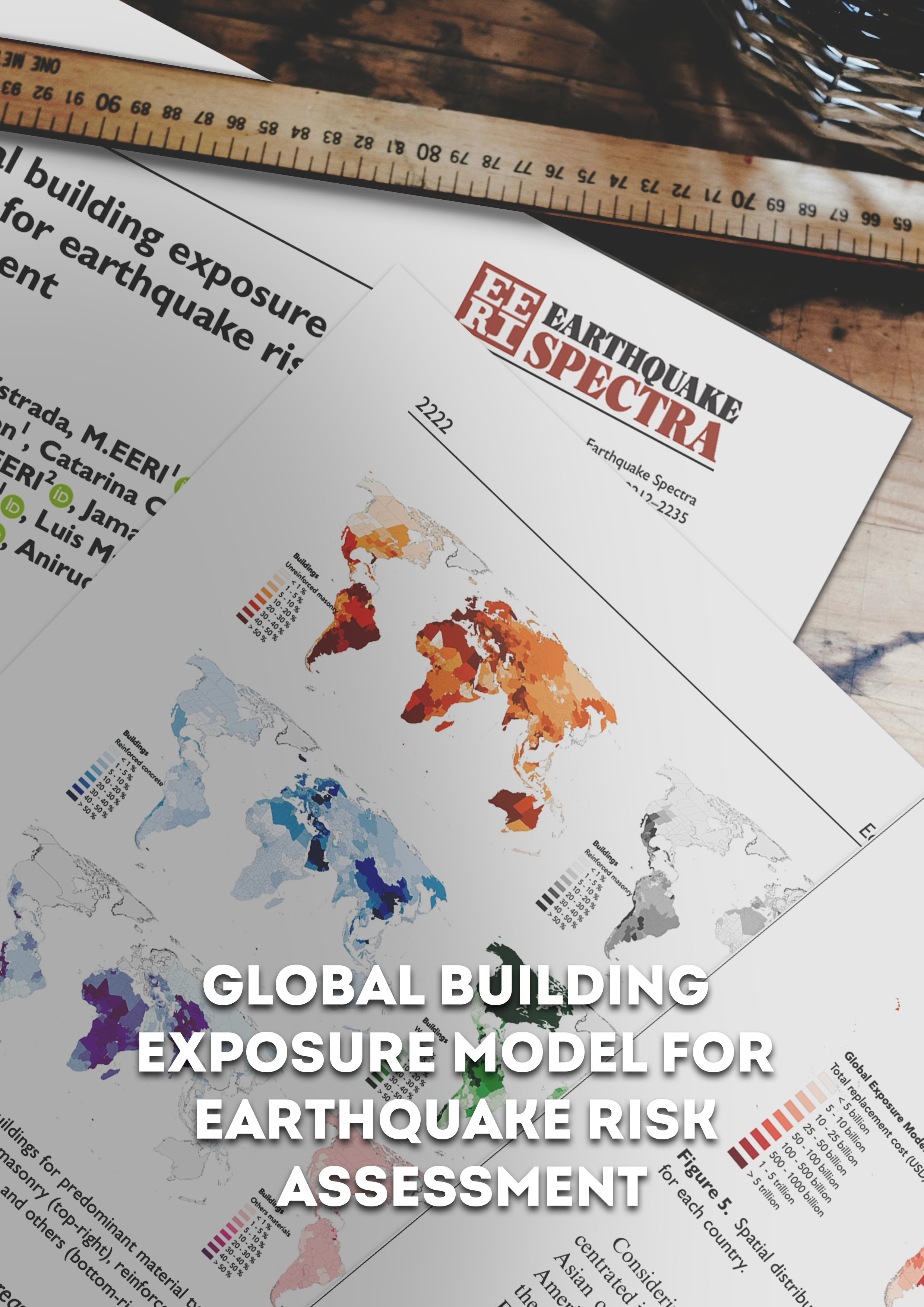
Publications Global building exposure model for earthquake risk assessment Share Facebook LinkedIn Download 2023 | Peer-reviewed The global building exposure model is a mosaic of local and regional models with information regarding the residential, commercial, and industrial building stock at the smallest available administrative division of each country and includes details about the number of buildings, number of occupants, vulnerability characteristics, average built-up area, and average replacement cost. We aimed for a bottom-up approach at the global scale, using national statistics, socio-economic data, and local datasets. This model allows the identification of the most common types of construction worldwide, regions with large fractions of informal construction, and areas prone to earthquakes with a high concentration of population and building stock. The mosaic of exposure models presented herein can be used for the assessment of probabilistic seismic risk and earthquake scenarios. Information at the global, regional, and national levels is available through a public repository (https://github.com/gem/global_exposure_model), which will be used to maintain, update and improve the models.
- GEM renews its commitment to help implement the Sendai Framework targets - GEM Foundation
News GEM renews its commitment to help implement the Sendai Framework targets By: Dec 13, 2021 Share Facebook LinkedIn GEM launched its Sendai Framework Voluntary Commitment page during this year’s International Day for Disaster Risk Reduction celebration. With the launch, GEM renewed its commitment to help implement the Sendai Framework targets and to continue its capacity development efforts with local scientists and government partners. The Sendai Framework promotes science to enable effective decision-making in disaster risk management. The Sendai Framework also created a shift from managing disasters to managing risks. To help this process, it promotes “dialogue and cooperation among scientific and technological communities, other relevant stakeholders and policymakers in order to facilitate a science policy interface for effective decision-making in disaster risk management.” Furthermore, it calls to focus on the disaster risk factors and scenarios, including emerging disaster risks, in the medium and long term; to increase research for regional, national and local application; and to support action by local communities and authorities. GEM is aligned with and contributes to the Sendai Framework. GEM is motivated to reduce earthquake risk and improve earthquake risk management especially in areas that are underserved, exposed and vulnerable to seismic risk. The contents of the Sendai Framework have strengthened the importance of our work. To sustain our efforts, GEM has trained people from more than 100 countries advancing earthquake science and engineering, and knowledge-sharing initiatives putting local experts at the forefront of regional and national initiatives in seismic hazard and risk assessments. GEM works in the Americas, Europe, Middle East, Africa and Asia-Pacific sharing knowledge, data and best practices to increase understanding of risk through social media and online channels to bring together international and local stakeholders. Visit our page at https://sendaicommitments.undrr.org/commitments/20210525_001 . No images found. GALLERY 1/1 Gallery VIDEO RELATED CONTENTS