Thanks for submitting!
You will be contacted as soon as possible


QUICK LINKS


PROFILES
PUBLICATIONS
EXPOSURE
VULNERABILTY
SOFTWARE
EQ MODELS
Search Results
Search this site
1170 results found with an empty search
- OQ Engine certified user Annisa Rizqilana | GEM Foundation
OpenQuake Engine certified user page This is to certify that Annisa Rizqilana has successfully completed the requirements to become a Certified OpenQuake Engine User for Scenario Assessment demonstrating the required knowledge and skills as assessed by the Global Earthquake Model (GEM) Foundation. GEM Foundation Secretary General Helen Crowley (signed) Date of Completion: Valid until: September 12, 2025 September 11, 2028
- Public Partnership FAQ | GEM Foundation
Publications Public Partnership FAQ Share Facebook LinkedIn Download 2025 | Brochure This document contains frequently asked questions about public partnership opportunities with the GEM Foundation. It covers eligibility requirements for applicant organizations, guidelines for the application form, and the multi-stage selection process. Related Information Call for Applications - Public Partnership Opportunity with the GEM Foundation We invite interested public organisations to submit a proposal outlining their commitment and potential contributions to GEM’s mission using the template that can be downloaded from the GEM website. Application Form - Public Partnership Opportunity with the GEM Foundation Please prepare your proposals with this Application Template and convert to a PDF file. Please ensure that your responses are clear and concise. If your organisation can provide additional supporting documents (e.g., reports, case studies, project summaries), you may attach them to your application. URL: https://www.globalquakemodel.org/get-involved?tab=partnership-opportunity
- OQ Engine certified user Lallawmawma Chawnghlut | GEM Foundation
OpenQuake Engine certified user page This is to certify that Lallawmawma Chawnghlut has successfully completed the requirements to become a Certified OpenQuake Engine User for Scenario Assessment demonstrating the required knowledge and skills as assessed by the Global Earthquake Model (GEM) Foundation. GEM Foundation Secretary General Helen Crowley (signed) Date of Completion: Valid until: September 11, 2026 September 11, 2029
- OpenQuake Hazard component testing procedures | GEM Foundation
Publications OpenQuake Hazard component testing procedures Share Facebook LinkedIn Download 2014 | Report The current document describes the testing procedures adopted in the development of the hazard component of the OpenQuake-engine (OQ-engine), the open source hazard and risk software developed by the Global Earthquake Model initiative. Nowadays seismic hazard analysis serves different needs coming from a variety of users and applications. These may encompass engineering design, assessment of earthquake risk to portfolios of assets within the insurance and reinsurance sectors, engineering seismological research, and effective mitigation via public policy in the form of urban zoning and building design code formulation.
- GEM Strain Rate Model | Global EarthQuake Model Foundation
A digital model of global strain rate estimates based on geodetic (mainly GPS) velocity data Products GEM Strain Rate Model A digital model of global strain rate estimates based on geodetic (mainly GPS) velocity data Share Facebook LinkedIn Description The GEM Strain Rate Model (GSRM v.2.1) is a model that estimates the crustal strain rates based on geodetic (mainly GPS) velocity data and is an update of the Global Strain Rate model (GSRM) v1.2 released in 2004. The GSRM provides important results for seismic hazard analysis, complementing information from active faulting and historical and instrumental seismicity. The GSRM v2.1 model is the product of a consortium of researchers led by C. Kreemer of University of Nevada, Reno. How to cite this work Kreemer, C., G. Blewitt, E.C. Klein, 2014, A geodetic plate motion and Global Strain Rate Model, Geochemistry, Geophysics, Geosystems, 15, 3849-3889, https://doi.org/10.1002/2014GC005407. Available Versions The GEM Strain Rate Model (GSRM) was funded by GEM as part of its five Global Hazard Components during GEM's first Working Programme (2009 - 2014). The model has not been updated since 2014, but the GEM Foundation maintains the dataset. You can download the last updated version of the model (Version 2.1, 2014) from the "Open Version Download" button on the right panel of this webpage. If your use case does not comply with the license terms, a license can be requested by clicking on the "License Request", where a specific agreement will be provided, depending on the use case. License information The open version is available under a Creative Commons CC BY-NC-SA 4.0 license, which requires: Attribution (you must give appropriate credit, provide a link to the license, and indicate if changes were made) Non-commercial (you may not use the material for commercial purposes) ShareAlike (derivatives created must be made available under the same license as the original) Any deviation from these terms incur in license infringement. For commercial use of the model, a specific license agreement must be made tailored to your use case, in such instance please click on "License Request". Facebook LinkedIn Share Latest Version v2014.2.1 License CC BY-SA 3.0 Available resources Open Version Download Documentation License Request text Map View Search Popup title Close Country/Region Available Resources Afghanistan Exposure Africa Exposure Alaska Exposure Country/Region Available Resources Afghanistan Vulnerability Africa Vulnerability Alaska Vulnerability Country/Region Resource Url Afghanistan Risk Profile Africa Risk Profile Alaska Risk Profile Search Found Country/Region Resource Url Afghanistan Exposure Africa Exposure Alaska Exposure Preview Preview is not available. Search Found Country/Region Resource Url Afghanistan Vulnerability Africa Vulnerability Alaska Vulnerability Preview Preview is not available. Search Found Country/Region Resource Url Afghanistan Risk Profile Africa Risk Profile Alaska Risk Profile Preview Preview is not available. Related products Related publications For downloading or accessing detailed product information like PNG/PDF maps, datasets, license request, shapefiles and more, please switch to a desktop or laptop computer. Thank you for your understanding.
- Arabia Hazard | GEM Foundation
License Request Form You have chosen to get more information about: Arabia Hazard Hazard Please check the link below to see if this product already meets your your requirements before submitting your request for a license. Thank you. DOWNLOAD THE OPEN VERSION Summary of steps to obtain a license for the requested product. Fill in the application form below. Click Submit. Please check your email Inbox or Spam folder for the summary of your request. You will then be contacted by the GEM Product Manager with either a request for more information, or a request to sign the license. If you do not hear from us within 2 weeks, please send an email to product@globalquakemodel.org . REQUEST DETAILS A. Requesting party information First Name Last Name Role/Job Email Business type Business type Other business Sector Sector Other sector B. License agreement signatory information The signatory must be someone who is authorised to sign license agreements on your behalf such as your immediate supervisor, manager or legal officer. If you’re a PhD student, the signatory must be your adviser or a university officer in charge of license agreements or similar legal documents. Full Name of Signatory Position Company Email of Signatory Organisation name Complete Address C. Purpose of request GEM is able to offer products for free because of the support of our project partners, national collaborators and institutional sponsors. All of GEM’s products are freely available for public good, non-commercial use, but with different license restrictions. In most cases we release products under an open license (e.g., CC BY-SA or CC BY-NC-SA), which permits (re)distribution. In this case, we are granting access under a more restricted license that forbids distribution or disclosure and requires signing by GEM and the licensee in order to better assure accountability for the confidentiality of the information. In order for GEM to properly assess your request, please answer the following questions below. 1. Explain briefly how will the GEM product be used e.g. project, research including the expected results and the foreseen public benefit. Minimum 60 words. 2. Will you be able to share the results of your work with GEM? YES NO 3. Will you be able to provide feedback to GEM on the quality and usefulness of this product via a survey? YES NO D. Privacy Policy By submitting this form, you consent to the processing of your personal data in accordance with our Privacy Policy and the EU General Data Protection Regulation (GDPR). We are committed to safeguarding your information and ensuring it is only used for the purpose outlined in this form. You have the right to access, rectify, or delete your data at any time. For more information, please refer to our Privacy Policy. I agree Words: 0 Email us at product@globalquakemodel.org if you're experiencing problems submitting your application. Thank you. Submit Thanks for submitting! You will be contacted as soon as possible Incomplete data. Please fill in all required fields. Thank you.
- Seismic risk assessment for mainland Portugal | GEM Foundation
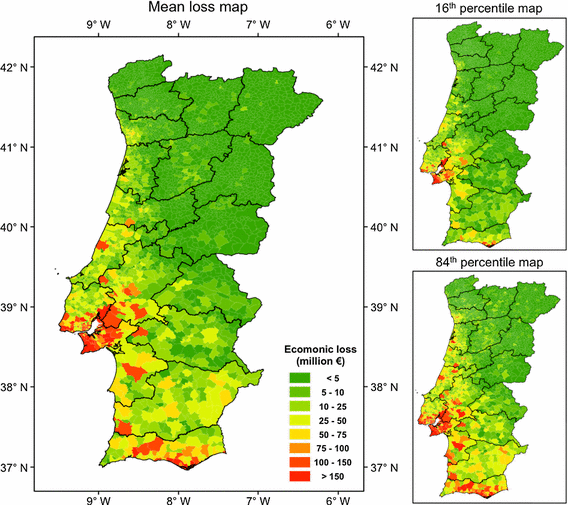
Publications Seismic risk assessment for mainland Portugal Share Facebook LinkedIn Download 2014 | Peer-reviewed The assessment of the seismic risk at a national scale represents an important resource in order to introduce measures that may reduce potential losses due to future earthquakes. This evaluation results from the combination of three components: seismic hazard, structural vulnerability and exposure data. In this study, a review of existing studies focusing on each one of these areas is carried out, and used together with data from the 2011 Building Census in Portugal to compile the required input models for the evaluation of seismic hazard and risk. In order to better characterize the epistemic uncertainty in the calculations, several approaches are considered within a logic tree structure, such as the consideration of different seismic source zonations, the employment of vulnerability functions derived based on various damage criteria and the employment of distinct spatial resolutions in the exposure model. The aim of this paper is thus to provide an overview of the recent developments regarding the different aspects that influence the seismic hazard and risk in Portugal, as well as an up-to-date identification of the regions that are more vulnerable to earthquakes, together with the expected losses for a probability of exceedance of 10 % in 50 years. The results from the present study were obtained through the OpenQuake engine, the open-source software for seismic risk and hazard assessment developed within the global earthquake model (GEM) initiative.
- Empirical fragility curves for houses in Chile using damage data from two earthquakes | GEM Foundation
Publications Empirical fragility curves for houses in Chile using damage data from two earthquakes Share Facebook LinkedIn Download 2024 | Peer-reviewed Strong seismic events frequently strike Chile. The last three significant events that caused considerable damage and losses are the 2010 ( 8.8, Maule), 2014 ( 8.2, Iquique), and 2015 ( 8.3, Illapel) earthquakes. Therefore, reliable fragility curves are necessary to evaluate the threat of earthquakes to the built environment. This study aims to develop empirical fragility curves of Chilean houses using damage from the 2014 and 2015 earthquakes. The data from 9085 and 7431 damaged houses from the 2014 and 2015 earthquakes, respectively, was obtained by the government. The fragility curves were estimated for reinforced concrete, reinforced masonry, timber, and adobe houses. Additionally, the fragility curves were constructed using three different Peak Ground Acceleration (PGA) maps to quantify the variation of the fragility parameters based on the selected PGA map and to identify which PGA map generates the highest correlation with observed damage. Additionally, fragility curves obtained in this study are compared with curves from other studies. The median values of the fragility curves obtained in this study are larger than those from other reported studies.
- Significant Seismic Risk Potential From Buried Faults Beneath Almaty City, Kazakhstan, Revealed From High-Resolution Satellite DEMs | GEM Foundation
Publications Significant Seismic Risk Potential From Buried Faults Beneath Almaty City, Kazakhstan, Revealed From High-Resolution Satellite DEMs Share Facebook LinkedIn Download 2021 | Peer-reviewed Major faults of the Tien Shan, Central Asia, have long repeat times, but fail in large (MwE 7+) earthquakes. In addition, there may be smaller, buried faults off the major faults which are not properly characterized or even recognized as active. These all pose hazard to cities along the mountain range front such as Almaty, Kazakhstan. Here, we explore the seismic hazard and risk for Almaty from specific earthquake scenarios. We run three historical-based earthquake scenarios (1887 Verny MwE 7.3, 1889 Chilik MwE 8.0 and 1911 Chon-Kemin MwE 8.0) on the current population and four hypothetical scenarios for near-field faulting. By making high-resolution Digital Elevation Models (DEMs) from SPOT and Pleiades stereo optical satellite imagery, we identify fault splays near and under Almaty. We assess the feasibility of using DEMs to estimate city building heights, aiming to better constrain future exposure datasets. Both Pleiades and SPOT-derived DEMs find accurate building heights of the majority of sampled buildings within error; Pleiades tri-stereo estimates 80% of 15 building heights within one sigma and has the smallest average percentage difference to field-measured heights (14%). A moderately sized MwE 6.5 earthquake rupture occurring on a blind thrust fault, under folding north of Almaty is the most damaging scenario explored here due to the modeled fault stretching under Almaty, with estimated 12,300E5,000 completely damaged buildings, 4,100 E 3,500 fatalities and an economic cost of 4,700 E 2,700 Million US dollars (one sigma uncertainty). This highlights the importance of characterizing location, extent, geometry, and activity of small faults beneath cities.
- Earthquake Models: Jan 2021 Release (brochure) | GEM Foundation
Publications Earthquake Models: Jan 2021 Release (brochure) Share Facebook LinkedIn Download 2021 | Brochure The GEM (Global Earthquake Model) Foundation develops hazard and risk models for the calculation of human and economic losses due to earthquakes. These models are important for a wide range of risk management applications, including standards for the design of buildings and infrastructure, insurance/risk transfer, national risk assessments, as well as public risk awareness and education.