Thanks for submitting!
You will be contacted as soon as possible


QUICK LINKS


PROFILES
PUBLICATIONS
EXPOSURE
VULNERABILTY
SOFTWARE
EQ MODELS
Search Results
Search this site
1170 results found with an empty search
- Estimating fault slip rates in the Cascadia region of North America using joint geologic-geodetic block modeling - GEM Foundation
News Estimating fault slip rates in the Cascadia region of North America using joint geologic-geodetic block modeling By: Jun 3, 2021 Share Facebook LinkedIn Richard Styron, GEM hazard team, was recently invited to present at the Seismological Society of America (SSA) Conference held in April on the ongoing collaborative research between GEM, Natural Resources Canada, and other scientists to study earthquake faults in the northwestern US and western Canada. The authors of the conference paper were Richard Styron, Tiegan Hobbs (Natural Resources Canada), Zach Lifton (Idaho Geological Survey), Nick Harrichhausen (University of California, Santa Barbara) and Murray Journeay (Natural Resources Canada). The project uses a software program developed by Richard called Oiler , that estimates the long-term movement of faults and corresponding production of earthquakes. Oiler uses geodetic (mostly global positioning system or GPS) measurements of the movement of tectonic plates, as well as geologic data such as geologic mapping and paleoseismic studies, to solve for the slip rate (and therefore earthquake production rate) of all faults within a fault network. For this project, the researchers used existing fault data augmented with some new mapping in the US, and completely new mapping of possibly-active faulting in Canada, to build the fault network. Over the next year or two, the researchers hope to be able to incorporate all of this data into a comprehensive database of seismically active faults in order to evaluate the earthquake potential of previously-unstudied faults in western Canada and the northwestern US. Watch Richard’s SSA presentation here. [ VIDEO LINK ] About #SSA2021 Held on 19–23 April 2021, the virtual SSA Annual Meeting featured more than 750 technical presentations, including sessions co-sponsored by the Latin American and Caribbean Seismological Commission and the Seismological Society of China. For more about SSA, visit https://www.seismosoc.org/ . No images found. GALLERY 1/0 Gallery VIDEO RELATED CONTENTS
- Guidelines for component-based analytical vulnerability assessment of buildings and nonstructural elements | GEM Foundation
Publications Guidelines for component-based analytical vulnerability assessment of buildings and nonstructural elements Share Facebook LinkedIn Download 2014 | Report A procedure is offered forthe analytical derivation ofthe seismic vulnerability of building classes, that is, probabilistic relationships between shaking and repair cost as a fraction of replacement cost new for a categoryofbuildings.Itsimulatesstructural response,damage,and repaircost for thestructuralandnonstructuralcomponents thatcontributemost toconstructioncost,and thenscalesup results toaccount for the components thatwere not simulated.It does so fora carefully selected sample of building specimens called index buildings whose designs span the domain of up to three features that are believed to most strongly influence seismic vulnerability within the building class. One uses moment matching to combine results for theindexbuildings toestimatebehaviourandvariabilityof thebuildingclass.Onecansimulate non-structuralvulnerabilityalonebyignoringdamageandrepaircostforstructuralcomponents.Theworkis written for a structural engineer with a master’s degree, skilled in structural analysis, but not necessarily experiencedinlossmodelling.
- Canada renews support for GEM as Public Sponsor - GEM Foundation
News Canada renews support for GEM as Public Sponsor By: May 21, 2020 Share Facebook LinkedIn The GEM-Canada National Steering Committee led by Natural Resources Canada - with members Public Safety Canada, Insurance Bureau of Canada, Defence Research and Development Canada, the Department of Finance, Institute for Catastrophic Loss Reduction, Canadian Institute of Planners, Assembly of First Nations, and the Métis National Council – renews its commitment to support GEM for five years as Public Sponsor. GEM Governing Board officially welcomed Canada as a new member in 2017. The renewed partnership is expected to continue its contribution to the assessment of earthquake risk using OpenQuake in support of disaster risk reduction (DRR) planning in Canada. Sonia Talwar, Geological Survey of Canada, who has replaced Phil Hill as official representative, expressed excitement and is looking forward to a continued fruitful collaboration in the development of GEM’s future tools and risk models for earthquakes and other hazards in Canada. “I am happy to represent Canada in the GEM Governing Board and continue the excellent working relationship that Phil Hill started three years ago. Canada will remain committed in the next five years to support GEM’s vision of a world that is resilient to earthquakes through development and enhancement of hazard and risk models, tools and data that are critical in formulating disaster risk reduction plans and strategies,” Sonia Talwar, Geological Survey of Canada. Sonia was officially welcomed in the governing board meeting held in December 2019 at the GEM headquarters in Pavia, Italy. Phil Hill represented Canada from 2017-2019. His dedication to achieve earthquake risk reduction during his tenure paved the way for a sustained commitment from Canada. “GEM is very pleased to continue our collaborative work with Canada to reduce and manage earthquake risk. We are thankful for the generous support that the government of Canada has committed for the years ahead. This will definitely strengthen our efforts in systemic risk and recovery modelling; and capacity development for integrated assessment and scenario planning,” John Schneider, GEM Secretary General. Under the new agreement, the partnership will deliver a high-resolution profile of earthquake risk in Canada with support for the use of tools and methods to understand earthquake risk and take decisions to improve resilience. The GEM-Canada partnership will use the open source hazard and risk assessment tools developed by GEM’s international consortium of experts and combine these with expertise and knowledge on the Canadian risk environment. No images found. GALLERY 1/0 Gallery VIDEO RELATED CONTENTS
- GEM Governing Board meeting (2-3 June 2022) - GEM Foundation
News GEM Governing Board meeting (2-3 June 2022) By: Sep 15, 2022 Share Facebook LinkedIn After more than two years of remote-only meetings, GEM held the first hybrid-format Governing Board meeting, with 25 partners and 23 staff attending in person, and 29 partners and 7 staff attending remotely. Another 30 guests remotely attended an open session featuring presentations of GEM’s progress report on its technical work program. The Governing Board approved several new and renewed memberships. Allianz Group and RMS are new Private Governors, represented by Matthias Hackl and Nilesh Shome, respectively. The Public Governor sponsorships of NIED Japan and Civil Protection Italy were renewed, represented by Hiroyuki Fujiwara and Daniela Di Bucci, respectively. Also approved was a change in sponsorship type for Swiss Re from Advisor to Private Governor, with Michael Ewald as the representative. The GB approved the formation of a standing committee on product development, which will guide the development of new and improved products for a range of users across public and private sectors, particularly aimed at the dissemination of information to downstream users in the broader risk management and disaster risk reduction communities. The GB also formed a task force to recommend new members to the GEM Advisory Board. The task force is seeking individuals for their technical and strategic perspectives in the context of GEM’s new strategic plan. The meeting featured Safehub’s donation of a building sensor for monitoring earthquake shaking to GEM to symbolise the commitment of both organisations to continue working together toward using sensor data to improve model predictions of damage from earthquakes; and the awarding of GEM Outstanding Contributor to Peter Pazak of Aon Impact Forecasting. GEM would like to extend its gratitude to all the participants and guests who actively participated in the open sessions. GEM will hold its next Governing Board meeting on Dec 1-2, also in hybrid format. No images found. GALLERY 1/13 VIDEO RELATED CONTENTS
- News Briefs December 2023: Institutional projects - GEM Foundation
News News Briefs December 2023: Institutional projects By: Dec 14, 2023 Dec 14, 2023 Share Facebook LinkedIn Institutional Projects SURA Project's Milestones The SURA project focused on enhancing OpenQuake's efficiency and developing a tailored rupture catalogue for Latin America. Improved computational efficiency now allows intricate risk calculations for vast regions with complex reinsurance schemes. Exporting loss curves based on Occurrence Exceedance Probability (OEP) and Aggregate Exceedance Probability (AEP) is now feasible. The curated rupture catalogue covers Chile, Colombia, Dominican Republic, Mexico, and Panama, ensuring consistent magnitude-frequency distributions and loss estimations across countries with different hazard models. Colombia's National Earthquake Risk Model GEM collaborates with the Colombian Geological Survey (SGC) and 11 universities to develop Colombia's National Earthquake Risk Model (MNRS). GEM leverages its experience in urban, national, and regional risk modelling using the OpenQuake engine. MNRS integrates detailed residential exposure models and vulnerability functions for representative building classes, developed by local experts. Expected in 2024, the model will feature public data on human impact, building damage, and economic losses for probabilistic risk and earthquake scenarios. Central America's PSHA Model Development GEM's work in the FORCE project focuses on developing a Probabilistic Seismic Hazard Assessment (PSHA) model for Central America. Key tasks involve developing datasets for seismic source characterisation, including a fault database derived from a block model encompassing the region. Advancements in homogenising the event catalogues and streamlining the workflow in the Modelling Building Toolkit (MBTK) are notable achievements within this initiative, aimed at enhancing seismic risk assessment capabilities in the region. FERMI: A Step Forward in Earthquake Source Modelling GEM's FERMI, replacing SHERIFS, revolutionises seismic hazard models' sub-fault to multi-fault earthquake source construction. Enhanced with superior performance and customisability, FERMI employs OQ-Engine functions, ensuring compatibility. In 2023, significant progress included a comprehensive system for enumerating potential multi-fault ruptures from a network, employing graph theory algorithms, while implementing filtering mechanisms based on plausibility for larger models. This breakthrough promises robust seismic modelling capabilities. No images found. GALLERY 1/0 VIDEO RELATED CONTENTS
- GEM Concludes Successful Online OpenQuake Training for its Bhutan partners - GEM Foundation
News GEM Concludes Successful Online OpenQuake Training for its Bhutan partners By: Oct 9, 2024 Aug 12, 2024 Share Facebook LinkedIn The Global Earthquake Model (GEM) continues its commitment to enhancing seismic resilience in Bhutan with the successful conclusion of a four-day online training on Earthquake Hazard and Risk, held from August 6-9, 2024. Following a productive visit in March, the training aimed to equip participants from key government agencies and academic institutions with vital skills in seismic hazard and risk assessment. This training is part of GEM's USAID-BHA-supported Forecasting and Communicating Earthquake Hazard and Risk (FORCE) project, of which Bhutan is one of the project sites. More than 60 participants attended the training, representing various organisations including the Ministry of Infrastructure and Transport, the Ministry of Works & Human Settlement, the Department of Culture and Dzongkha Development, and the College of Science and Technology at the Royal University of Bhutan (RUB). The sessions provided hands-on experience in utilising OpenQuake for seismic hazard and risk assessment. Facilitated by GEM Senior Seismic Risk Modeller, Alejandro Calderón, the training was tailored to meet Bhutan's specific needs. It covered essential topics such as earthquake rupture modeling and damage and loss estimation. Participants had their first hands-on experience with the models being developed for Bhutan within the context of FORCE, which aims to strengthen the country’s disaster preparedness. Key government participants provided valuable feedback on the methodology and results of the seismic risk model for Bhutan during the sessions. GEM expresses optimism about the impact of these tools on Bhutan's future disaster response efforts and looks forward to seeing their implementation in enhancing national resilience against seismic events. For more information about the FORCE project, you can learn more at this link. https://www.globalquakemodel.org/proj/force ## No images found. GALLERY 1/0 VIDEO RELATED CONTENTS
- Request demo for Oceania Exposure | GEM Foundation
You have chosen to request a demo on: Oceania Exposure First Name Last Name Email Company or Institution Name Country Sector Provide Details I accept the license terms and the conditions of products use. Email us at product@globalquakemodel.org if you're experiencing problems submitting this form or if you have any inquiries. Thank you. Request Thanks for submitting! You will be contacted as soon as possible Add answer here
- The Global Earthquake Model 2018: A step toward earthquake resilience - GEM Foundation
News The Global Earthquake Model 2018: A step toward earthquake resilience By: Mar 6, 2019 Share Facebook LinkedIn Since 2009, GEM has been developing collaborations around the world to assess earthquake hazard and risk. In 2015, GEM released the OpenQuake-Engine, a software program that is rapidly becoming the standard worldwide for calculating earthquake hazard and risk. Later that year, GEM committed to completing the Global Earthquake Model, leveraging its global collaborations of hundreds of experts and several regional programs using a common methodology and open analysis tools to coordinate the completion of a global mosaic of hazard and risk models. Combined, this represents the culmination of a 10-year effort to bring a comprehensive and globally complete set of information about earthquake hazard and risk together into a suite of products for use by the entire community of risk modellers, risk management professionals, and the public. On December 5th in Pavia, Italy, the GEM Event will feature: release of the global earthquake hazard and risk maps, presentations on new directions from public, private and academic perspectives panel discussions to explore development, uses, drivers and future of maps and models posters and demonstrations showing the development and application of GEM tools and models You will get an insider’s look on how the GEM2018 map was made and its applications in risk management, on interactive tools specially developed for the map, and on the strategic drivers, demands, and future directions for research and applications. You will find out what has changed in our global understanding of earthquake hazard since the release of GSHAP in 1999; you will learn how we have assembled information on the exposure and vulnerability of population and the built environment to assess the risks of economic loss and human mortality at national level globally. Further, you will see how these risks are distributed around the world and gain insights for a wide range of risk management applications and resilience planning. No images found. GALLERY 1/0 VIDEO RELATED CONTENTS
- Making Seismic Risk Information Open and Accessible: A Collaboration Between PreventionWeb and GEM Foundation - GEM Foundation
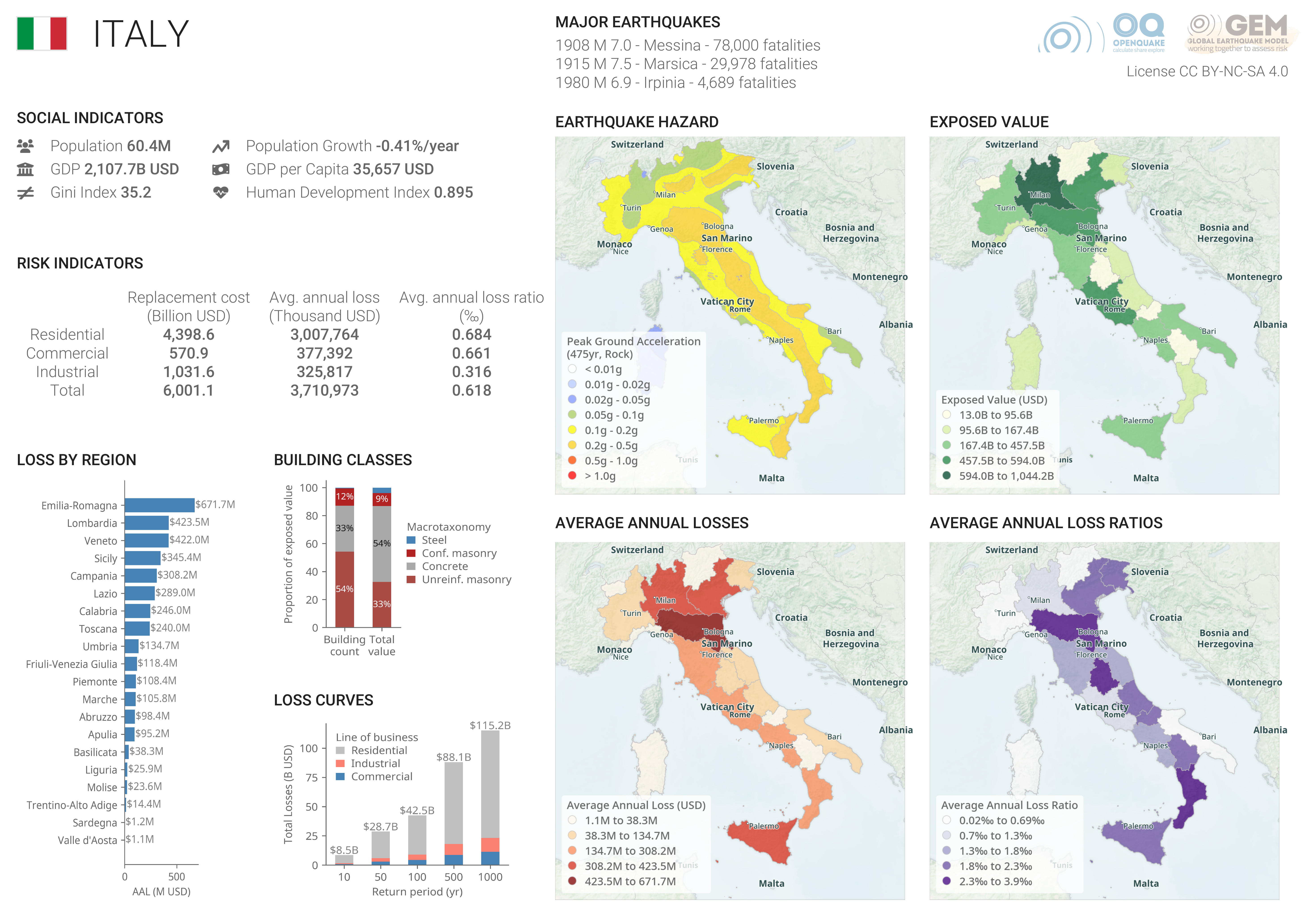
News Making Seismic Risk Information Open and Accessible: A Collaboration Between PreventionWeb and GEM Foundation By: Mar 27, 2024 Mar 20, 2024 Share Facebook LinkedIn March 20, 2024. A powerful new resource for understanding and mitigating earthquake risk at the national level is now available on the United Nations Office for Disaster Risk Reduction (UNDRR) PreventionWeb platform. This collaboration between UNDRR PreventionWeb and the Global Earthquake Model (GEM) Foundation makes over 200 country and territory seismic risk profiles accessible to a diverse global audience. These comprehensive profiles, developed by GEM , provide stakeholders in risk management with a vital overview of seismic risk in each country or territory. Each profile explores social and risk indicators, detailing factors like population density, building types, and historical earthquake impact. Additionally, loss curves depict potential losses based on different earthquake return periods, and maps visualise the geographical distribution of hazard, exposure, and potential losses. This collaboration marks a significant step forward in open access to critical disaster risk information. “Making this wealth of information readily available on PreventionWeb aligns perfectly with UNDRR’s mission to promote understanding and action on disaster risk reduction. By providing stakeholders with these insights, we can work together to better understand earthquake risk and build more resilient communities,” says Ms. Paola Albrito, Acting Special Representative of the Secretary-General for Disaster Risk Reduction and Director of UNDRR. “Open access to data and knowledge is fundamental for effective risk reduction strategies,” says Helen Crowley, GEM Secretary General. “This collaboration with UNDRR PreventionWeb ensures that our country and territory seismic risk profiles can reach the widest possible audience, informing decision-making, enhancing disaster preparedness and minimising earthquake losses.” Making these profiles available on a widely recognised platform like PreventionWeb, GEM and UNDRR enable stakeholders at various levels to make informed decisions about earthquake risk mitigation. This collaborative effort promotes a deeper understanding of seismic risk on a national scale, ultimately contributing to a safer future for communities around the world. To access the profiles, visit the following: PreventionWeb - https://www.preventionweb.net/knowledge-base/continents-countries GEM website - https://www.globalquakemodel.org/product/seismic-risk-profiles No images found. GALLERY 1/0 VIDEO RELATED CONTENTS
- Request demo for Middle East Hazard | GEM Foundation
You have chosen to request a demo on: Middle East Hazard First Name Last Name Email Company or Institution Name Country Sector Provide Details I accept the license terms and the conditions of products use. Email us at product@globalquakemodel.org if you're experiencing problems submitting this form or if you have any inquiries. Thank you. Request Thanks for submitting! You will be contacted as soon as possible Add answer here