Thanks for submitting!
You will be contacted as soon as possible


QUICK LINKS


PROFILES
PUBLICATIONS
EXPOSURE
VULNERABILTY
SOFTWARE
EQ MODELS
Search Results
Search this site
1170 results found with an empty search
- Middle East Hazard | Global EarthQuake Model Foundation
OpenQuake engine input model to perform hazard calculations for the Middle East Products Middle East Hazard OpenQuake engine input model to perform hazard calculations for the Middle East Share Facebook LinkedIn Description The v2026.0.0 model for the Middle East has been developed within a project led by ETH Zurich with the collaboration of GEM and various scientists from the region. This previous model (v2016.1.0) was developed within the 2014 Earthquake Model of the Middle East (EMME) Project. The model was natively developed for the OpenQuake (OQ) engine. EMME products, data and results are available and documented through the web-platform of the European Facilities for Earthquake Hazard and Risk (http://hazard.efehr.org/en/Documentation/specific-hazard-models/middle-east/overview/). How to cite this work L. Danciu, R. Styron, R. Basili, K. Bayliss, A. Rovida, D. DiGiacomo, S. Ceylan, B. Güryuva, O. Kale, A.Sandıkkaya, C. Brooks, M. Stucchi (2026). Earthquake Model of the Middle East (EMME2). Available Versions The model can be requested by clicking on the "License Request", where a specific license will be provided, depending on the use case. Previous versions of this model are listed in the table at the bottom of this page. License information Currently, the v2026 model is only available under a restricted license that has to be tailored for each specific use case. Please click on "License Request". Facebook LinkedIn Share Latest Version v2026.0.0 License Custom license Available resources Documentation License Request text Map View Search Popup title Close Country/Region Available Resources Afghanistan Exposure Africa Exposure Alaska Exposure Country/Region Available Resources Afghanistan Vulnerability Africa Vulnerability Alaska Vulnerability Country/Region Resource Url Afghanistan Risk Profile Africa Risk Profile Alaska Risk Profile Search Found Country/Region Resource Url Afghanistan Exposure Africa Exposure Alaska Exposure Preview Preview is not available. Search Found Country/Region Resource Url Afghanistan Vulnerability Africa Vulnerability Alaska Vulnerability Preview Preview is not available. Search Found Country/Region Resource Url Afghanistan Risk Profile Africa Risk Profile Alaska Risk Profile Preview Preview is not available. Previous Product Versions Product Version License Documentation Access Request / Open Repository v2016.1.0 CC BY-SA 4.0 Read https://cloud.openquake.org/s/BLErLEQ3kZifJTy Related products Global Liquefaction Hazard Global Exposure Model Global Vulnerability Model Global Seismic Embodied Carbon Risk Global Seismic Risk Map Country-Territory Seismic Risk Profiles Model Builder's Toolkit (oq-mbtk) Global Seismic Hazard Map Related publications Development of a Probabilistic Earthquake Loss Model for Iran Read More For downloading or accessing detailed product information like PNG/PDF maps, datasets, license request, shapefiles and more, please switch to a desktop or laptop computer. Thank you for your understanding.
- GEM releases a new toolkit, an open‑source platform for vulnerability analysis - GEM Foundation
News GEM releases a new toolkit, an open‑source platform for vulnerability analysis By: Aug 30, 2021 Share Facebook LinkedIn GEM recently released a new toolkit for vulnerability analysis, an open‑source platform compatible with commonly used earthquake engineering software such as OpenQuake and OpenSees. Implemented in the Python programming language, it is freely accessible through a public GitHub repository. The toolkit which comes with a graphical user interface (GUI), is divided into seven modules designed to guide users through the different stages of analytical vulnerability modelling from the selection of ground motion records to the validation and verification of the models. A unique feature of the toolkit is the integration in a single environment of all phases of seismic vulnerability assessment, including critical issues in vulnerability modelling related with the propagation of sources of uncertainty, verification of the resulting functions through risk metrics, and assessment of the performance of the chosen intensity measures in terms of sufficiency and efficiency. Vulnerability functions describe the expected loss for a given ground shaking intensity level and are an essential component in probabilistic seismic risk assessment. However, these functions are usually developed using scripts created by the authors, which in the vast majority of the cases are not released along with the associated fragility and vulnerability functions. This lack of transparency can prevent users from fully comprehending the modelling options and assumptions involved in the development of the models, which could be fundamental in understanding the range of applicability of the results. Luis Martins, GEM’s principal author and developer of the toolkit said that “It is thus important to improve the transparency in vulnerability modelling, through the employment of open-source tools whose methodologies and assumptions can be reviewed, and even adapted, by the users.” “The toolkit and are intended to provide earthquake engineers with a comprehensive platform to develop vulnerability models, while allowing a wide flexibility in terms of seismic demand, structural capacity, damage criteria and damage-to-loss conversion,” Luis added. The paper provides a description of the capabilities of both the source code and the GUI. The complete toolkit, including source code and GUI, is currently hosted publicly at: No images found. GALLERY 1/0 Gallery VIDEO RELATED CONTENTS
- News Briefs for January to March 2026 - GEM Foundation
News News Briefs for January to March 2026 By: Apr 24, 2026 Apr 29, 2026 Share Facebook LinkedIn Annual TREAD meeting brings doctoral researchers and senior scientists to Pavia 1. Science, tools and technical development New study examines the environmental impact of earthquakes in Europe GEM highlighted a new study examining the embodied carbon associated with earthquake damage across Europe. The research estimates that repair, debris management and reconstruction generate an average of 6.6 million tonnes of CO2e each year, adding an environmental dimension to conventional measures of seismic risk. The work broadens how earthquake impacts are evaluated and supports growing links between risk reduction and sustainability analysis. Paper: https://doi.org/10.1038/s41467-025-68120-6 Platform: https://embodiedcarbon.builtenvdata.eu/ Data/code: https://github.com/gem/global_embodied_carbon_model Early action session highlights seismic impact workflow in GDACS At Humanitarian Networks and Partnerships Week 2026, Catarina Costa contributed to a session led by the European Commission’s Joint Research Centre on strengthening regional early action systems. The contribution highlighted GEM’s work with JRC on an automated seismic impact workflow integrated into GDACS - Global Disaster Awareness and Coordination System and built on the OpenQuake Engine, supporting faster impact estimation and stronger links between scientific modelling and operational humanitarian response. Link: https://vosocc.unocha.org/Report.aspx?page=o0t9pExuBwMwml9Wkc49cgxxxequalxxxequal PAPERS platform featured at FABRE 2026 At the III FABRE Conference, GEM presented recent work on the PAPERS project and its operational WebGIS platform for scenario-based seismic hazard and risk assessment. Presented by Martina Caruso and Paul Henshaw, the contribution showed how modelling tools developed through PAPERS can support more practical infrastructure assessment and long-term resilience planning, linking seismic risk science with infrastructure management and engineering decision-making. PAPERS Project: https://www.globalquakemodel.org/proj/papers-gem Conference: https://eventi.consorziofabre.it/eventi/a683b607-5057-47ed-afc6-f332193102f4 Tsunami preparedness workshop links hazard maps with local action As part of the EU co-funded NEAM-COMMITMENT project, workshops in Athens and Methoni advanced tsunami preparedness by connecting national inundation mapping with local evacuation planning. GEM contributed to the Methoni workshop, where Marco Baiguera presented a methodology for considering prior earthquake damage in tsunami evacuation analysis. The discussions highlighted how science-based tools and local coordination can strengthen coastal preparedness and implementation. Link: https://www.globalquakemodel.org/proj/neam-commitment Open lecture explores earthquake risk in the age of new technology On 21 April, Vitor Silva contributed to the Open Lectures hosted by the Institute of Earthquake Engineering and Engineering Seismology, IZIIS, in North Macedonia, with a talk on how advances in modelling, data integration and computation are reshaping seismic risk assessment. The session highlighted how new technologies are expanding the way earthquake risk is analysed and applied, while supporting more effective decisions on the built environment. Link: https://www.iziis.ukim.edu.mk/en/ Webinar highlights OpenQuake applications for earthquake-triggered hazards A webinar organised by the Costa Rican Geotechnical Association examined how OpenQuake can be applied to earthquake-triggered hazards such as liquefaction and landslides. Presented by Vitor Silva and Lana Todorović, the session outlined GEM’s integrated risk framework and ongoing developments in secondary hazard modelling, helping extend risk assessment beyond ground shaking and support more comprehensive analysis in different regional contexts. Overture Summit discussions connect mapping data with exposure modelling needs In April, Paul Henshaw and Marco Baiguera represented GEM at the Overture Summit in Florence, where participants explored the development of open, interoperable geospatial data for global applications. The event was relevant to GEM’s ongoing work in exposure modelling, where consistent building and mapping data are increasingly important for strengthening global risk assessment tools and supporting more detailed, comparable analyses across regions. Photo Credit: Overture Maps Foundation (except for the 3rd photo, top row) Link: https://overturemaps.org/event/overture-member-summit-2026/ 2. Events, speaking engagements and visibility From Data to Inclusion: GEM at ESCAP 82 On 24 April, GEM Secretary General Helen Crowley contributed remotely to a side event organised by APDIM (GEM Associate Partner) at the 82nd session of the United Nations Economic and Social Commission for Asia and the Pacific in Bangkok. Her presentation highlighted how GEM’s open-source models and software, the OpenQuake Engine, and AI can help accelerate model development under a rapidly changing urban environment, which will lead to more accessible and actionable public goods, supporting inclusive disaster risk decision-making across Asia and the Pacific. Link: https://www.unescap.org/events/commission82 Uncertainty and collaboration in focus at EPOS Days 2026 At EPOS Days March 2026 in Cagliari, Helen Crowley presented on rapid earthquake impact assessment, focusing on how uncertainty affects early estimates of damage and losses. She also joined a discussion with Finn Løvholt of the Norwegian Geotechnical Institute on collaboration between the Global Earthquake Model and the Global Tsunami Model, highlighting shared approaches that can strengthen the use of scientific services in research and operational settings. Link: https://events.epos-eu.org/event/30/ Earthquake risk perspective featured at Exponential Risk London 2026 At InsTech’s Exponential Risk London 2026, Helen Crowley joined discussions on catastrophe modelling, transparency and risk insight in a changing analytics landscape. She contributed to the Owning Your View of Risk session organised by Zurich to discuss the role GEM played in supporting their in-house cat modelling development, and was on the main stage for a fireside chat with Goran Trendafiloski (Aon Impact Forecasting) to discuss the continued importance of seismic risk, even as climate-related hazards dominate much of the global conversation. The event provided a platform for engagement with insurance and analytics leaders on evolving risk priorities. Link: https://www.instech.co/past-events/exponential-risk-london-26/ Insurance seminar reviews catastrophe losses and earthquake implications At the Willis Natural Catastrophe Review Seminar on 28 January, Vitor Silva contributed to a panel discussion on major 2025 disaster events and what they mean for the insurance sector. His participation brought an earthquake risk perspective to a wider catastrophe review, helping connect recent losses with ongoing questions around model interpretation, portfolio understanding and the role of risk science in insurance decision-making. Link: https://www.wtwco.com/en-gb/insights/2026/01/natural-catastrophe-review-january-2026 Research-to-practice dialogue at the 2BESAFE final conference At the final conference of the 2BESAFE project in Zagreb, GEM contributed to discussions on how seismic vulnerability modelling can better support urban risk assessment and retrofit strategies. Contributions from Helen Crowley, Vitor Silva and Alejandro Calderón connected advances in hazard, exposure and vulnerability modelling with efforts to support seismic risk assessment in Croatia and across Europe. Link: https://2besafe.grad.hr/final-conference/ 3. Training, education and exchange Annual TREAD meeting brings doctoral researchers and senior scientists to Pavia Hosted at GEM headquarters in Pavia, the annual meeting of the TREAD project brought together doctoral researchers and senior scientists working across earthquake observation, physics, hazard and risk. The meeting provided space to review progress, exchange perspectives across disciplines and coordinate next research steps, reinforcing GEM’s role in supporting scientific collaboration and training at the interface of earthquake science and risk modelling. Link: https://www.globalquakemodel.org/proj/tread Doctoral course examines sustainable retrofit design beyond seismic safety GEM contributed to the IUSS Pavia doctoral course Beyond Seismic Safety: Sustainable Retrofit Design, co-hosted by GEM Seismic Risk Modeller Martina Caruso and Assistant Professor Gianrocco Mucedero, IUSS Pavia. Held from 23 February to 6 March, the course examined retrofit approaches that integrate seismic safety with environmental impact, life-cycle sustainability and energy efficiency. The programme reflects GEM’s growing engagement in linking risk reduction with broader performance and sustainability objectives in the built environment. Link: https://www.linkedin.com/feed/update/urn:li:activity:7422220675718987777/ Colorado visit supports exchange on earthquake risk tools A visit by Anirudh Rao, Seismic Risk Modelling Lead, and Al Mouayed Bellah Nafeh, Physical Vulnerability Lead, to the U.S. Geological Survey in Golden, Colorado, provided an opportunity for technical exchange on earthquake hazard and risk modelling, including areas of shared interest between GEM and USGS. Photo credit: Kishor Jaiswal, USGS. Discussions focused mainly on the use of GEM’s exposure and vulnerability models within the U.S. Geological Survey’s PAGER 2.0 framework, and also covered the dissemination of the International Macroseismic Scale, a pilot cost-benefit study for El Salvador on risk-informed seismic design actions, and implementation of the latest seismic risk model for the United States and its territories into the OpenQuake Engine for incorporation into GEM’s global seismic risk map. Anirudh and Moe also presented GEM’s work on exposure, vulnerability and scenario-based verification for the 2026 global model at a USGS Geological Hazards Science Cent re Engineering and Risk Brown Bag Seminar. The visit was supported by the U.S. Geological Survey under Cooperative Agreement No. G26AC00056-00. 4. Institutional and community updates ATLAS 2.0: facilitated access to global seismic hazard curves GEM has introduced a more streamlined online procurement system for ATLAS 2.0, its hazard data service providing access to global probabilistic seismic hazard curves launched in 2024. The update is intended to support users seeking consistent, high-resolution hazard information across countries and regions for commercial applications, while GEM continues to make the data underlying the Global Seismic Hazard Map available for free, upon request, for public-good use. Link: https://www.globalquakemodel.org/products/atlas Subscription plans: https://www.globalquakemodel.org/atlas-subscription-plans Seventeen years of advancing earthquake risk science In March, GEM marked its 17th anniversary, reflecting on nearly two decades of work to advance earthquake hazard and risk understanding through models, data and analytical tools. The milestone also pointed ahead to the next phase of GEM’s work, including new global products, integrated risk assessment and continued collaboration across its international community of partners, sponsors and technical contributors. Marking women’s participation and equality in science and practice During the first quarter, GEM marked both the International Day of Women and Girls in Science and International Women’s Day, highlighting how inclusive knowledge systems strengthen research, modelling, software development and decision support. The foundation also noted that the gender pay gap among its scientific staff reached 0% in 2024, linking equality in practice with broader efforts to ensure opportunity, participation and leadership remain open and accessible. Link: https://www.globalquakemodel.org/gempublications/gem-foundation-gender-equality-plan No images found. GALLERY 1/0 VIDEO RELATED CONTENTS
- GEM Hosts In-Person “Models and OpenQuake Engine” Training in Pavia - GEM Foundation
News GEM Hosts In-Person “Models and OpenQuake Engine” Training in Pavia By: Jul 7, 2025 May 16, 2025 Share Facebook LinkedIn From 5 to 16 May 2025, GEM delivered a comprehensive “GEM Models and OpenQuake Engine Training” course at the EUCENTRE Foundation in Pavia, Italy. Organised under the IUSS Pavia Doctoral Programme in Earthquake Engineering, the course brought together over 30 participants from 19 countries, including researchers, students and practitioners from GEM’s global network. Over two full weeks, participants attended seven theoretical lectures and six hands-on tutorials covering: Seismic hazard modelling, including classical, event‑based and scenario‑based probabilistic seismic hazard assessment (PSHA), disaggregation, conditional spectra, and ground‑motion field conditioning Seismic risk analysis, including exposure and vulnerability modelling, OpenQuake Engine scenario and PSRA calculations, and use of GEM’s global exposure and vulnerability frameworks The training was led by a team of GEM experts: Marco Baiguera, Kirsty Bayliss, Christopher Brooks, Alejandro Calderón, Martina Caruso, Al Mouayed Bellah Nafeh, Marco Pagani, Anirudh Rao, Manuela Villani, and Catalina Yepes. Held in cooperation with EUCENTRE, the course provided an opportunity for in-depth knowledge exchange, reinforcing GEM’s commitment to technical capacity development and open, transparent use of the OpenQuake Engine for hazard and risk modelling. The event page remains open for enquiries from future participants. External students and practitioners interested in similar training opportunities can contact GEM at info@globalquakemodel.org or visit the event page for more details. No images found. GALLERY training 4.png training 1.png oq training group pic may 2025.jpg training 4.png 1/7 VIDEO RELATED CONTENTS
- Middle East Exposure | GEM Foundation
License Request Form You have chosen to get more information about: Middle East Exposure Exposure Please check the link below to see if this product already meets your your requirements before submitting your request for a license. Thank you. DOWNLOAD THE OPEN VERSION Summary of steps to obtain a license for the requested product. Fill in the application form below. Click Submit. Please check your email Inbox or Spam folder for the summary of your request. You will then be contacted by the GEM Product Manager with either a request for more information, or a request to sign the license. If you do not hear from us within 2 weeks, please send an email to product@globalquakemodel.org . REQUEST DETAILS A. Requesting party information First Name Last Name Role/Job Email Business type Business type Other business Sector Sector Other sector B. License agreement signatory information The signatory must be someone who is authorised to sign license agreements on your behalf such as your immediate supervisor, manager or legal officer. If you’re a PhD student, the signatory must be your adviser or a university officer in charge of license agreements or similar legal documents. Full Name of Signatory Position Company Email of Signatory Organisation name Complete Address C. Purpose of request GEM is able to offer products for free because of the support of our project partners, national collaborators and institutional sponsors. All of GEM’s products are freely available for public good, non-commercial use, but with different license restrictions. In most cases we release products under an open license (e.g., CC BY-SA or CC BY-NC-SA), which permits (re)distribution. In this case, we are granting access under a more restricted license that forbids distribution or disclosure and requires signing by GEM and the licensee in order to better assure accountability for the confidentiality of the information. In order for GEM to properly assess your request, please answer the following questions below. 1. Explain briefly how will the GEM product be used e.g. project, research including the expected results and the foreseen public benefit. Minimum 60 words. 2. Will you be able to share the results of your work with GEM? YES NO 3. Will you be able to provide feedback to GEM on the quality and usefulness of this product via a survey? YES NO D. Privacy Policy By submitting this form, you consent to the processing of your personal data in accordance with our Privacy Policy and the EU General Data Protection Regulation (GDPR). We are committed to safeguarding your information and ensuring it is only used for the purpose outlined in this form. You have the right to access, rectify, or delete your data at any time. For more information, please refer to our Privacy Policy. I agree Words: 0 Email us at product@globalquakemodel.org if you're experiencing problems submitting your application. Thank you. Submit Thanks for submitting! You will be contacted as soon as possible Incomplete data. Please fill in all required fields. Thank you.
- Exploring earthquake databases for the creation of magnitude-homogeneous catalogues: tools for application on a regional and global scale | GEM Foundation
Publications Exploring earthquake databases for the creation of magnitude-homogeneous catalogues: tools for application on a regional and global scale Share Facebook LinkedIn Download 2016 | Peer-reviewed The creation of a magnitude-homogenized catalogue is often one of the most fundamental steps in seismic hazard analysis. The process of homogenizing multiple catalogues of earthquakes into a single unified catalogue typically requires careful appraisal of available bulletins, identification of common events within multiple bulletins and the development and application of empirical models to convert from each catalogue's native scale into the required target. The database of the International Seismological Center (ISC) provides the most exhaustive compilation of records from local bulletins, in addition to its reviewed global bulletin. New open-source tools are developed that can utilize this, or any other compiled database, to explore the relations between earthquake solutions provided by different recording networks, and to build and apply empirical models in order to harmonize magnitude scales for the purpose of creating magnitude-homogeneous earthquake catalogues. These tools are described and their application illustrated in two different contexts. The first is a simple application in the Sub-Saharan Africa region where the spatial coverage and magnitude scales for different local recording networks are compared, and their relation to global magnitude scales explored. In the second application the tools are used on a global scale for the purpose of creating an extended magnitude-homogeneous global earthquake catalogue. Several existing high-quality earthquake databases, such as the ISC-GEM and the ISC Reviewed Bulletins, are harmonized into moment magnitude to form a catalogue of more than 562 840 events. This extended catalogue, while not an appropriate substitute for a locally calibrated analysis, can help in studying global patterns in seismicity and hazard, and is therefore released with the accompanying software.
- Request demo for Mexico Hazard | GEM Foundation
You have chosen to request a demo on: Mexico Hazard First Name Last Name Email Company or Institution Name Country Sector Provide Details I accept the license terms and the conditions of products use. Email us at product@globalquakemodel.org if you're experiencing problems submitting this form or if you have any inquiries. Thank you. Request Thanks for submitting! You will be contacted as soon as possible Add answer here
- Request demo for Canada Hazard | GEM Foundation
You have chosen to request a demo on: Canada Hazard First Name Last Name Email Company or Institution Name Country Sector Provide Details I accept the license terms and the conditions of products use. Email us at product@globalquakemodel.org if you're experiencing problems submitting this form or if you have any inquiries. Thank you. Request Thanks for submitting! You will be contacted as soon as possible Add answer here
- GEM’s next journey: Turning GEM models into products useful for the insurance industry - GEM Foundation
News GEM’s next journey: Turning GEM models into products useful for the insurance industry By: Jul 31, 2019 Share Facebook LinkedIn John Schneider (L), Malcolm Haylock, Luis Sousa, Michael Ewald and Dickie Whitaker during a panel discussion at Oasis-Swiss Re Conference, June 2019 The 4th Oasis Conference in conjunction with Swiss Re Institute John Schneider, GEM Secretary General represented GEM at the 4th Oasis Conference held on June 12, 2019 at Swiss Re Next Auditorium, Zurich, Switzerland. The event, organized by Oasis and Swiss Re Institute brought together some of the world’s best natural catastrophe (natcat) risk experts and modelers. The objective of the 1-day event was to learn more about the suite of available models, options to deploy Oasis, and how Oasis technology is developing. It also provided model providers an opportunity to demonstrate tools and models to participants. Discussions also focused on key issues in models, the need for transparency and the future of catastrophe risk modeling. Three GEM collaborators presented how they have applied GEM models, tools and data to their respective risk modelling activities. Michael Ewald, Swiss Re (a project partner and now a Sponsor) demonstrated how GEM’s OpenQuake is being integrated into their earthquake modeling approach, in particular the OQ Hazard Module (stochastic earthquake catalogue and ground motion prediction equations, or GMPEs). Luis Sousa, AIR Worldwide (a founding Governor Sponsor) showed the history of GEM-AIR collaboration, showing examples of how GEM data and model components have been used to inform the development of their own risk models in several areas around the world. Malcolm Haylock, Sunstone Risk Solutions, described his implementation of GEM’s OpenQuake model for Puerto Rico, a prototype that runs on the Oasis modeling platform Flamingo. http://www.sunstonerisk.com/gem/ John presented GEM data, models and other products that are currently available i.e. global earthquake ground shaking loss to buildings and population that the insurance sector can immediately use. John also mentioned that financial loss models in OASIS, Touchtone and Elements would become available over the coming months. In addition to the financial loss models, he mentioned that over the next three years, the capability of OpenQuake would be extended to cover multi-perils, while tools and models would include time dependence, secondary perils and critical infrastructure - components that are vital in the insurance industry. Daniel Martin Eckhart, Swiss Re Institute Advocate, in his summary of the event, mentioned on his blog John’s analogy of turning GEM models into products consumable by the industry: In a way it was John Schneider who found the perfect image for this moment in time – the image of a potato! He shared the journey of GEM (Global Earthquake Model) with a simple visual that showed how it went from farming the land to harvesting to now producing the potato (aka models). Said John: "I view the potato as something that's useful. We produce the best organic potato and it's useful to many people." But, he pointed out, the potato is bland and its real value appears when it is turned into other things. "What we have now is great, but it is not what the insurance industry is used to consuming. The next part of the GEM journey is turning the potato into French fries." The fries then stand for models that are useful (consumable) for the whole industry. Dickie Whitaker, OASIS Chief Operating Officer and Beat Aeberhardt closed the conference. Dickie highlighted the significant progress made, the increasing maturity of the Oasis code base and the sophistication of the work done over a short period of time. For more details on the 4thOasis Conference, read Daniel Eckhart’s blog here . No images found. GALLERY 1/3 VIDEO RELATED CONTENTS
- GEM's Success at WCEE2024: Sharing Knowledge, Expertise, and Strengthening Collaboration in Earthquake Resilience - GEM Foundation
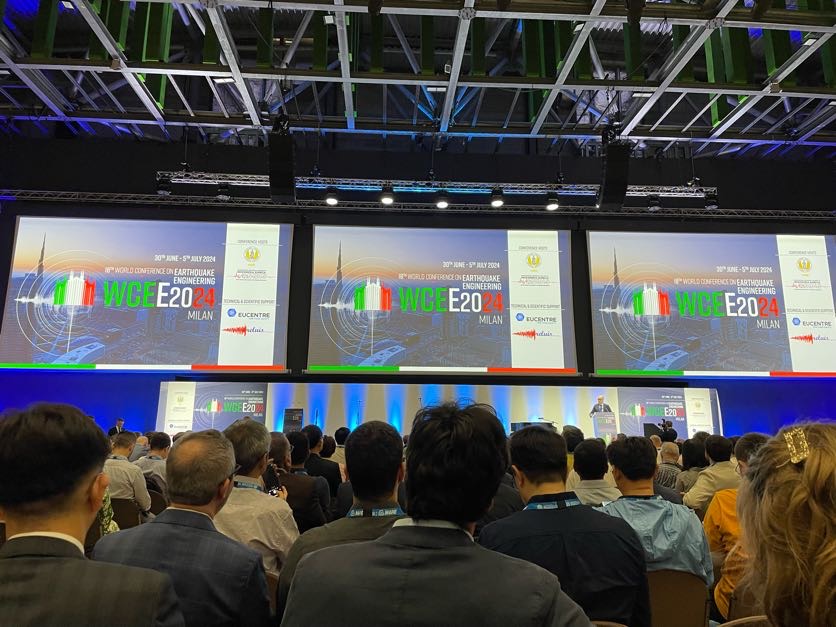
News GEM's Success at WCEE2024: Sharing Knowledge, Expertise, and Strengthening Collaboration in Earthquake Resilience By: Jul 8, 2024 Jul 8, 2024 Share Facebook LinkedIn The Global Earthquake Model (GEM) Foundation solidified its position as a key partner in earthquake hazard and risk assessment at the prestigious 18th World Conference on Earthquake Engineering (WCEE2024) held in Milan, Italy, from June 30th to July 5th, 2024. This premier event provided GEM with a valuable platform to showcase its ongoing projects, collaborate with international peers, and contribute to advancing global earthquake resilience. "Participating in WCEE2024 was a great opportunity for us to share our research on the future of seismic hazard and risk modelling, and to learn from our global community. I extend my sincere gratitude to the organisers for this stimulating event and commend our dedicated GEM staff whose expertise, passion and contributions made our WCEE2024 participation a big success." - Helen Crowley, GEM Secretary General. GEM actively participated in various sessions throughout the week, delivering presentations on a wide range of topics critical to earthquake risk assessment, reduction, and mitigation. Here's a glimpse into GEM's successful week: Day 1 focused on core earthquake science. Through GEM-led technical sessions, experts discussed advances in hazard analysis, characterising ground motion, and how to build a systemic approach to risk assessment. Day 2 offered in-depth exploration. Presentations explored how earthquakes affect access to healthcare, the resilience of masonry buildings, and the estimation of tsunami flow depths using data and machine learning. The day was capped by the well-attended panel session co-hosted by GEM and Aon, titled “From Academia to Insurance Industry: What's in it for Earthquake Engineers?" This session brought together over 100 industry experts and academics to explore, amongst other topics, the career opportunities available for earthquake engineering researchers within the insurance sector. Day 3 showcased a number of GEM's projects. Talks covered diverse areas such as nuclear power plant safety, global earthquake loss assessment, and advancements in the OpenQuake software. Other notable sessions explored topics ranging from using artificial intelligence for exposure models to the impact of recovery efforts on future earthquake risk. The day concluded with a stakeholder needs assessment session run by the Global Tsunami Model (GTM) community, providing a valuable opportunity to connect with colleagues in tsunami hazard and risk assessment. Day 4 wrapped up with prestigious talks. GEM presented on how we evaluate our models after damaging earthquakes, along with advancements in global environmental impact models. The day concluded with the prestigious Joyner Memorial Lecture by GEM Secretary General, Helen Crowley, which looked at the history of seismic zonation in Italy, the criticisms often (unjustly) targeted at seismic hazard models and the ways in which seismic risk modelling can be used to define seismic actions for design. Watch Helen's presentation below. https://www.youtube.com/watch?v=htRE6O5y4vQ Day 5 offered some final insights. Presentations explored a global vulnerability function database and a multi-criteria approach for optimal building retrofitting, leaving attendees with valuable knowledge on products and methods for earthquake risk mitigation. A Hub of Knowledge Exchange and Collaboration The GEM booth (B12) served as a vibrant hub for attendees and offered opportunities to engage with GEM’s earthquake engineering and hazard experts including GEM’s Product Manager, Andres Abarca. Discussions centred on GEM's latest tools and methodologies for earthquake hazard and risk assessment, promoting a collaborative environment for knowledge exchange and capacity building. Many attendees also stopped by and filled out our survey to contribute to GEM's Global Seismic Regulation Database and Mapping Initiative. WCEE2024: A Stepping Stone for Future Collaboration GEM's active participation at WCEE2024 served as a springboard for continued collaboration and knowledge-sharing within the earthquake engineering community. By presenting its latest advancements, engaging in discussions, and strengthening partnerships, GEM has solidified its role as a global partner in building global seismic resilience. "As we reflect on WCEE2024, it's clear that GEM's contributions are important in shaping seismic hazard and risk assessment globally. It was incredible to see the depth and breadth of GEM's influence and impact throughout the conference. This conference has underlined the importance of collaborative efforts in advancing earthquake engineering, and I'm grateful for the opportunity to share insights that drive our field forward." - John Schneider, GEM Senior Advisor. Stay Connected! Visit the dedicated GEM WCEE2024 event page or contact us at communication@globalquakemodel.org for further information, presentations, and other resources from the conference. Other Photos from the WCEE2024 Event (Photo credit: WCEE2024/EUCENTRE) No images found. GALLERY 1/42 VIDEO RELATED CONTENTS