Thanks for submitting!
You will be contacted as soon as possible


QUICK LINKS


PROFILES
PUBLICATIONS
EXPOSURE
VULNERABILTY
SOFTWARE
EQ MODELS
Search Results
Search this site
1170 results found with an empty search
- GEM at UR24: Advancing Global Resilience through Collaborative Efforts - GEM Foundation
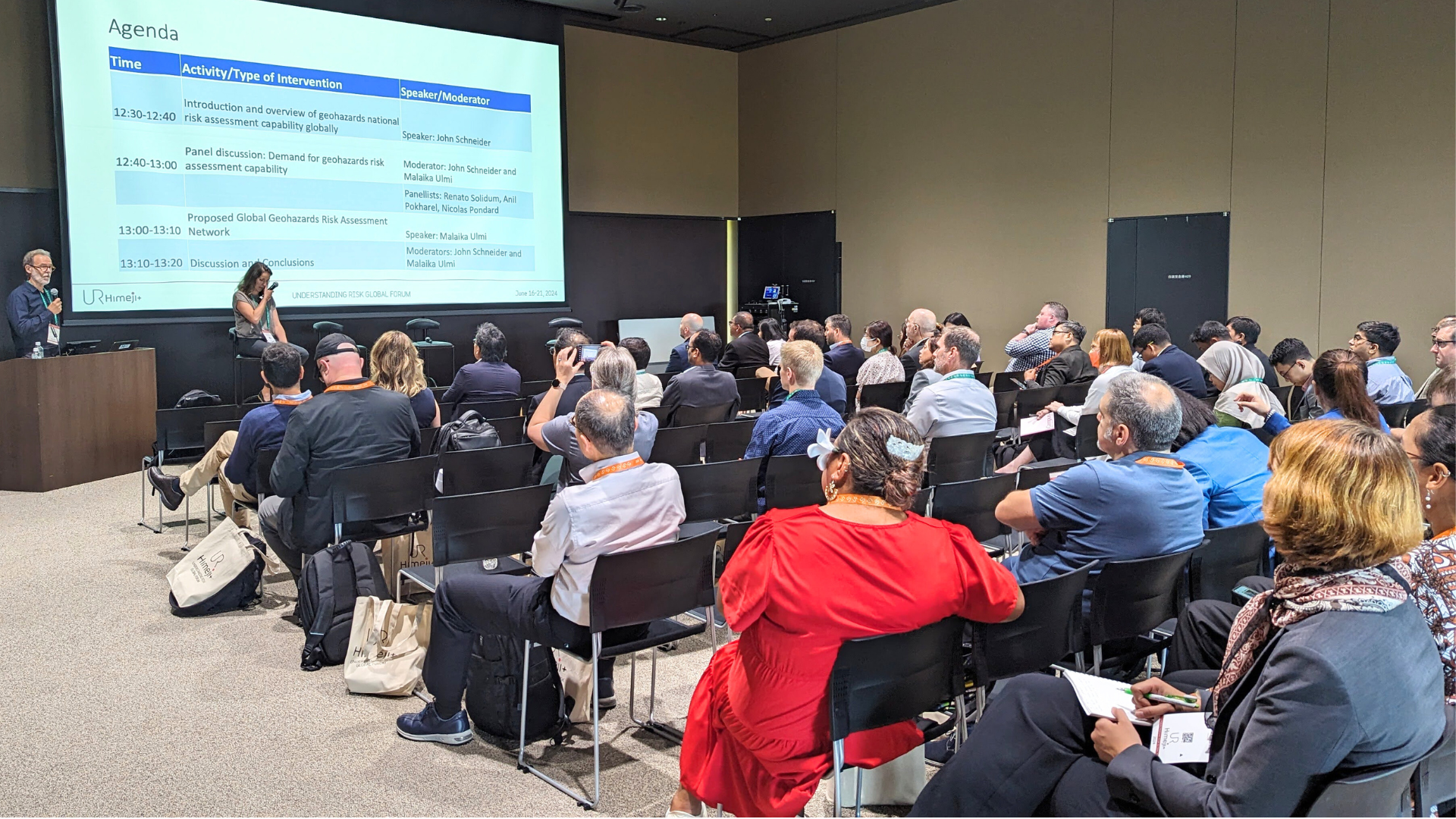
News GEM at UR24: Advancing Global Resilience through Collaborative Efforts By: Jun 25, 2024 Jun 25, 2024 Share Facebook LinkedIn The Global Earthquake Model (GEM) Foundation showcased its leadership in seismic hazard and risk assessment at the Understanding Risk Global Forum 2024 (UR24) held in Himeji, Japan from June 16-21, and organised by the Global Facility for Disaster Reduction and Recovery (GFDRR). This event provided an invaluable platform for GEM to share insights, promote collaboration, and reinforce global resilience against geohazards. Building a Global Community for Geohazards Risk Assessment On June 20, GEM concluded its activities with a successful focus day session titled "What about Geohazards? Building a Global Community for Hazard and Risk Assessment." Convened by John Schneider, Senior Advisor, GEM; Malaika Ulmi, Geological Survey of Canada; and Gill Jolly, GNS Science NZ, this session brought together experts from organisations such as USAID, USGS, GNS Science, PHIVOLCS, and NASA. It built upon the discussions from the June 18th session, "What About Geohazards? The State of Practice in Risk Assessment and Needs for Improvement at National to Sub-National Level," where contributions from Nicolas Pondard (The World Bank) and Renato Solidum (Secretary of the Department of Science and Technology, Philippines) were crucial. The June 20th session focused on establishing a globally coordinated network to improve access to information and expertise in geohazards risk assessment and promote collaboration to strengthen capacities in developing countries. There was widespread interest from attendees for such an initiative, highlighting the importance of a committed community of experts working together to drive significant advancements in understanding and mitigating natural hazard risks. Exploring Future Directions for Disaster Scenarios Another key session, "Can ‘Seeing’ the Future Help us Change it?", organised by GeoHazards International and featuring GEM’s Helen Crowley, underscored the power of disaster scenarios. The session demonstrated how co-producing scenarios with stakeholders can help connect technical understanding of risk with locally sustainable actions, including new policies, mitigation, and preparedness. Key takeaways included the importance of effective co-creation with communities, leveraging recent research insights, and transforming scenarios into practical and actionable mitigation strategies. First Day Success and Continued Engagement On the first day of UR24, GEM Secretary General Helen Crowley played a key role in two significant sessions: the plenary session "Richter Resilience: Advancing Seismic Protection Worldwide" and "Symphony of Tradition and Innovation: Orchestrating Global Resilience in Diverse Communities", organised by ImageCat. Both sessions addressed crucial aspects of earthquake resilience, combining tradition with modern advancements to foster a resilient future. Watch Helen’s plenary presentation below. https://www.youtube.com/watch?v=EbhmnmeWuMc Engagement at the Exhibition Booth Throughout the forum, GEM maintained a strong presence at booth S7, where attendees could engage with GEM's Product Manager, Andres Abarca, and earthquake experts, including Marco Pagani, Head of Seismic Hazards. The booth showcased GEM’s latest tools and methodologies for earthquake hazard and risk assessment, providing valuable insights into driving global earthquake preparedness and resilience. From left: Marco Pagani, Helen Crowley, Andres Abarca and John Schneider UR24 has underscored GEM's commitment to global collaboration and innovation in geohazards risk assessment. Through its active participation and leadership, GEM continues to pave the way for a more resilient future against seismic threats. For updated information on GEM's activities at UR24 - photos, available videos, and other resources - visit the GEM UR24 event page or contact GEM directly: communication@globalquakemodel.org . No images found. GALLERY 1/17 VIDEO RELATED CONTENTS
- Sub-Saharan Africa Hazard | GEM Foundation
License Request Form You have chosen to get more information about: Sub-Saharan Africa Hazard Hazard Please check the link below to see if this product already meets your your requirements before submitting your request for a license. Thank you. DOWNLOAD THE OPEN VERSION Summary of steps to obtain a license for the requested product. Fill in the application form below. Click Submit. Please check your email Inbox or Spam folder for the summary of your request. You will then be contacted by the GEM Product Manager with either a request for more information, or a request to sign the license. If you do not hear from us within 2 weeks, please send an email to product@globalquakemodel.org . REQUEST DETAILS A. Requesting party information First Name Last Name Role/Job Email Business type Business type Other business Sector Sector Other sector B. License agreement signatory information The signatory must be someone who is authorised to sign license agreements on your behalf such as your immediate supervisor, manager or legal officer. If you’re a PhD student, the signatory must be your adviser or a university officer in charge of license agreements or similar legal documents. Full Name of Signatory Position Company Email of Signatory Organisation name Complete Address C. Purpose of request GEM is able to offer products for free because of the support of our project partners, national collaborators and institutional sponsors. All of GEM’s products are freely available for public good, non-commercial use, but with different license restrictions. In most cases we release products under an open license (e.g., CC BY-SA or CC BY-NC-SA), which permits (re)distribution. In this case, we are granting access under a more restricted license that forbids distribution or disclosure and requires signing by GEM and the licensee in order to better assure accountability for the confidentiality of the information. In order for GEM to properly assess your request, please answer the following questions below. 1. Explain briefly how will the GEM product be used e.g. project, research including the expected results and the foreseen public benefit. Minimum 60 words. 2. Will you be able to share the results of your work with GEM? YES NO 3. Will you be able to provide feedback to GEM on the quality and usefulness of this product via a survey? YES NO D. Privacy Policy By submitting this form, you consent to the processing of your personal data in accordance with our Privacy Policy and the EU General Data Protection Regulation (GDPR). We are committed to safeguarding your information and ensuring it is only used for the purpose outlined in this form. You have the right to access, rectify, or delete your data at any time. For more information, please refer to our Privacy Policy. I agree Words: 0 Email us at product@globalquakemodel.org if you're experiencing problems submitting your application. Thank you. Submit Thanks for submitting! You will be contacted as soon as possible Incomplete data. Please fill in all required fields. Thank you.
- GEM Building Taxonomy | GEM Foundation
License Request Form You have chosen to get more information about: GEM Building Taxonomy Exposure Please check the link below to see if this product already meets your your requirements before submitting your request for a license. Thank you. DOWNLOAD THE OPEN VERSION Summary of steps to obtain a license for the requested product. Fill in the application form below. Click Submit. Please check your email Inbox or Spam folder for the summary of your request. You will then be contacted by the GEM Product Manager with either a request for more information, or a request to sign the license. If you do not hear from us within 2 weeks, please send an email to product@globalquakemodel.org . REQUEST DETAILS A. Requesting party information First Name Last Name Role/Job Email Business type Business type Other business Sector Sector Other sector B. License agreement signatory information The signatory must be someone who is authorised to sign license agreements on your behalf such as your immediate supervisor, manager or legal officer. If you’re a PhD student, the signatory must be your adviser or a university officer in charge of license agreements or similar legal documents. Full Name of Signatory Position Company Email of Signatory Organisation name Complete Address C. Purpose of request GEM is able to offer products for free because of the support of our project partners, national collaborators and institutional sponsors. All of GEM’s products are freely available for public good, non-commercial use, but with different license restrictions. In most cases we release products under an open license (e.g., CC BY-SA or CC BY-NC-SA), which permits (re)distribution. In this case, we are granting access under a more restricted license that forbids distribution or disclosure and requires signing by GEM and the licensee in order to better assure accountability for the confidentiality of the information. In order for GEM to properly assess your request, please answer the following questions below. 1. Explain briefly how will the GEM product be used e.g. project, research including the expected results and the foreseen public benefit. Minimum 60 words. 2. Will you be able to share the results of your work with GEM? YES NO 3. Will you be able to provide feedback to GEM on the quality and usefulness of this product via a survey? YES NO D. Privacy Policy By submitting this form, you consent to the processing of your personal data in accordance with our Privacy Policy and the EU General Data Protection Regulation (GDPR). We are committed to safeguarding your information and ensuring it is only used for the purpose outlined in this form. You have the right to access, rectify, or delete your data at any time. For more information, please refer to our Privacy Policy. I agree Words: 0 Email us at product@globalquakemodel.org if you're experiencing problems submitting your application. Thank you. Submit Thanks for submitting! You will be contacted as soon as possible Incomplete data. Please fill in all required fields. Thank you.
- Country-Territory Seismic Risk Profiles | GEM Foundation
License Request Form You have chosen to get more information about: Country-Territory Seismic Risk Profiles Risk Please check the link below to see if this product already meets your your requirements before submitting your request for a license. Thank you. DOWNLOAD THE OPEN VERSION Summary of steps to obtain a license for the requested product. Fill in the application form below. Click Submit. Please check your email Inbox or Spam folder for the summary of your request. You will then be contacted by the GEM Product Manager with either a request for more information, or a request to sign the license. If you do not hear from us within 2 weeks, please send an email to product@globalquakemodel.org . REQUEST DETAILS A. Requesting party information First Name Last Name Role/Job Email Business type Business type Other business Sector Sector Other sector B. License agreement signatory information The signatory must be someone who is authorised to sign license agreements on your behalf such as your immediate supervisor, manager or legal officer. If you’re a PhD student, the signatory must be your adviser or a university officer in charge of license agreements or similar legal documents. Full Name of Signatory Position Company Email of Signatory Organisation name Complete Address C. Purpose of request GEM is able to offer products for free because of the support of our project partners, national collaborators and institutional sponsors. All of GEM’s products are freely available for public good, non-commercial use, but with different license restrictions. In most cases we release products under an open license (e.g., CC BY-SA or CC BY-NC-SA), which permits (re)distribution. In this case, we are granting access under a more restricted license that forbids distribution or disclosure and requires signing by GEM and the licensee in order to better assure accountability for the confidentiality of the information. In order for GEM to properly assess your request, please answer the following questions below. 1. Explain briefly how will the GEM product be used e.g. project, research including the expected results and the foreseen public benefit. Minimum 60 words. 2. Will you be able to share the results of your work with GEM? YES NO 3. Will you be able to provide feedback to GEM on the quality and usefulness of this product via a survey? YES NO D. Privacy Policy By submitting this form, you consent to the processing of your personal data in accordance with our Privacy Policy and the EU General Data Protection Regulation (GDPR). We are committed to safeguarding your information and ensuring it is only used for the purpose outlined in this form. You have the right to access, rectify, or delete your data at any time. For more information, please refer to our Privacy Policy. I agree Words: 0 Email us at product@globalquakemodel.org if you're experiencing problems submitting your application. Thank you. Submit Thanks for submitting! You will be contacted as soon as possible Incomplete data. Please fill in all required fields. Thank you.
- Introduction to the GEM Earthquake Consequences Database (GEMECD) | GEM Foundation
Publications Introduction to the GEM Earthquake Consequences Database (GEMECD) Share Facebook LinkedIn Download 2014 | Report Fromtheinception oftheGEMGlobalEarthquakeConsequencesDatabase(GEMECD)theambitionwasthat the database will serve to inform users on consequences from past events, as a benchmarking tool for analyticallossmodelsand to support thedevelopmentof tools tocreatevulnerabilitydataappropriate to specificcountries,structures,orbuildingclasses.Theaimofthisreportistosummarisetheworkcarriedout by 10internationalpartners toachieve thisgoalandincludesadescriptionof thedatabasein termsofits contents and framework, the development of a set of guidelines for data collection and templates to populate thedatabaseandfinallysomeexamplesoftypesofinformationincludedinGEMECD,notablythe updatedUSGSShakemaps.
- Earthquake Model for the European-Mediterranean Region for the purpose of GEM1 | GEM Foundation
Publications Earthquake Model for the European-Mediterranean Region for the purpose of GEM1 Share Facebook LinkedIn Download 2010 | Report This is an external report, produced within the scope of the GEM1 project. GEM1 was a focused pilot project of the Global Earthquake Model initiative, which ran from January 1st 2009 to March 31st 2010 and was aimed at generating GEM’s first products and developing GEM’s initial IT infrastructure. The technical achievements of GEM1 have been summarised in a series of 10 reports; 6 internal and 4 external GEM1 reports. The internal reports are based on the achievements of the GEM1 team, the external reports are written by external experts who had been awarded a subcontract to carry out a specific task. In addition to reading this external reports, it is suggested to also read the rest of the GEM1 reports and in particular the GEM1 Executive Summary.
- Extensible Data Schemas for Multiple Hazards, Exposure and Vulnerability Data | GEM Foundation
Publications Extensible Data Schemas for Multiple Hazards, Exposure and Vulnerability Data Share Facebook LinkedIn Download 2019 | Report The data required for assessing disaster risk can generally be divided into three categories: hazard, exposure and vulnerability. To date there is no widely accepted approach for storing and sharing such risk-related data using a common data structure. As a result, using risk-related data often requires a significant amount of upfront work to collect, extract and transform data before it can be used for purposes such as a risk assessment. In addition, the lack of a consistent data structure hinders the development of tools that can be used for more than one set of data. In practice, this situation introduces a significant amount of friction in efforts to quantify and manage disaster risk. Here we report on an effort by three consortia to develop extensible, internally consistent schemas for hazard, exposure and vulnerability data. The consortia coordinated their efforts so the three schemas are compatible. For example, the intensity measure types used to define the hazard datasets are compatible with the intensity measures used by the vulnerability models. Similarly, the asset attributes used in the exposure data taxonomy are compatible with the asset attributes used for the vulnerability data. Hazard data can be provided as either event footprints or stochastic catalogs. Exposure classes include buildings, infrastructure, agriculture, livestock, forestry and socio-economic data. The vulnerability component includes fragility and vulnerability functions and indicators for physical and social vulnerability. The schemas also provide the ability to define uncertainties associated with the hazard data and allows the scoring of vulnerability data for relevance and quality. As a proof of concept, the schemas were populated with data covering the three components for Tanzania and with additional exposure data for several other countries.
- User guide Windows tool for field data collection and management | GEM Foundation
Publications User guide Windows tool for field data collection and management Share Facebook LinkedIn Download 2014 | User manual TheaimofthisreportistoprovideguidelinesfortheuseofthedigitalWindowsMobileToolsthathavebeen designedandbuilt tocollectbuildinginventorypre- andpost-earthquakeevents.Theguideinstructsusers how toinstall the software onaWindows deviceand provides step-by-stepinstructions for collectingand managingthedatathathasbeencollected. Itisexpectedthatthefieldstaffarealreadyexpertsincollectingbuildinginventory,thereforethisguidedoes notprovidesinstructionshowtorecogniseorunderstandbuildingstructuralcomponents.
- North Asia Exposure | GEM Foundation
License Request Form You have chosen to get more information about: North Asia Exposure Exposure Please check the link below to see if this product already meets your your requirements before submitting your request for a license. Thank you. DOWNLOAD THE OPEN VERSION Summary of steps to obtain a license for the requested product. Fill in the application form below. Click Submit. Please check your email Inbox or Spam folder for the summary of your request. You will then be contacted by the GEM Product Manager with either a request for more information, or a request to sign the license. If you do not hear from us within 2 weeks, please send an email to product@globalquakemodel.org . REQUEST DETAILS A. Requesting party information First Name Last Name Role/Job Email Business type Business type Other business Sector Sector Other sector B. License agreement signatory information The signatory must be someone who is authorised to sign license agreements on your behalf such as your immediate supervisor, manager or legal officer. If you’re a PhD student, the signatory must be your adviser or a university officer in charge of license agreements or similar legal documents. Full Name of Signatory Position Company Email of Signatory Organisation name Complete Address C. Purpose of request GEM is able to offer products for free because of the support of our project partners, national collaborators and institutional sponsors. All of GEM’s products are freely available for public good, non-commercial use, but with different license restrictions. In most cases we release products under an open license (e.g., CC BY-SA or CC BY-NC-SA), which permits (re)distribution. In this case, we are granting access under a more restricted license that forbids distribution or disclosure and requires signing by GEM and the licensee in order to better assure accountability for the confidentiality of the information. In order for GEM to properly assess your request, please answer the following questions below. 1. Explain briefly how will the GEM product be used e.g. project, research including the expected results and the foreseen public benefit. Minimum 60 words. 2. Will you be able to share the results of your work with GEM? YES NO 3. Will you be able to provide feedback to GEM on the quality and usefulness of this product via a survey? YES NO D. Privacy Policy By submitting this form, you consent to the processing of your personal data in accordance with our Privacy Policy and the EU General Data Protection Regulation (GDPR). We are committed to safeguarding your information and ensuring it is only used for the purpose outlined in this form. You have the right to access, rectify, or delete your data at any time. For more information, please refer to our Privacy Policy. I agree Words: 0 Email us at product@globalquakemodel.org if you're experiencing problems submitting your application. Thank you. Submit Thanks for submitting! You will be contacted as soon as possible Incomplete data. Please fill in all required fields. Thank you.
- Northeast Asia Hazard | Global EarthQuake Model Foundation
OpenQuake engine input model to perform hazard calculations for Northeast Asia Products Northeast Asia Hazard OpenQuake engine input model to perform hazard calculations for Northeast Asia Share Facebook LinkedIn Description The Northeast Asia (NEA) model was developed internally by the GEM hazard team. The active shallow part of the model is based on the combination of distributed sources and active faults, the latter obtained from the Global Active Fault Database of GEM. As for the case of Northern Africa, we have applied rate redistribution to better represent the spatial variability of seismicity. The deeper portion of the Kamchatka subduction zone was modelled as a combination of complex faults (the subduction interface) and finite ruptures (the slab zone) using the Subduction Toolkit developed by GEM. Border harmonisation of the present model with neighbouring hazard models, particularly with China and EMCA, posed a challenge in developing this model. How to cite this work Poggi, V., Garcia-Pelaez, J., Styron, R. (2023). PSHA input model documentation for Northeast Asia (NEA-2018.3.0). GEM Foundation. Available Versions The open version (v2018.3.0) is available for direct download under a CC BY-NC-SA 4.0 license. Users interested in this version can click the "Open Version Download" button in the right panel to access the information. If your use case does not comply with the license terms, a license can be requested by clicking on the "License Request", where a specific agreement will be provided, depending on the use case. License information The open version is available under a Creative Commons CC BY-NC-SA 4.0 license, which requires: Attribution (you must give appropriate credit, provide a link to the license, and indicate if changes were made) Non-commercial (you may not use the material for commercial purposes) ShareAlike (derivatives created must be made available under the same license as the original) Any deviation from these terms incur in license infringement. For commercial use of the model, a specific license agreement must be made tailored to your use case, in such instance please click on "License Request". Facebook LinkedIn Share Latest Version v2018.3.0 License CC BY-NC-SA 4.0 Available resources Open Version Download Documentation License Request text Map View Search Popup title Close Country/Region Available Resources Afghanistan Exposure Africa Exposure Alaska Exposure Country/Region Available Resources Afghanistan Vulnerability Africa Vulnerability Alaska Vulnerability Country/Region Resource Url Afghanistan Risk Profile Africa Risk Profile Alaska Risk Profile Search Found Country/Region Resource Url Afghanistan Exposure Africa Exposure Alaska Exposure Preview Preview is not available. Search Found Country/Region Resource Url Afghanistan Vulnerability Africa Vulnerability Alaska Vulnerability Preview Preview is not available. Search Found Country/Region Resource Url Afghanistan Risk Profile Africa Risk Profile Alaska Risk Profile Preview Preview is not available. Related products Global Liquefaction Hazard Global Exposure Model Global Vulnerability Model Global Seismic Embodied Carbon Risk Global Seismic Risk Map Country-Territory Seismic Risk Profiles Model Builder's Toolkit (oq-mbtk) Global Seismic Hazard Map Related publications For downloading or accessing detailed product information like PNG/PDF maps, datasets, license request, shapefiles and more, please switch to a desktop or laptop computer. Thank you for your understanding.