Thanks for submitting!
You will be contacted as soon as possible


QUICK LINKS


PROFILES
PUBLICATIONS
EXPOSURE
VULNERABILTY
SOFTWARE
EQ MODELS
Search Results
Search this site
1170 results found with an empty search
- GEM's IDDRR Event Recap - Unveiling Global Earthquake Hazard and Risk Products - GEM Foundation
News GEM's IDDRR Event Recap - Unveiling Global Earthquake Hazard and Risk Products By: Dec 14, 2023 Oct 13, 2023 Share Facebook LinkedIn October 13, 2023. In a time when disaster risks are inextricably linked with inequalities, the Global Earthquake Model (GEM) Foundation continues to make strides in addressing this critical issue. GEM’s global earthquake hazard and risk products, introduced on International Day for Disaster Risk Reduction 2023, are expected to contribute to disaster risk management efforts globally, helping reduce vulnerabilities, and promoting equity. Highlighting Inequality and Disaster Risk The UN’s International Day for Disaster Risk Reduction (IDDRR) for 2023 focused on the nexus between disaster risks and inequality. It emphasised how unequal access to resources and insurance often leaves the most vulnerable communities exposed to catastrophe. Additionally, disasters tend to exacerbate disparities, plunging marginalised communities further into poverty. GEM's Contribution to Risk Reduction GEM's newly released global earthquake hazard and risk products are key contributors to addressing this challenge. They provide vital insights into the world's varying risk landscape. This, in turn, equips risk managers, insurers, engineers, building regulators, and community planners with the data they need to formulate effective risk reduction strategies. These strategies encompass improving building safety and land use, enhancing earthquake preparedness, and incentivising risk transfer mechanisms such as insurance. IDDRR 2023 Event Highlights The GEM event featured several presentations from the secretariat team with Helen Crowley, GEM's Secretary General, leading the event and providing an introductory address, setting the stage for discussions on global earthquake hazard and risk. Innovative global flagship products were unveiled, including global seismic hazard and risk mosaics; over 200 updated national exposure and vulnerability models, and country seismic profiles; interactive geoviewers, and downloadable high-resolution image files of the global maps, promising to transform disaster risk management on a global scale. About 250 attendees from 52 countries were guided through accessing and effectively utilising GEM's new and improved products page. Link to the event page . https://www.youtube.com/watch?v=F1z9NplcGTs Towards a more equitable future GEM's IDDRR 2023 event celebrated the release of its new global earthquake hazard and risk products. These data and tools are poised to make a difference in disaster risk management, empowering a more equitable and resilient world. GEM remains at the forefront of disaster risk reduction, bringing us one step closer to a safer, more equitable future. Q&A and Discussion The event was interactive, featuring a lively question-and-answer session led by John Schneider, former Secretary General and currently Senior Advisor at GEM. The engaging interactions between the GEM presenters and participants encouraged an insightful exchange of ideas and perspectives. The summary of these discussions, along with the comprehensive list of questions and answers, are now available below. Hazard The following slides feature questions and answers regarding hazards discussed during the launch of GEM's global products, which took place on the International Day for Disaster Risk Reduction in 2023. Fragility & Vulnerability The following slides feature questions and answers regarding fragility and vulnerability discussed during the launch of GEM's global products, which took place on the International Day for Disaster Risk Reduction in 2023. Exposure The following slides feature questions and answers regarding exposure discussed during the launch of GEM's global products, which took place on the International Day for Disaster Risk Reduction in 2023. Risk Assessment The following slides feature questions and answers regarding risk assessment discussed during the launch of GEM's global products, which took place on the International Day for Disaster Risk Reduction in 2023. Future Activities The following slides feature questions and answers regarding GEM’s future activities discussed during the launch of GEM's global products, which took place on the International Day for Disaster Risk Reduction in 2023. Resources The following slides feature questions and answers regarding the availability of various resources discussed during the launch of GEM's global products, which took place on the International Day for Disaster Risk Reduction in 2023. No images found. GALLERY 1/0 VIDEO RELATED CONTENTS
- End-to-end demonstration of the inventory data capture tools (IDCT) | GEM Foundation
Publications End-to-end demonstration of the inventory data capture tools (IDCT) Share Facebook LinkedIn Download 2014 | User manual TheGlobalEarthquakeModel(GEM)aimstoprovideasetoftoolsandmodelsforhazardandriskanalysis. ThefundamentalaimoftheGEMInventoryDataCaptureTools(IDCT)riskglobalcomponentistoprovidea set of software and accompanying user protocols toenable users to collect andmodify buildingexposure information, which can be input into the Global Exposure Database (GED) and the Global Earthquake ConsequencesDatabase.
- Modeling distributed seismicity for probabilistic seismic_hazard analysis: Implementation and insights with the OpenQuake engine | GEM Foundation
Publications Modeling distributed seismicity for probabilistic seismic_hazard analysis: Implementation and insights with the OpenQuake engine Share Facebook LinkedIn Download 2014 | Peer-reviewed In any probabilistic seismic‐hazard model, the earthquake activity that cannot be associated with well‐characterized fault structures is taken into account as seismicity distributed over a geographical region. Ground‐motion prediction equations (GMPEs) are generally based on predictor variables describing the spatial extension of a rupture. The approach taken to model rupture finiteness can therefore bias the estimation of seismic hazard. We study the effect of rupture finiteness in modeling distributed seismicity using the OpenQuake (OQ) engine, the open‐source software for seismic hazard and risk assessment promoted by the Global Earthquake Model initiative. For a simple test case we show how the inclusion of rupture finiteness, with respect to the point‐rupture approximation, leads to a significant increase in the probabilities of exceedance for a given level of motion. We then compare the OQ engine with the calculation software developed by the U.S. Geological Survey‐National Seismic Hazard Mapping Project. By considering a gridded seismicity model for California, we show how different approaches for modeling finite ruptures affect seismic‐hazard estimates. We show how sensitivity to rupture finiteness depends not only on the spatial distribution of activity rates but also on the GMPE model. Considering two sites in Los Angeles and San Francisco, we show that for a return period of 475 years, the percent difference in the associated ground‐motion levels when using point and finite ruptures ranges from 19% to 46%; for a return period of 2475 years the difference ranges from 29% to 58%.
- Colombia Financial Loss Model | GEM Foundation
License Request Form You have chosen to get more information about: Colombia Financial Loss Model Financial Loss Please check the link below to see if this product already meets your your requirements before submitting your request for a license. Thank you. DOWNLOAD THE OPEN VERSION Summary of steps to obtain a license for the requested product. Fill in the application form below. Click Submit. Please check your email Inbox or Spam folder for the summary of your request. You will then be contacted by the GEM Product Manager with either a request for more information, or a request to sign the license. If you do not hear from us within 2 weeks, please send an email to product@globalquakemodel.org . REQUEST DETAILS A. Requesting party information First Name Last Name Role/Job Email Business type Business type Other business Sector Sector Other sector B. License agreement signatory information The signatory must be someone who is authorised to sign license agreements on your behalf such as your immediate supervisor, manager or legal officer. If you’re a PhD student, the signatory must be your adviser or a university officer in charge of license agreements or similar legal documents. Full Name of Signatory Position Company Email of Signatory Organisation name Complete Address C. Purpose of request GEM is able to offer products for free because of the support of our project partners, national collaborators and institutional sponsors. All of GEM’s products are freely available for public good, non-commercial use, but with different license restrictions. In most cases we release products under an open license (e.g., CC BY-SA or CC BY-NC-SA), which permits (re)distribution. In this case, we are granting access under a more restricted license that forbids distribution or disclosure and requires signing by GEM and the licensee in order to better assure accountability for the confidentiality of the information. In order for GEM to properly assess your request, please answer the following questions below. 1. Explain briefly how will the GEM product be used e.g. project, research including the expected results and the foreseen public benefit. Minimum 60 words. 2. Will you be able to share the results of your work with GEM? YES NO 3. Will you be able to provide feedback to GEM on the quality and usefulness of this product via a survey? YES NO D. Privacy Policy By submitting this form, you consent to the processing of your personal data in accordance with our Privacy Policy and the EU General Data Protection Regulation (GDPR). We are committed to safeguarding your information and ensuring it is only used for the purpose outlined in this form. You have the right to access, rectify, or delete your data at any time. For more information, please refer to our Privacy Policy. I agree Words: 0 Email us at product@globalquakemodel.org if you're experiencing problems submitting your application. Thank you. Submit Thanks for submitting! You will be contacted as soon as possible Incomplete data. Please fill in all required fields. Thank you.
- Model Builder's Toolkit (oq-mbtk) | Global EarthQuake Model Foundation
A toolkit for developing PSHA models for the OpenQuake Engine Products Model Builder's Toolkit (oq-mbtk) A toolkit for developing PSHA models for the OpenQuake Engine Share Facebook LinkedIn Description The OpenQuake Model Building Toolkit (oq-mbt) is a suite of tools for the construction of components of a Probabilistic Seismic Hazard (PSH) model that is hosted on a GitHub Repository. The main contributors to this suite of tools are GEM Hazard Team members. Contribution from extenal users are very welcome! How to cite this work If you use this work, please cite both the publication and the software. Publication: Pagani, M., Bayliss, K., Brooks, C., Johnson, K., Styron, R., Villani, M., & Rong, Y. (2026). The OpenQuake Model Building Toolkit: A suite of tools for building components of a seismic hazard model. Seismica, 5(1). https://doi.org/10.26443/seismica.v5i1.1677 Software: Pagani, M., Johnson, K., Bayliss, K., Brooks, C., Styron, R., & Villani, M. (2025). OpenQuake Model Building Toolkit (MBTK) v0.9.0 (0.9.0). Zenodo. https://doi.org/10.5281/zenodo.15111998 Available Versions The Open Repository can be accessed by clicking on the link on the right. License information There are no restrictions on the use (commercial or otherwise) of the Model Builder's Toolkit (oq-mbtk). The source code of the software is available under a GNU Affero General Public License v3.0 license, which requires: Permissions of this strongest copyleft license are conditioned on making available complete source code of licensed works and modifications, which include larger works using a licensed work, under the same license. Copyright and license notices must be preserved. Contributors provide an express grant of patent rights. When a modified version is used to provide a service over a network, the completed modified version must be made available. Any deviation from these terms incur in license infringement. Facebook LinkedIn Share Latest Version v0.9 License AGPL v3.0 Available resources Open Repository Documentation License Request text Map View Search Popup title Close Country/Region Available Resources Afghanistan Exposure Africa Exposure Alaska Exposure Country/Region Available Resources Afghanistan Vulnerability Africa Vulnerability Alaska Vulnerability Country/Region Resource Url Afghanistan Risk Profile Africa Risk Profile Alaska Risk Profile Search Found Country/Region Resource Url Afghanistan Exposure Africa Exposure Alaska Exposure Preview Preview is not available. Search Found Country/Region Resource Url Afghanistan Vulnerability Africa Vulnerability Alaska Vulnerability Preview Preview is not available. Search Found Country/Region Resource Url Afghanistan Risk Profile Africa Risk Profile Alaska Risk Profile Preview Preview is not available. Related products Related publications For downloading or accessing detailed product information like PNG/PDF maps, datasets, license request, shapefiles and more, please switch to a desktop or laptop computer. Thank you for your understanding.
- A UNISDR survey is underway to help develop an international framework for sharing risk information and promoting a pro-active culture of risk-informed decision-making - GEM Foundation
News A UNISDR survey is underway to help develop an international framework for sharing risk information and promoting a pro-active culture of risk-informed decision-making By: Mar 20, 2019 Share Facebook LinkedIn The UNISDR is currently conducting a survey to inform the development of a Global Risk Assessment Framework (GRAF). The information will be used to develop an initial assessment and understanding of the profiles of potential users of GRAF and their needs (existing and anticipated) with the goal of establishing an international framework for developing and sharing risk information and promoting a pro-active culture of risk-informed decision-making. The survey was developed by the GRAF Mapping & Gap Analysis Working Group, co-led by John Schneider (GEM) and John Rees (BGS representative the GEM Governing Board), which is providing expert advice to the the UNISDR on the GRAF. Inasmuch as GEM itself is a part of the envisaged GRAF, GEM also aims to use the results of the survey to inform GEM’s strategic planning process. Therefore, for the benefit of the GRAF and GEM, we would very much appreciate your filling out the questionnaire. The GRAF and GEM would like to better understand: how your organisation is perceiving the barriers and opportunities for leveraging disaster risk management from different angles, including: i. Geographic scales – from global, national, sub-national, to local; ii. Risk dimensions – hazard, exposure and vulnerability; iii. Impact dimensions – human, ecological, economic, infrastructural and political. The questionnaire has nine questions and takes about 10-20 minutes to complete. We would very much appreciate your responses by 1st April. Thank you in advance for your participation. << TAKE THE SURVEY >> No images found. GALLERY 1/4 VIDEO RELATED CONTENTS
- GEM Foundation Gender Equality Plan | GEM Foundation
Publications GEM Foundation Gender Equality Plan Share Facebook LinkedIn Download 2026 | Report GEM’s Gender Equality Plan reflects ongoing efforts to promote fairness, inclusivity, and equal opportunities across the organisation. The highlights below present key achievements and areas of focus in 2024, including gender pay equity, workforce balance, leadership opportunities, and support for work-life balance. Key Highlights from GEM’s Gender Equality Plan (2024 data) GEM’s Gender Equality Plan reflects ongoing efforts to promote fairness, inclusivity, and equal opportunities across the organisation. The highlights below present key achievements and areas of focus in 2024, including gender pay equity, workforce balance, leadership opportunities, and support for work-life balance. Gender Pay Gap: GEM is committed to ensuring equal pay for equal work. Regular reviews of staff salaries help identify and address gender-based discrepancies. Recent efforts have significantly reduced the gender pay gap, particularly among scientific staff, reflecting GEM’s dedication to fairness and equity in compensation. 0% gender pay gap among scientific staff. Overall gender pay gap reduced from 53% to just 2% in 2024, following the appointment of a female Secretary General. Workforce Gender Balance: GEM recognises the importance of gender balance across all levels of the organisation. While there is near parity among scientific staff, challenges remain in achieving gender balance in leadership and technical roles. GEM continues to work towards greater diversity, including in senior and decision-making positions. Near gender parity among scientific staff (non-management roles). Management team remains predominantly male, but leadership progress includes appointment of GEM’s first female Secretary General in August 2023. GEM’s IT team remains all male, reflecting broader trends in the tech sector (only 16.1% of ICT workforce in Italy is female). Career and Organizational Structure: GEM is actively working to align job roles, responsibilities, and salary grades, ensuring a transparent and fair organisational structure. Regular evaluations aim to improve career development pathways and promote gender equality in leadership opportunities and professional growth across all areas of the organisation. Efforts ongoing to better align salary grades with actual roles and responsibilities. Commitment to gender balance in leadership and decision-making processes. Work-Life Balance Measures: Supporting a healthy work-life balance is a priority at GEM. Flexible working arrangements, such as smart-working agreements and parental leave, are available to all staff. Regular performance reviews help monitor workloads and ensure staff well-being, contributing to a supportive and inclusive work environment. Smart-working agreements in place for all staff, regardless of gender, age, or position, valid until the end of 2025. Parental and family leave offered to both men and women, though little used so far. Performance reviews twice a year to ensure workload balance and support staff well-being. Project Management and Research: GEM promotes equal opportunities in project leadership and research roles. Efforts to achieve gender balance in managing projects and research activities have resulted in both male and female staff leading initiatives, demonstrating GEM’s commitment to fairness and inclusivity in scientific work. Gender balance achieved in project leadership, with both male and female staff leading projects of roughly equal value over time. Commitments and Actions GEM’s Gender Equality Plan outlines clear actions to promote diversity and inclusion. These include regular monitoring of gender indicators, improving recruitment processes, offering gender equality training, and establishing safe reporting mechanisms for misconduct. GEM remains committed to continuous improvement and accountability in advancing gender equality. Continuous monitoring of gender equality indicators. Regular sharing of GEP with Governing Board for feedback and accountability. Review and improvement of hiring procedures to ensure gender parity and fairness. Establishment of a mechanism for anonymous reporting of gender-related misconduct or harassment. Promotion of gender equality training and awareness within GEM.
- GEM-USGS partnership to help enhance global earthquake loss modeling efforts - GEM Foundation
News GEM-USGS partnership to help enhance global earthquake loss modeling efforts By: May 23, 2019 Share Facebook LinkedIn USA Average Annual Loss map. Map credit: Anirudh Rao The Global Earthquake Model (GEM) Foundation and the United States Geological Survey (USGS) signed an agreement that will pave the way for both parties to work collaboratively to enhance global earthquake loss modeling efforts and to incorporate these new developments into the USGS PAGER System – a system that provides fatality and economic loss impact estimates following significant earthquakes worldwide. The USGS will be designated as an Associate Partner of GEM to allow USGS scientists to directly participate in the GEM Governing Board meetings. The agreement also stipulates for both parties to undertake new scientific collaboration, hazard and loss model calibration, and to promote new developments, and to seek new national or international joint collaboration activities/projects to be funded internally or through external partners, e.g., USAID/OFDA, World Bank, UNDRR. “We have been a strong supporter of GEM since GEM’s early days, and I have worked very closely with the Risk Team on various projects. With our partnership formalized, I have no doubt that this will usher in a new era of collaboration on global seismic hazard and risk assessment efforts for both organizations. ” - Kishor Jaiswal, Research Civil Engineer, USGS. “This partnership is important not only for GEM but also for our public and private stakeholders worldwide. The expertise and experience that USGS brings will complement GEM’s programs in global earthquake hazard and risk assessment.” – John Schneider, GEM Secretary General. No images found. GALLERY USGS logo USA AAL USGS logo 1/2 VIDEO RELATED CONTENTS
- The communication strategy for the release of the first European Seismic Risk Model and the updated European Seismic Hazard Model | GEM Foundation
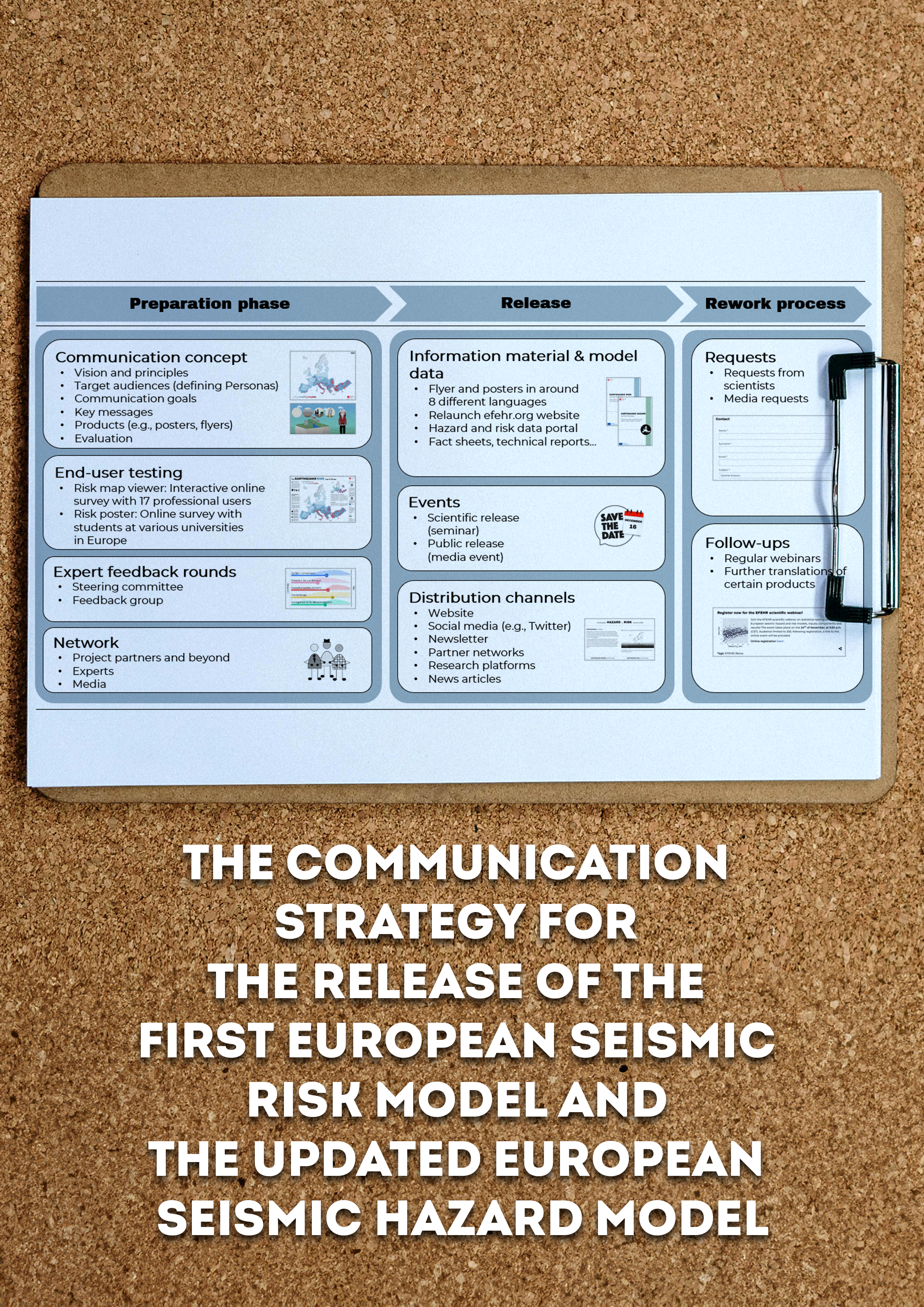
Publications The communication strategy for the release of the first European Seismic Risk Model and the updated European Seismic Hazard Model Share Facebook LinkedIn Download 2024 | Peer-reviewed To design user-centred and scientifically high-quality outreach products to inform about earthquake-related hazards and the associated risk, a close collaboration between the model developers and communication experts is needed. In this contribution, we present the communication strategy developed to support the public release of the first openly available European Seismic Risk Model and the updated European Seismic Hazard Model. The backbone of the strategy was the communication concept in which the overall vision, communication principles, target audiences (including personas), key messages, and products were defined. To fulfil the end-users' needs, we conducted two user testing surveys: one for the interactive risk map viewer and one for the risk poster with a special emphasis on the European earthquake risk map. To further ensure that the outreach products are not only understandable and attractive for different target groups but also adequate from a scientific point of view, a two-fold feedback mechanism involving experts in the field was implemented. Through a close collaboration with a network of communication specialists from other institutions supporting the release, additional feedback and exchange of knowledge was enabled. Our insights, gained as part of the release process, can support others in developing user-centred products reviewed by experts in the field to inform about hazard and risk models.
- Guía para profesores para el desarrollo de un curso introductorio de riesgo sísmico | GEM Foundation
Publications Guía para profesores para el desarrollo de un curso introductorio de riesgo sísmico Share Facebook LinkedIn Download 2022 | User manual Reporte sobre la guía para profesores para el desarrollo de un curso introductorio de riesgo sísmico.