Thanks for submitting!
You will be contacted as soon as possible


QUICK LINKS


PROFILES
PUBLICATIONS
EXPOSURE
VULNERABILTY
SOFTWARE
EQ MODELS
Search Results
Search this site
1170 results found with an empty search
- Data Interchange Formats for the Global Earthquake Model (GEM) | GEM Foundation
Publications Data Interchange Formats for the Global Earthquake Model (GEM) Share Facebook LinkedIn Download 2010 | Report Sixteen draft data interchange formats and 7 terminology standards (collectively referred to here as DIFs) are proposed here for use in GEM1. This initial draft includes several DIFs for hazard output (to be used as input to risk analyses), exposure (i.e., values exposed to seismic risk), vulnerability, and fragility. Samples are provided of each DIF, and in each case, each parameter is explained, assigned a variable type (e.g., integer, text string, double-precision floating point, etc.) and any constraints are specified (e.g., probabilities between 0 and 1). The proposed data standards in this draft draw primarily on OpenSHA, OpenRisk, PAGER, and to a limited extent HAZUS-MH, EMS-98, and the World Housing Encyclopedia. The DIFs presented in this draft are entirely human-readable, plain-text flat files (commas-and-quotes); no attempt has been made yet to define XML formats. The emphasis in these DIFs is on simplicity and universality over storage efficiency. It is not intended that these DIFs represent a complete or exhaustive set of what GEM1 will require. Later drafts may add XML format and DIFs for other I/O needs. GEM1 participants are encouraged to contact the authors to recommend additions, modifications, and clarification.
- Global Seismic Risk Map | GEM Foundation
License Request Form You have chosen to get more information about: Global Seismic Risk Map Risk Please check the link below to see if this product already meets your your requirements before submitting your request for a license. Thank you. DOWNLOAD THE OPEN VERSION Summary of steps to obtain a license for the requested product. Fill in the application form below. Click Submit. Please check your email Inbox or Spam folder for the summary of your request. You will then be contacted by the GEM Product Manager with either a request for more information, or a request to sign the license. If you do not hear from us within 2 weeks, please send an email to product@globalquakemodel.org . REQUEST DETAILS A. Requesting party information First Name Last Name Role/Job Email Business type Business type Other business Sector Sector Other sector B. License agreement signatory information The signatory must be someone who is authorised to sign license agreements on your behalf such as your immediate supervisor, manager or legal officer. If you’re a PhD student, the signatory must be your adviser or a university officer in charge of license agreements or similar legal documents. Full Name of Signatory Position Company Email of Signatory Organisation name Complete Address C. Purpose of request GEM is able to offer products for free because of the support of our project partners, national collaborators and institutional sponsors. All of GEM’s products are freely available for public good, non-commercial use, but with different license restrictions. In most cases we release products under an open license (e.g., CC BY-SA or CC BY-NC-SA), which permits (re)distribution. In this case, we are granting access under a more restricted license that forbids distribution or disclosure and requires signing by GEM and the licensee in order to better assure accountability for the confidentiality of the information. In order for GEM to properly assess your request, please answer the following questions below. 1. Explain briefly how will the GEM product be used e.g. project, research including the expected results and the foreseen public benefit. Minimum 60 words. 2. Will you be able to share the results of your work with GEM? YES NO 3. Will you be able to provide feedback to GEM on the quality and usefulness of this product via a survey? YES NO D. Privacy Policy By submitting this form, you consent to the processing of your personal data in accordance with our Privacy Policy and the EU General Data Protection Regulation (GDPR). We are committed to safeguarding your information and ensuring it is only used for the purpose outlined in this form. You have the right to access, rectify, or delete your data at any time. For more information, please refer to our Privacy Policy. I agree Words: 0 Email us at product@globalquakemodel.org if you're experiencing problems submitting your application. Thank you. Submit Thanks for submitting! You will be contacted as soon as possible Incomplete data. Please fill in all required fields. Thank you.
- Modelo Probabilístico de Amenaza Sísmica para la República Dominicana | GEM Foundation
Publications Modelo Probabilístico de Amenaza Sísmica para la República Dominicana Share Facebook LinkedIn Download 2022 | Report Descripción del modelo probabilístico de amenaza sísmica desarrollado para La República Dominicana
- GEM-USAID Vulnerability Workshop - GEM Foundation
News GEM-USAID Vulnerability Workshop By: Jul 2, 2018 Share Facebook LinkedIn The Global Earthquake Model Foundation (GEM) in cooperation with the United States Agency for International Development (USAID), successfully conducted a 2-day Vulnerability and Loss Estimation Workshop in Pavia, Italy from 3-4 April 2017. The objective of the workshop was to discuss various issues in vulnerability analysis to reduce scientific uncertainties and bias in the different approaches for fragility derivation, as well exchange ideas on how these results could be validated and verified. The workshop hopes that the discussions around these issues will also contribute to Sendai’s first priority action: understanding disaster risks. More than 60 participants attended the first day which included presentations by several international experts such as Jack Baker of Stanford University, USA who presented on the trade-offs in regional versus site-specific ground motion selection for vulnerability assessment, Sinan Akkar from Bogazici University, Turkey on ideas and challenges in ground motion selection; and Kyriazis Pitilakis of Aristotle University of Thessaloniki, Greece on Vulnerability assessment of buildings exposed to seismically induced slope displacements. In addition, about 30 participants from around the world joined day 1 of the workshop remotely, which was streamed over the Internet. On the second day, group discussions focused on the limitations, challenges, and future directions for loss estimation and vulnerability modeling. Key recommendations from the workshop are still being finalized and will be shared to the public through GEM’s website once completed. No images found. GALLERY 1/0 VIDEO RELATED CONTENTS
- Request demo for Global Vulnerability Model | GEM Foundation
You have chosen to request a demo on: Global Vulnerability Model First Name Last Name Email Company or Institution Name Country Sector Provide Details I accept the license terms and the conditions of products use. Email us at product@globalquakemodel.org if you're experiencing problems submitting this form or if you have any inquiries. Thank you. Request Thanks for submitting! You will be contacted as soon as possible Add answer here
- Seismic Risk Assessment | GEM Foundation
Back to Bangladesh Outcomes Bangladesh Seismic Risk Assessment The project estimated seismic risk metrics utilising the OpenQuake-engine's stochastic event-based risk assessment calculator. A probabilistic seismic hazard analysis model was employed to generate earthquake rupture forecasts, forming a stochastic event set over a 100,000-year span. Economic and human losses were computed for each event, producing event loss tables and year loss tables. Risk metrics included exceedance probability curves and average annualized losses. Fatality and injury estimates relied on vulnerability models informed by global earthquake data, with a focus on South Asian building characteristics. Results were tabulated nationally and regionally by the project. The assessment also considers the exposure and risk of healthcare facilities, educational facilities, and the national road network to seismic hazards. Maps set 1 | Maps set 2 | Profile Data Download Risk OpenQuake Data job_risk_250ky.ini job_ses_10ky.ini job_ses_1ky.ini summary_risk.xlsx ebr-250ky/ aggcurves-NAME_1_99956600.csv aggcurves-_99956600.csv aggrisk-NAME_1_99956600.csv aggrisk-_99956600.csv avg_losses-Zila_99956600.csv avg_losses-rlz-000_99956600.csv events_99956600.csv realizations_99956600.csv report_99956600.rst risk_by_event_99956600.csv ebr-upazila-250ky/ aggcurves-NAME_1_99956602.csv aggcurves-_99956602.csv aggrisk-NAME_1_99956602.csv aggrisk-_99956602.csv realizations_99956602.csv report_99956602.rst
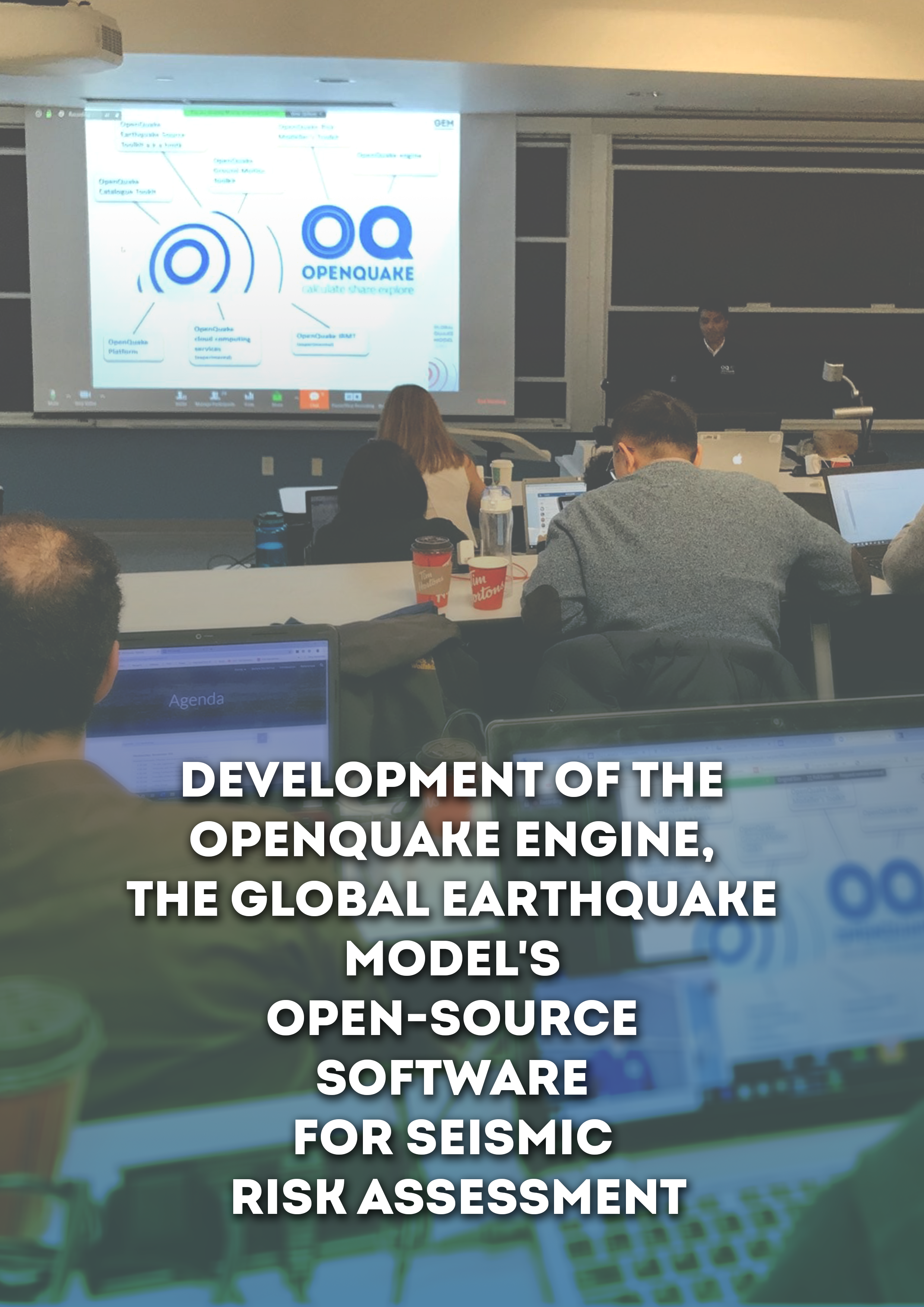
- Development of the OpenQuake engine, the Global Earthquake Model's open-source software for seismic risk assessment | GEM Foundation
Publications Development of the OpenQuake engine, the Global Earthquake Model's open-source software for seismic risk assessment Share Facebook LinkedIn Download 2013 | Peer-reviewed The Global Earthquake Model aims to combine the main features of state-of-the-art science, global collaboration and buy-in, transparency and openness in an initiative to calculate and communicate earthquake risk worldwide. One of the first steps towards this objective has been the open-source development and release of software for seismic hazard and risk assessment called the OpenQuake engine. This software comprises a set of calculators capable of computing human or economic losses for a collection of assets, caused by a given scenario event, or by considering the probability of all possible events that might happen within a region within a certain time span. This paper provides an insight into the current status of the development of this tool and presents a comprehensive description of each calculator, with example results.
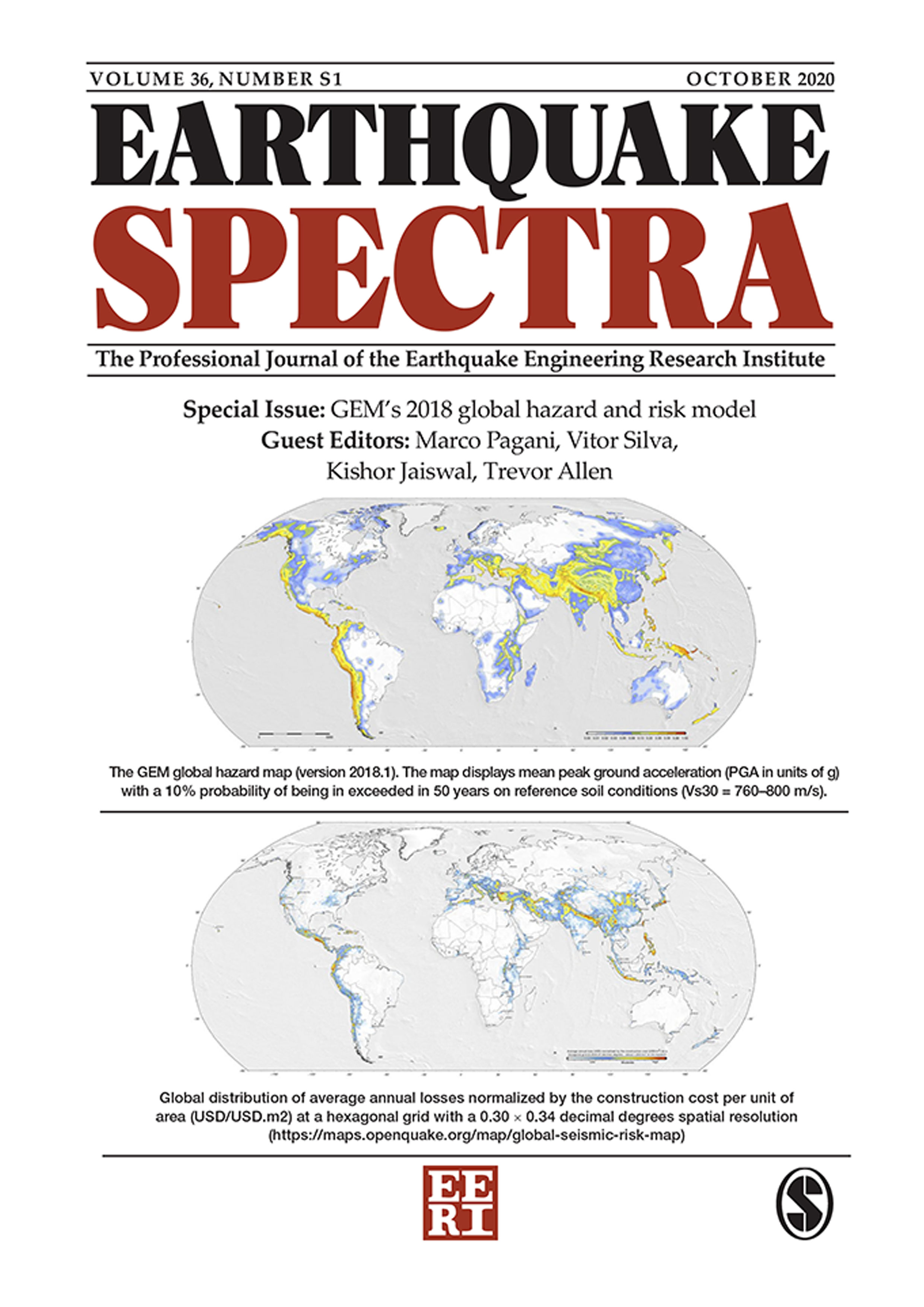
- GEM's 2018 global hazard and risk models | GEM Foundation
Publications GEM's 2018 global hazard and risk models Share Facebook LinkedIn Download 2020 | Peer-reviewed This special issue of Earthquake Spectra documents the supporting research critical to the development of the Global Seismic Hazard and Risk models by the GEM (Global Earthquake Model) Foundation, representing a major step in understanding earthquake risk globally. Seismic hazard and risk models are needed for accurate assessment of risks in order to promote risk reduction and mitigating actions, such as the improvement of building codes and construction practices, sustainable land use, emergency response, and protection of critical infrastructures, as well as risk transfer through insurance. GEM’s Global Seismic Hazard Model comprises a mosaic of 30 probabilistic seismic hazard models. Using this collection of hazard models as input, GEM computed a Global Seismic Risk Model depicting the average Annual Economic Losses (AEL) caused by ground shaking on the residential, commercial, and industrial building stock. Additional results were successively compiled including global maps for different intensity measure types, soil conditions and return periods. This collection of papers is intended for scientists and researchers in the hazard and risk modeling sector, and risk professionals for application to disaster risk reduction around the globe. This issue is made possible with partial support by the Global Earthquake Model (GEM) Foundation. Founded in Pavia, Italy in 2009, GEM is a non-profit public-private partnership that drives global collaborative efforts to develop scientific and high-quality resources for transparent assessment of earthquake risk and to facilitate their application for risk management around the globe. Learn more at www.globalquakemodel.org.
- European Seismic Risk Model 2020: Focus on Croatia | GEM Foundation
Publications European Seismic Risk Model 2020: Focus on Croatia Share Facebook LinkedIn Download 2020 | Report This paper summarises the development of the European seismic risk model that is being undertaken within the Horizon 2020 SERA project in collaboration with the Global Earthquake Model (GEM) Foundation. The main innovation of the current effort with respect to previous initiatives relates to the extension of seismic risk to 46 countries within Europe, the use of a fully probabilistic methodology, the consideration of socio-economic aspects, and the involvement of the local scientific community in the development of the models. Some specific details of the European risk model for Croatia are also presented, together with some preliminary results.
- Strengthening Global Earthquake Resilience: GEM’s Role at 3CroCEE 2025 - GEM Foundation
News Strengthening Global Earthquake Resilience: GEM’s Role at 3CroCEE 2025 By: Apr 5, 2025 Mar 31, 2025 Share Facebook LinkedIn The Third Croatian Conference on Earthquake Engineering (3CroCEE) recently concluded in Split, Croatia, reaffirming the importance of international collaboration in advancing seismic risk reduction. This year’s event brought together a community of researchers, engineers, and policymakers from the Balkans and beyond - both as keynote speakers and participants - to address challenges in seismic hazard assessment and promote strategies for protecting vulnerable and culturally significant areas such as Split. As a platform dedicated to seismic risk awareness, 3CroCEE played a vital role in encouraging dialogue on integrating research findings into practical measures. The conference highlighted the need for risk-informed planning and innovative engineering solutions, particularly in regions prone to seismic activity. GEM’s participation at 3CroCEE reflected its commitment to advancing earthquake resilience through collaboration and knowledge sharing. Helen Crowley, GEM Secretary General, delivered a keynote lecture titled “Why Seismic Hazard Modelling Has Become a Risky Business.” In her presentation, Crowley explored the evolving challenges in updates to seismic hazard models and their implications for risk reduction efforts. The conference also featured a dynamic session led by Vitor Silva, GEM Head of Risk Engineering, who co-chaired the “Risk Uncertainty Brawl” with Paolo Bazzurro and Dimitrios Vamvatsikos. This interactive session included a debate between the three experts regarding the main driver of uncertainty in risk. The session’s engaging format encouraged participants to critically examine the assumptions behind risk models, provoking a deeper understanding of their application in real-world scenarios. In the end, future directions and new developments in seismic risk modelling were also presented. Helen Crowley’s keynote and Vitor Silva’s session demonstrated GEM’s proactive approach to addressing the evolving nature of seismic risk assessment. Their participation not only contributed to the technical discourse but also reinforced the value of global cooperation in enhancing earthquake resilience. GEM’s involvement at 3CroCEE underscores the foundation’s ongoing dedication to improving earthquake risk understanding and promoting resilient practices worldwide. No images found. GALLERY 1/7 VIDEO RELATED CONTENTS