Thanks for submitting!
You will be contacted as soon as possible


OVERVIEW
This course, part of the Doctoral Programme in Earthquake Engineering at IUSS Pavia, is organised by the Global Earthquake Model (GEM) Foundation, and aims to provide a comprehensive overview of state-of-the-art methods and models for seismic hazard, exposure, vulnerability and risk assessment, and their implementation within the OpenQuake Engine under a number of different use cases. The course will include both theoretical lectures and training sessions on how to use the OpenQuake Engine, from basic scenario analysis to advanced modelling of probabilistic seismic hazard and risk.
Speakers & Panelists
Session Title

Hugo Rodrigues
University of Aveiro
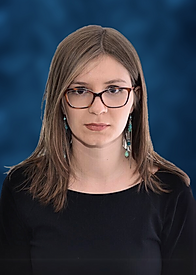
Lana Todorovic
GEM

Daniel Emilio
University of Aveiro

Christopher Brooks
GEM

Catalina Yepes
GEM

Karim Aljawhari
GEM

Catarina Costa
GEM

Finn Løvholt
Norwegian Geotechnical Institute
More invited speakers coming soon!
AGENDA
Session Title
Collapsible text is great for longer section titles and descriptions. It gives people access to all the info they need, while keeping your layout clean. Link your text to anything, or set your text box to expand on click. Write your text here...
Auditorium
Time | Title | Speaker | Organisation |
|---|---|---|---|
Global Ground Motion Flatfile | Christopher Brooks | GEM Foundation | |
13:00 - 14:30 | Lunch | ||
14:30 - 14:50 | GEM's New Vulnerability Modelling Framework | Al Mouayed Bellah Nafeh | GEM Foundation |
15:20- 15:50 | Future Exposure/Risk to 2065 | Alejandro Calderon | GEM Foundation |
14:50- 15:10 | Global Exposure of Infrastructure to Liquefaction | Catarina Costa | GEM Foundation |
15:10 - 15:20 | Global Carbon Cost of Earthquakes | Martina Caruso | GEM Foundation |
15:50 - 16:20 | Coffee break + GEM demos + GEM PhD posters | ||
16:20 - 16:50 | Keynote: Advancing Seismic Risk Assessment in El Salvador using GEM Tools Moderator: Lindsay Davis, USGS | Luis Mixco | MARN, El Salvador |
16:50 - 17:30 | Ignite Session for Live Demos Moderator: Iain Stewart, University of Plymouth | ||
Luis Mixco | MARN-El Salvador | ||
Iwan Stalder | Zurich Insurance | ||
Josip Atalic | University of Zagreb | ||
Marzia Santini | European Commission | ||
Trevor Allen | GA | ||
Carmine Galasso | UCL | ||
Vitor Silva | GEM | ||
Marco Pagani | GEM | ||
Helen Crowley | GEM | ||
Carmine Galasso | UCL | ||
Vitor Silva | GEM | ||
Marco Pagani | GEM | ||
Helen Crowley | GEM | ||
Chung-Han Chan | National Central University | ||
Ana Beatriz Acevedo | EAFIT University, Colombia | ||
Jenty Kirsch-Wood | UNDRR | ||
Kirsty Bayliss | GEM | ||
Iain Stewart | GEM, University of Plymouth | ||
Catalina Yepes-Estrada | GEM | ||
Anirudh Rao | GEM | ||
Karim Aljawhari | GEM | ||
Jamal Dabbeek | GEM, An-Najah University | ||
Karim Aljawhari | |||
Fatemeh Jalayer | |||
Maria Durante | |||
Finn Løvholt
| |||
Romeu Vicente | |||
Vitor Silva | GEM | ||
Christopher Brooks | |||
Daniela Di Bucci | DPC Italy | ||
Jamal Dabbeek | GEM | ||
Catalina Yepes | GEM | ||
Helen Crowley | GEM | ||
Christopher Brooks | GEM | ||
Kirsty Bayliss | GEM | ||
Manuela Villani | GEM | ||
Marco Pagani | GEM | ||
Catalina Yepes Estrada | GEM | ||
Anirudh Rao | GEM | ||
Al Mouayed Bellah Nafeh | GEM | ||
Martina Caruso | GEM | ||
Alejandro Calderón | GEM | ||
Marco Baiguera | GEM | ||
16:45-17:00 | Q&A | Moderator | GEM |
Catarina Costa | |||
Meera Raghunandan | |||
Cláudia Pinto | |||
Al Mouayed Nafeh | |||
Christopher Brooks | |||
Maria Durante | |||
Finn Løvholt
| |||
Stavroula Fotopou | |||
Fatemah Jalayer | |||
Romeu Vicente | |||
Vitor Silva | GEM | ||
PSHA models for the oceans (Pacific Region) | |||
Development of the Pacific Islands (PAC) Model | |||
16:20-16:45 | Expansion plans under the FORCE project covering small island communities | Kirsty Bayliss | GEM |
16:00-16:20 | Overview of GEM's Global Seismic Hazard Mosaic | Kendra Johnson | GEM |
Anil Pokhrel | Chief Executive, National Disaster Risk Reduction & Management Authority, Nepal | ||
Nicolas Pondard | Senior Disaster Risk Management Specialist, The World Bank | ||
Helen Crowley | Secretary General, GEM | ||
Dominik Lang | Director, Natural Hazards Division, NGI, Norway | ||
Shinji Takarada | Chief Senior Researcher, Geological Survey of Japan | ||
Robert Emberson | Associate Program Manager, NASA Earth Applied Sciences Program | ||
Janise Rodgers | COO, Geohazards International | ||
Ramesh Guragain | Deputy Executive Director, National Society for Earthquake Technology (NSET) Nepal | ||
Discussion: Forming a global geohazards risk assessment network (community of practice) | Malaika Ulmi and John Schneider | GSC and GEM | |
Renato Solidum, Jr. | Secretary, Department of Science & Technology-Philippines | ||
Lindsay Davis | Manager, Global Portfolio-Earthquake Hazard & Risk, USAID/USGS | ||
Christina Magill | Natural Hazard Risk Scientist, GNS Science, NZ | ||
Anselmo Pedrazzi | Executive Coordinator, Applied Geology Division, (LAMESO-SGB), Brazil | ||
Celestin Mahinda | Scientific Director, Research Center of Natural Sciences, Democratic Republic of Congo | ||
Teresito Bacolcol | Director, Phivolcs, Philippines | ||
Mabelline Cahulogan | Supervising Science Research Specialist, -Phivolcs, Philippines | ||
Asaka Iwaki | Chief Researcher, National Research Institute for Earth Science and Disaster Resilience (NIED), Japan | ||
Hendriyawan Djazilus | Head, Ocean Engineering Program, ITB-Indonesia | ||
Takeshi Sato | Senior Engineer, Earthquake and Tsunami Div, Japan Meteorological Agency | ||
Panel 2: Existing Global Networks | John Schneider | Senior Advisor, GEM | |
Malaika Ulmi | Nat. Hazards & Climate Change Geoscience Program Manager, Geo Survey of Canada | ||
Judith Giblin | Ocean & Coastal Risk Data Analyst, South Pacific (SPC) | ||
Panel 1: Assessing National Capability | John Schneider and Malaika Ulmi | GEM and GSC | |
Gill Jolly | Chief Science Advisor, MBIE, GNS Science, NZ | ||
Malaika Ulmi | Nat. Hazards & Climate Change Geoscience Program Manager, Geo Survey of Canada | ||
Nicolas Pondard | Senior Disaster Risk Management Specialist, The World Bank | ||
Renato Solidum, Jr. | Secretary, Department of Science & Technology-Philippines | ||
Anil Pokharel | Chief Executive, National Disaster Risk Reduction & Management Authority (NSET), Nepal | ||
Shunichi Koshimura | Deputy Director, IRIDes-Tohoku University | ||
Shubharoop Ghosh | Vice President, ImageCat, Inc. | ||
Laurie Johnson | CEO, Laurie Johnson Consulting | ||
Helen Crowley | Secretary General, GEM |
Daily Oral Presentations Schedule
Daily Posters and Demos Schedule
POSTERS & DEMOS
Showcasing GEM Integration, Innovative Tools, and Advanced Data for Enhanced Hazard and Risk Assessment
Agenda
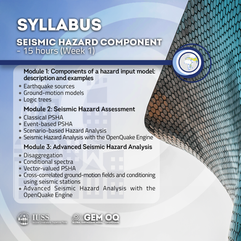
Seismic Hazard Component - 15 hours (Week 1)
Module 1: Components of a hazard input model: description and examples
Earthquake sources
Ground-motion models
Logic trees
Module 2: Seismic Hazard Assessment
Classical PSHA
Event-based PSHA
Scenario-based Hazard Analysis
Seismic Hazard Analysis with the OpenQuake Engine
Module 3: Advanced Seismic Hazard Analysis
Disaggregation
Conditional spectra
Vector-valued PSHA
Cross-correlated ground-motion fields and conditioning using seismic stations
Advanced Seismic Hazard Analysis with the OpenQuake Engine
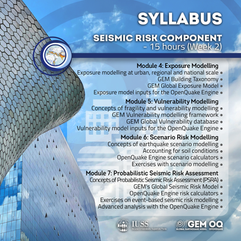
Seismic Risk Component - 15 hours (Week 2)
Module 4: Exposure Modelling
Exposure modelling at urban, regional and national scale
GEM Building Taxonomy
GEM Global Exposure Model
Exposure model inputs for the OpenQuake Engine
Module 5: Vulnerability Modelling
Concepts of fragility and vulnerability modelling
GEM Vulnerability modelling framework
GEM Global Vulnerability database
Vulnerability model inputs for the OpenQuake Engine
Module 6: Scenario Risk Modelling
Concepts of earthquake scenario modelling
Accounting for soil conditions
OpenQuake Engine scenario calculators
Exercises with scenario modelling
Module 7: Probabilistic Seismic Risk Assessment
Concepts of Probabilistic Seismic Risk Assessment (PSRA)
GEM’s Global Seismic Risk Model
OpenQuake Engine risk calculators
Exercises on event-based seismic risk modelling
Advanced analysis with the OpenQuake Engine






LOCATION
HOTEL
TRANSPORTATION
RESOURCES
Videos
Gallery
Recording
Videos

Gallery


Recording