Thanks for submitting!
You will be contacted as soon as possible


QUICK LINKS


PROFILES
PUBLICATIONS
EXPOSURE
VULNERABILTY
SOFTWARE
EQ MODELS
Search Results
Search this site
1172 results found with an empty search
- Arabia Hazard | Global EarthQuake Model Foundation
OpenQuake engine input model to perform hazard calculations for the Arabian Peninsula Products Arabia Hazard OpenQuake engine input model to perform hazard calculations for the Arabian Peninsula Share Facebook LinkedIn Description The 2018.0.0 seismic hazard model was developed by the Saudi Geological Survey (SGS) (Sokolov et al, 2017). The model covers Saudi Arabia, Yemen, Oman, and Qatar. Since the original version, three updates were made to the model by the GEM hazard team, leading to the latest release (v2018.3.0) which includes sources from the latest Middle East v2026.0.0 model. How to cite this work V. Sokolov et al., “Probabilistic seismic hazard assessment for Saudi Arabia using spatially smoothed seismicity and analysis of hazard uncertainty,” Bull Earthquake Eng, vol. 15, no. 7, pp. 2695–2735, Jul. 2017. H. M. Zahran et al., “Preliminary probabilistic seismic hazard assessment for the Kingdom of Saudi Arabia based on combined areal source model: Monte Carlo approach and sensitivity analyses,” Soil Dynamics and Earthquake Engineering, vol. 77, pp. 453–468, Oct. 2015. H. M. Zahran et al., “On the development of a seismic source zonation model for seismic hazard assessment in western Saudi Arabia,” J Seismol, vol. 20, no. 3, pp. 747–769, Jul. 2016. Available Versions The latest version (v2018.3.0) is available for direct download under a CC BY-NC-SA 4.0 license. Users interested in this version can click the "Open Version Download" button in the right panel to access the information. If your use case does not comply with the license terms, a license can be requested by clicking on the "License Request", where a specific agreement will be provided, depending on the use case License information The open version is available under a Creative Commons CC BY-NC-SA 4.0 license, which requires: Attribution (you must give appropriate credit, provide a link to the license, and indicate if changes were made) Non-commercial (you may not use the material for commercial purposes) ShareAlike (derivatives created must be made available under the same license as the original) Any deviation from these terms incur in license infringement. For commercial use of the model, a specific license agreement must be made tailored to your use case, in such instance please click on "License Request". Facebook LinkedIn Share Latest Version v2018.3.0 License CC BY-NC-SA 4.0 Available resources Open Version Download Documentation License Request text Map View Search Popup title Close Country/Region Available Resources Afghanistan Exposure Africa Exposure Alaska Exposure Country/Region Available Resources Afghanistan Vulnerability Africa Vulnerability Alaska Vulnerability Country/Region Resource Url Afghanistan Risk Profile Africa Risk Profile Alaska Risk Profile Search Found Country/Region Resource Url Afghanistan Exposure Africa Exposure Alaska Exposure Preview Preview is not available. Search Found Country/Region Resource Url Afghanistan Vulnerability Africa Vulnerability Alaska Vulnerability Preview Preview is not available. Search Found Country/Region Resource Url Afghanistan Risk Profile Africa Risk Profile Alaska Risk Profile Preview Preview is not available. Related products Global Liquefaction Hazard Global Exposure Model Global Vulnerability Model Global Seismic Embodied Carbon Risk Global Seismic Risk Map Country-Territory Seismic Risk Profiles Model Builder's Toolkit (oq-mbtk) Global Seismic Hazard Map Related publications For downloading or accessing detailed product information like PNG/PDF maps, datasets, license request, shapefiles and more, please switch to a desktop or laptop computer. Thank you for your understanding.
- Calibrating collapse and fatality rates for the assessment of fatalities due to earthquakes | GEM Foundation
Publications Calibrating collapse and fatality rates for the assessment of fatalities due to earthquakes Share Facebook LinkedIn Download 2025 | Peer-reviewed In recent decades, hundreds of studies have covered seismic vulnerability assessment and the derivation of fragility models. However, these studies primarily focus on structural damage and the associated repair costs. Assessing fatalities requires an evaluation of the proportion of damaged buildings that suffer partial or total collapse, as well as the expected fatality rates for occupants inside those collapsed buildings. To support these modeling needs, we reviewed past studies on casualties, existing proposals for collapse and fatality rates, and detailed damage databases that characterize different collapse mechanisms. Based on this review, collapse and fatality rates are proposed relative to a baseline building class. These rates are further calibrated considering reported fatalities since 1950 and the average annual fatalities estimated by the Global Seismic Risk Model of the Global Earthquake Model (GEM) Foundation. Results show that the probability of collapse tends to decrease with the number of stories, while fatality rates have the opposite trend. Furthermore, an open-access database of calibrated collapse and fatality rates is provided and can be used to assess fatalities due to earthquake scenarios or in probabilistic seismic risk analysis.
- OQ Engine certified user Bogdan Gheorghe | GEM Foundation
OpenQuake Engine certified user page This is to certify that Bogdan Gheorghe has successfully completed the requirements to become a Certified OpenQuake Engine User for Scenario Assessment demonstrating the required knowledge and skills as assessed by the Global Earthquake Model (GEM) Foundation. GEM Foundation Secretary General Helen Crowley (signed) Date of Completion: Valid until: September 11, 2026 September 11, 2029
- OQ Engine certified user Lisselyn Cordova Arias | GEM Foundation
OpenQuake Engine certified user page This is to certify that Lisselyn Cordova Arias has successfully completed the requirements to become a Certified OpenQuake Engine User for Scenario Assessment demonstrating the required knowledge and skills as assessed by the Global Earthquake Model (GEM) Foundation. GEM Foundation Secretary General Helen Crowley (signed) Date of Completion: Valid until: September 11, 2026 September 11, 2029
- The Global Earthquake Model Physical Vulnerability Database | GEM Foundation
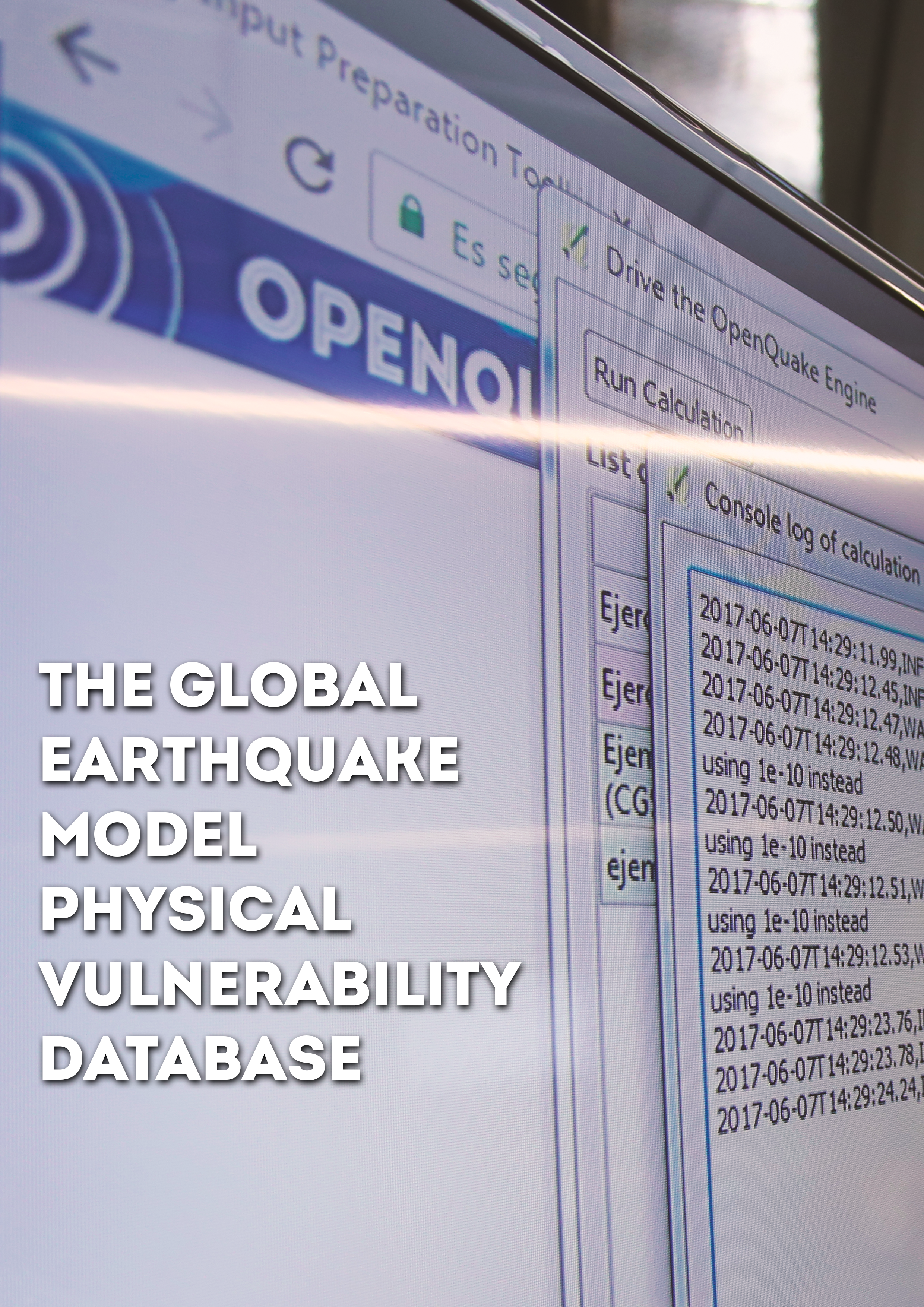
Publications The Global Earthquake Model Physical Vulnerability Database Share Facebook LinkedIn Download 2016 | Peer-reviewed There are almost 50 years of research on fragility and vulnerability assessment, both key elements in seismic risk or loss estimation. This paper presents the online database of physical vulnerability models that has been created as part of the Global Earthquake Model (GEM) initiative. The database comprises fragility and vulnerability curves, damage-to-loss models, and capacity curves for various types of structures. The attributes that have been selected to characterize each function, the constraints of setting up a usable database, the challenges in collecting these models, and the current trends in the development of vulnerability models are discussed in this study. The current collection of models leverages upon the outputs of several initiatives, such as GEM's Global Vulnerability Consortium and the European Syner-G project. This database is publicly available through the web-based GEM OpenQuake-platform http://doi.org/10.13117/GEM.DATASET.VULN.WEB-V1.0.
- GEM and its partners complete GFDRR’s Challenge Funds Global Exposure Database for Multi-hazard Risk Analysis (GED4ALL) - GEM Foundation
News GEM and its partners complete GFDRR’s Challenge Funds Global Exposure Database for Multi-hazard Risk Analysis (GED4ALL) By: May 28, 2018 Share Facebook LinkedIn A consortium led by the GEM Foundation with partners ImageCat Inc. and the Humanitarian OpenStreetMap Team completed recently an open exposure database for multi-hazard risk assessment, as part of the Challenge Funds portfolio, managed by the GFDRR, and funded by the Department for International Development (DFID) of the United Kingdom. The main objective of Challenge Fund Global Exposure Database for Multi-hazard Risk Analysis is the development of an open exposure database, for the purposes of performing multi-hazard risk analyses. The database is capable of storing different assets (building stock, lifelines, crops, socio-economic data) across six natural hazards: earthquakes, floods, volcanoes, strong winds, tsunamis and drought. The database has been successfully piloted in Tanzania for the development of an exposure model at the national scale, and to the city of Dar Es Salaam demonstrating how an exposure dataset at a building-by-building resolution can be created. The process has also been demonstrated for five countries around Tanzania (Ethiopia, Uganda, Kenya, Malawi and Mozambique) as well as Cape Verde, Senegal, Mali, Niger and in other countries outside of the African continent. The outputs include a detailed description of the structure of the tables comprising the GED4ALL exposure database schema and the relationships between them, a description of the software components required for installation and basic operation of the database and the associated tools for converting, importing and exporting data. Paul Henshaw, GEM Director of Technology and Development also notes that “The project is a major step forward in defining a global multi-hazard database for use in assessing risks due to natural hazards. The approach also demonstrates how the combination of international expertise, open standards, local knowledge, inclusiveness and collaborative approach can encourage risk awareness and mitigation.” Paul also presented the final outputs of Global Facility for Disaster Recovery and Reduction (GFDRR) Challenge Fund 2: Global Exposure Database for Multi-hazard Risk Analysis (GED4ALL) during the projects closing workshop held in Dar Es Salaam, Tanzania from 22-24 March. The British Geological Survey (BGS) and University College London (UCL) presented the results of Challenge Fund 1 (multi-hazard database) and 3 (vulnerability database) respectively. More than 30 individuals participated from various organizations such as Geological Survey of Tanzania, Ardhi University (Tanzania), Dar Es Salaam University (Tanzania), DFID Tanzania, Prime Minister's Office - Disaster Management Department (Tanzania), DoMA (Malawi), INGC (Mozambique), Ministry of Energy & Mineral Development (Uganda), ImageCat (USA), Humanitarian OpenStreetMap Team (HOT Indonesia), NSET (Nepal), GFDRR (USA), DFID UK, IDF (Switzerland), BGS (UK), UA (Netherlands), NGI (Norway), NOC (UK), CIMA (Italy) and UCL-EPI (UK). No images found. GALLERY 1/0 VIDEO RELATED CONTENTS
- Global Liquefaction Hazard | GEM Foundation
License Request Form You have chosen to get more information about: Global Liquefaction Hazard Hazard Please check the link below to see if this product already meets your your requirements before submitting your request for a license. Thank you. DOWNLOAD THE OPEN VERSION Summary of steps to obtain a license for the requested product. Fill in the application form below. Click Submit. Please check your email Inbox or Spam folder for the summary of your request. You will then be contacted by the GEM Product Manager with either a request for more information, or a request to sign the license. If you do not hear from us within 2 weeks, please send an email to product@globalquakemodel.org . REQUEST DETAILS A. Requesting party information First Name Last Name Role/Job Email Business type Business type Other business Sector Sector Other sector B. License agreement signatory information The signatory must be someone who is authorised to sign license agreements on your behalf such as your immediate supervisor, manager or legal officer. If you’re a PhD student, the signatory must be your adviser or a university officer in charge of license agreements or similar legal documents. Full Name of Signatory Position Company Email of Signatory Organisation name Complete Address C. Purpose of request GEM is able to offer products for free because of the support of our project partners, national collaborators and institutional sponsors. All of GEM’s products are freely available for public good, non-commercial use, but with different license restrictions. In most cases we release products under an open license (e.g., CC BY-SA or CC BY-NC-SA), which permits (re)distribution. In this case, we are granting access under a more restricted license that forbids distribution or disclosure and requires signing by GEM and the licensee in order to better assure accountability for the confidentiality of the information. In order for GEM to properly assess your request, please answer the following questions below. 1. Explain briefly how will the GEM product be used e.g. project, research including the expected results and the foreseen public benefit. Minimum 60 words. 2. Will you be able to share the results of your work with GEM? YES NO 3. Will you be able to provide feedback to GEM on the quality and usefulness of this product via a survey? YES NO D. Privacy Policy By submitting this form, you consent to the processing of your personal data in accordance with our Privacy Policy and the EU General Data Protection Regulation (GDPR). We are committed to safeguarding your information and ensuring it is only used for the purpose outlined in this form. You have the right to access, rectify, or delete your data at any time. For more information, please refer to our Privacy Policy. I agree Words: 0 Email us at product@globalquakemodel.org if you're experiencing problems submitting your application. Thank you. Submit Thanks for submitting! You will be contacted as soon as possible Incomplete data. Please fill in all required fields. Thank you.
- Japan Hazard | Global EarthQuake Model Foundation
OpenQuake engine input model to perform hazard calculations for Japan Products Japan Hazard OpenQuake engine input model to perform hazard calculations for Japan Share Facebook LinkedIn Description The v2021 model for Japan was based on the 2014 seismic hazard model issued by the Headquarters for Earthquake Research Promotion (HERP). The model is described by Fujiwara et al. (2009), Fujiwara et al. (2015), and Fujiwara et al. (2023). The v2025 model has been developed by the National Research Institute for Earth Science and Disaster Resilience (NIED) and will be publicly released at the end of 2025. The models have been translated from its original format into the OpenQuake (OQ) engine within a collaboration between the National Research Institute for Earth Science and Disaster Resilience (NIED) of Japan, and GEM. How to cite this work The v2025.0.0 model, by N. Morikawa and A.Iwaki, has not yet been published. The v2021 version of the model can be cited as follows: Fujiwara, H., Kawai, S., Aoi, S., Morikawa, N., Senna, S., Kudo, N., Ooi, M., Hao, K. X., Wakamatsu, K., Ishikawa, Y., Okumura, T., Ishii, T., Matsushima, S., Hayakawa, Y., Toyama, N. and Narita, A. (2009). Technical reports on national seismic hazard maps for Japan, Technical Note of the National Research Institute for Earth Science and Disaster Resilience, No. 336, 512 pp. Fujiwara, H., Morikawa, N., Kawai, S., Aoi, S., Senna, S., Maeda, T., Azuma, H., Hao, K. X., Iwaki, A., Wakamatsu, K., Imoto, M., Hasegawa, N., Okumura, T., Hayakawa, T., Takahashi, M. (2015). Improved seismic hazard assessment after the 2011 great East Japan earthquake,” Technical Note of the National Research Institute for Earth Science and Disaster Resilience, No. 399 Fujiwara, H., Morikawa, N., Maeda, T., Iwaki, A., Senna, S., Kawai, S., Azuma, H., Hao, X., Imoto, M., Wakamatsu, K., Miyakoshi, J., Morii, T., Shimazu, N., Takahashi, M. and Akatsuka, M. (2023). Improved seismic hazard assessment after the 2011 great East Japan earthquake (Part 2). Technical Note of the National Research Institute for Earth Science and Disaster Resilience, No. 489 Available Versions The latest available version (v2021.0.0) translated from its original format into the OpenQuake engine by NIED and GEM can be requested by clicking on the "License Request", where a specific license will be provided, depending on the use case. Instead, the v2025.0.0 model can be requested from NIED (http://www.j- shis.bosai.go.jp/en) License information Currently, only the v2021 model is available under a restricted license that has to be tailored for each specific use case. Please click on "License Request". Those that are interested in the v2025.0.0 model should contact NIED. Facebook LinkedIn Share Latest Version v2025.0.0 License Custom license Available resources Documentation License Request text Map View Search Popup title Close Country/Region Available Resources Afghanistan Exposure Africa Exposure Alaska Exposure Country/Region Available Resources Afghanistan Vulnerability Africa Vulnerability Alaska Vulnerability Country/Region Resource Url Afghanistan Risk Profile Africa Risk Profile Alaska Risk Profile Search Found Country/Region Resource Url Afghanistan Exposure Africa Exposure Alaska Exposure Preview Preview is not available. Search Found Country/Region Resource Url Afghanistan Vulnerability Africa Vulnerability Alaska Vulnerability Preview Preview is not available. Search Found Country/Region Resource Url Afghanistan Risk Profile Africa Risk Profile Alaska Risk Profile Preview Preview is not available. Related products Global Liquefaction Hazard Global Exposure Model Global Vulnerability Model Global Seismic Embodied Carbon Risk Global Seismic Risk Map Country-Territory Seismic Risk Profiles Model Builder's Toolkit (oq-mbtk) Global Seismic Hazard Map Related publications Appraising the PSHA earthquake source models of Japan, New Zealand, and Taiwan Read More For downloading or accessing detailed product information like PNG/PDF maps, datasets, license request, shapefiles and more, please switch to a desktop or laptop computer. Thank you for your understanding.
- GEM | Press Release Embargoed
PRESS RELEASE ----- GEM Conference 2023: A Milestone Event Showcasing Advances in Global Earthquake Hazard and Risk Maps, Models and Databases ----- Bergamo, Italy - June 13, 2023 The Global Earthquake Model (GEM) Foundation, a leading organisation in earthquake hazard and risk modelling and assessment, is set to release its new version of the global earthquake hazard and risk models, maps, and databases. This ground-breaking event will take place as the centrepiece of GEM’s international conference in Bergamo, Italy, on June 13th. Gathering leading researchers and risk management experts, the conference aims to propel the world towards greater earthquake resilience and discuss recent developments in the field. Since GEM released the Global Earthquake Hazard and Risk maps to the public in December 2018 , the data and maps have been recognised as a major milestone in establishing a unified and global understanding of seismic risk. Downloaded thousands of times and embraced by industry experts, these maps have provided valuable insights into earthquake-prone regions worldwide. Building upon this success, GEM continued to develop new products such as Atlas 1.0 , an interactive global seismic hazard map, and comprehensive hazard maps available through GEM and distributor platforms. "We are excited to host this important conference and bring world-leading experts in earthquake hazard and risk research, together with partners across the public and private disaster risk management and risk reduction sectors," said John Schneider, GEM Secretary General. "By sharing our knowledge and expertise, we can work together to reduce the impact of earthquakes and build more resilient communities around the world." What’s new In the forthcoming 2023 version of the global seismic hazard model, GEM has made substantial enhancements. Marco Pagani, the Hazard Team Coordinator, shared, "We have incorporated several new models contributed from our partners including the US, Canada, New Zealand and Japan, and achieved greater homogeneity among independent models. We have also improved the spatial resolution of computed results and added more intensity measure types to the hazard outputs, offering a more comprehensive and detailed assessment." Vitor Silva, the Risk Team Coordinator, highlighted the major updates in the seismic risk model, stating, "Enhancements include major improvements to the global exposure by incorporating new building data due to inflation and population growth, and disaggregating exposure information to a much higher spatial resolution to improve risk estimates, particularly for major urban areas. Building vulnerability estimates have also been updated to reflect local construction practices as well as to incorporate the vulnerability of building contents. Most importantly for humanitarian applications, risk results now include estimates of human mortality, injuries, and displacement." Alongside the global maps update, GEM’s Catalina Yepes, Seismic Risk Engineer will introduce the Earthquake Scenarios Database saying “We have developed a collection of information on the impacts of some of the most important historical earthquakes, including information on the physical and economic impact, as well as records of ground shaking and ground failure. This approach fills an important gap in disaster consequences databases by providing information on hazard and impact that is much needed for verifying models and estimating future event consequences. We are hosted in GitLab, as a free and open resource for global earthquake risk assessment efforts.” What to expect The theme of GEM’s conference “Are we making a difference” provides the platform to showcase these new developments as well as to sample some important applications of GEM’s analysis tools, models and data for risk assessment to inform risk reduction and management decisions. The conference sets off on an impactful note with an introductory session that highlights the invaluable insights gained from the 2023 M7.7 Kahramanmaras-Gaziantep, Turkey Earthquake. This serves as a powerful reminder of the pivotal role of integrating advanced earthquake risk analysis and modeling into comprehensive risk mitigation strategies. The final session will explore the future of earthquake risk assessment science and practice, emphasising innovation and collaboration. Distinguished keynote speakers will share their expertise, including Sinan Akkar, Principal Catastrophe Modeler at Turk Reinsurance Inc., who will discuss lessons from the recent M7.7 Kahramanmaras-Gaziantep earthquake in Turkey. Alanna Simpson, Lead Disaster Risk Management Specialist at the World Bank Group, will present on the landscape of disaster risk reduction initiatives, both past and future. Finally, David Wald, Research Geophysicist at the United States Geological Survey (USGS), will present the case for developing an International Macroseismic Scale. The conference welcomes select attendees in-person by invitation only, while also offering online registration for virtual participation. To join or watch the event online and to learn more about the conference, please visit the official conference web page at: https://www.globalquakemodel.org/gem-conference-2023 For more information or to request an interview with the GEM Secretary General, scientists and earthquake engineers, please contact: Jephraim Oro GEM Communications Email: communication@globalquakemodel.org ###
- 11th National Conference on Earthquake Engineering - GEM Foundation
News 11th National Conference on Earthquake Engineering By: Jul 12, 2018 Share Facebook LinkedIn From June 25 to 29, the 11th National Conference on Earthquake Engineering took place in Los Angeles, California. The theme of this year’s conference was integrating science, engineering, & policy. “11NCEE is the U.S. National Conference on Earthquake Engineering. It is hosted by the Earthquake Engineering Research Institute (EERI) every 4 years in conjunction with federal and local partners. This milestone conference brings together professionals from a broad range of disciplines: architecture, civil and structural engineering, seismology, geology, geophysics, geotechnical engineering, business, public policy, the social sciences, regional planning, emergency response, and regulation.” On June 28, GEM’s Vitor Silva, Seismic Risk Coordinator, was awarded the 2017 Shah Family Innovation Prize by EERI, which “rewards younger professionals and academics for creativity, innovation and entrepreneurial spirit in the field of earthquake risk mitigation and management.” No images found. GALLERY 1/0 VIDEO RELATED CONTENTS