Thanks for submitting!
You will be contacted as soon as possible


QUICK LINKS


PROFILES
PUBLICATIONS
EXPOSURE
VULNERABILTY
SOFTWARE
EQ MODELS
Search Results
Search this site
1172 results found with an empty search
- 28th July 2026 M6.8 Japan
Post Event List PURPOSE The purpose of this page is to provide GEM website visitors, researchers, loss modellers, and emergency and disaster risk reduction professionals with specific downloadable information related to red alert events based on USGS PAGER alerts. GEM promotes the sharing of seismic hazard and risk information with a wide range of stakeholders to enhance understanding of damaging earthquake events. This initiative aims not only to give an overview of the models, data and publications available in areas recently impacted by earthquakes, but also hopes to serve as a resource that can inform future risk reduction strategies. The information provided is intended solely for situational awareness purposes and is not aimed towards driving an official emergency response. Please contact your local authorities for further assistance related to official emergency response services and support. 28th July 2026 M6.8 Japan On 28 July 2026 at 16:27:15 JST (07:27:15 UTC), an earthquake struck Kumamoto Prefecture in southern Japan with a magnitude of Mw 6.8 at a depth of 10 km. The earthquake was caused by strike‑slip faulting. The USGS focal mechanism solution suggests coseismic slip occurred on either on a northwest-trending left‑lateral fault or northeast-trending right‑lateral fault. (source: https://en.wikipedia.org/wiki/2026_Kumamoto_earthquake). USGS PAGER Alert https://earthquake.usgs.gov/earthquakes/eventpage/us6000tgb9/pager Related GEM Products Name Description Global Seismic Hazard Map First seismic hazard map to depict seismic hazard globally, including the oceans East Asia Exposure Repository with the inventory of residential, commercial and industrial buildings in East Asia Active Faults Database A repository with global homogenised characteristics of active faults Japan Hazard OpenQuake engine input model to perform hazard calculations for Japan Global Seismic Risk Map Global earthquake risk, mapped with the latest science No content. Related GEM Publications GEM1 Seismic Risk Report User guide Android mobile tool for field data collection Variable resolution probabilistic modeling of residential exposure and vulnerability for risk applications Earthquake-induced liquefaction and landslides in Cali, Colombia Variable resolution probabilistic modeling of residential exposure and vulnerability for risk applications User guide Android mobile tool for field data collection Earthquake-induced liquefaction and landslides in Cali, Colombia Earthquake-induced liquefaction and landslides in Cali, Colombia User guide Android mobile tool for field data collection Variable resolution probabilistic modeling of residential exposure and vulnerability for risk applications Variable resolution probabilistic modeling of residential exposure and vulnerability for risk applications User guide Android mobile tool for field data collection No content. Other Related Products test test2 test test GEM Vulnerability Model for Colombia GEM's country risk profile for Colombia GEM's Country Risk Profile for Venezuela GEM Vulnerability Model for Venezuela Other Related Publications 1234 aaa aaa 1234 aaa 1234 South America Risk Assessment (SARA) Project DISCLAIMER The information and data provided on this page are for informational purposes only. The Global Earthquake Model (GEM) Foundation makes no warranties, expressed or implied, regarding the accuracy, completeness, or reliability of the data. Users are responsible for their own interpretation and use of the information. GEM shall not be liable for any loss, damage, or injury arising from the use of, or reliance on, the information provided on this page. By downloading or utilising the data, users acknowledge and agree to these terms. The information presented on this page is provided by different organisations and governed by different licenses, please check the individual license before use. CONTACT US
- News Briefs: October - December 2025 - GEM Foundation
News News Briefs: October - December 2025 By: Dec 16, 2025 Dec 18, 2025 Share Facebook LinkedIn The GEM Foundation continues to expand its global outreach through active participation in international conferences, training workshops, and governance meetings. These engagements highlight GEM's ongoing efforts to advance seismic risk reduction, strengthen collaboration with key global partners, and contribute to the development of innovative risk assessment tools. In this section, we bring you the latest updates from GEM’s involvement in these various events. GEM joins Overture Maps Foundation The Global Earthquake Model (GEM) Foundation became a contributing member of the Overture Maps Foundation on 7 November 2025, following the acceptance of its application. Overture Maps Foundation is a collaborative initiative that brings together organisations to develop and maintain open, interoperable global map datasets, including building and infrastructure data. As a non-profit member, GEM will participate in Overture’s working groups and task forces, supporting collaboration on global building datasets relevant to seismic exposure modelling. The membership aligns with GEM’s ongoing work to improve the quality, consistency and transparency of global exposure data used in seismic risk assessment. Through this engagement, GEM aims to contribute to and benefit from shared efforts to advance open geospatial data for risk-informed decision-making. PHIVOLCS becomes first information partner for GEM Learning Centre The Global Earthquake Model (GEM) Foundation has received formal consent from the Philippine Institute of Volcanology and Seismology (PHIVOLCS) to feature publicly available information from its official website on GEM’s forthcoming Learning Centre. The Philippines will serve as one of the pilot country pages for the Learning Centre, which is being developed as a web-based educational platform to share earthquake science, hazard information, preparedness resources and examples of disaster risk reduction practice. PHIVOLCS will be acknowledged as an information and contribution partner, with all materials properly cited and linked to their original sources. The collaboration marks an initial step in GEM’s plans to expand accessible, science-based learning resources for diverse audiences. First OpenQuake Engine certifications awarded The Global Earthquake Model (GEM) Foundation has issued the first OpenQuake Engine certifications, marking the launch of a new accreditation initiative linked to structured OpenQuake training. The certification page went live on 10 October 2025, providing a dedicated platform for issuing and verifying credentials. Certificates were awarded on 12 September 2025 to 17 participants who successfully completed the Scenario Analysis course at the GEM–EGU Summer School on GeoHazards Risk, held from 8 to 12 September 2025 at the University of Aveiro, Portugal. Each certificate is issued with a unique, verifiable URL, allowing participants to reference their certification directly, including on professional profiles such as LinkedIn. The initiative supports GEM’s efforts to recognise technical competence in the use of OpenQuake tools and to promote consistent and transparent application of seismic hazard and risk methodologies. OpenQuake training delivered at EDF/CEA GEM staff delivered an OpenQuake training at EDF/CEA Training in Aix-en-Provence, France, supporting capacity building in seismic hazard and risk assessment. The training was led by Marco Pagani, Head of Seismic Hazards, Michele Simionato, Senior Software Developer, and Christopher Brooks, Seismic Hazard Scientist, who introduced participants to OpenQuake methodologies and workflows relevant to hazard and risk analysis. The activity forms part of GEM’s ongoing engagement with technical and institutional partners to support the application of open, science-based tools in operational contexts. GEM expertise shared at IAEA workshop on seismic hazard assessment GEM participated in the IAEA International Workshop on Seismic Hazard Assessment of Nuclear Installation Sites in Low Seismicity Regions, held in Brussels, Belgium, from 4 to 7 November 2025. The workshop brought together experts to discuss approaches and challenges in assessing seismic hazard for nuclear facilities in regions of low to moderate seismicity. GEM was represented by Marco Pagani, Head of Seismic Hazards, and Manuela Villani, Senior Seismic Hazard Scientist, who contributed to technical discussions during the training meeting organised by the International Atomic Energy Agency. EPOS Seismology and Geo-INQUIRE Workshop 2025 GEM participated in the EPOS Seismology and Geo-INQUIRE Workshop 2025: From Big and Novel Datasets to AI for Frontier Seismological Science and Services, held from 24 to 27 November 2025 at the National and Kapodistrian University of Athens, Greece. The workshop focused on the use of large and emerging datasets, including artificial intelligence methods, to advance seismological science and services. GEM was represented by Lana Todorović, Liquefaction and Landslide Modeller, and Vitor Silva, Head of Risk Engineering, who took part in discussions on data-driven approaches and their application to seismic hazard and risk assessment. The workshop was co-organised by EFEHR, ORFEUS and EMSC, with support from the Geo-INQUIRE project. GEM’s exposure modelling expertise featured at EU Science for Preparedness Conference GEM participated in the EU Science for Preparedness Conference, held in Turin, Italy, from 4 to 6 November 2025. The conference brought together experts from science, policy and crisis-response communities to examine how evidence-based knowledge can strengthen Europe’s capacity to anticipate and respond to disasters. Organised by the Copernicus Emergency Management Service (CEMS) and the Disaster Risk Management Knowledge Centre (DRMKC) of the European Commission’s Joint Research Centre, the event featured sessions on early-warning systems, impact modelling, exposure mapping and resilience planning. GEM was represented by Marco Baiguera, Exposure Analyst, who contributed to a session on the Global Human Settlement Layer (GHSL) by presenting GEM’s exposure modelling activities and their relevance for exposure mapping and risk-informed decision-making. Exposure modelling for global risk assessment presented at Human Planet Forum 2025 GEM participated in the Human Planet Forum 2025, held at the European Commission’s Joint Research Centre in Ispra, Italy, which brought together scientists, policymakers, UN agencies and practitioners to examine how open geospatial data can support disaster risk reduction, sustainability and societal resilience. Marco Baiguera, Exposure Analyst at GEM, presented how Earth observation datasets are being integrated into GEM’s exposure modelling to support seismic risk assessment. His presentation highlighted recent improvements in estimating building characteristics, increasing the spatial detail of exposure models, and developing scenarios of how populations and structures may evolve over time. A recording of the presentation is available via the event webcast, starting at 15:15:29. https://webcast.ec.europa.eu/geo-human-planet-forum-2025-25-11-20 Shake-table demonstration at EUCENTRE attended by GEM staff GEM staff took part in a technical shake-table demonstration at EUCENTRE, illustrating how buildings respond to strong ground shaking under different structural configurations. The demonstration used EUCENTRE’s six-degree-of-freedom shake table, with a payload capacity of 30 tonnes, to reproduce motions from the 1999 Chi-Chi earthquake (Mw 7.7) in Taiwan. The exercise highlighted how engineering design choices influence structural behaviour during earthquakes and reinforced the importance of accurate modelling, robust standards and informed decision-making for public safety. The demonstration also provided practical insight into the link between ground motion characteristics and structural response, supporting GEM’s ongoing work in seismic risk assessment and resilience. ## No images found. GALLERY 1761651862070.jfif 1761651862707.jfif IMG_1394.HEIC 1761651862070.jfif 1/39 VIDEO RELATED CONTENTS
- Request demo for Middle East Exposure | GEM Foundation
You have chosen to request a demo on: Middle East Exposure First Name Last Name Email Company or Institution Name Country Sector Provide Details I accept the license terms and the conditions of products use. Email us at product@globalquakemodel.org if you're experiencing problems submitting this form or if you have any inquiries. Thank you. Request Thanks for submitting! You will be contacted as soon as possible Add answer here
- RMS Joins the Global Earthquake Model Foundation - GEM Foundation
News RMS Joins the Global Earthquake Model Foundation By: Mar 16, 2022 Share Facebook LinkedIn Pavia, Italy. March 21st. – RMS , a world leading risk modeling and solutions company, has joined the Global Earthquake Model (GEM) Foundation , an international public-private partnership that develops and disseminates open-source earthquake hazard and risk assessment software, models and data. The GEM Foundation collaborates worldwide, building local and organizational capacity toward understanding and managing earthquake risk on a local to global scale. The combination of RMS’ latest scientific research and applications, and comprehensive coverage of seismically active regions across the globe; and GEM’s array of open earthquake hazard and risk models and OpenQuake software tools will further enable insurers, reinsurers, financial services organizations, and the public sector with the most informed view of earthquake risk available today. In the last 12 years, GEM has contributed substantially to the broader objectives of the disaster risk reduction community through public-private partnership, research, technical cooperation, training and distribution of open tools that have been used to build a global mosaic of earthquake hazard models and to develop a global risk model centered on the physical and financial risk to the built environment and human population. John Schneider, GEM Secretary General, said: “GEM has become widely known for its work and its contribution to improving the state of knowledge of earthquake risk. Working with RMS to advance earthquake science and open data can further strengthen our scientific insights and commitment to understand, evaluate, and manage earthquake risk especially in underserved regions of the world.” Mohsen Rahnama, Chief Risk Modeling Officer, RMS, said: “RMS started at Stanford University by developing earthquake models for California. The science around earthquakes continues to grow and develop, as does the technology that helps support even greater analysis and understanding of these catastrophic events. RMS has long admired the work of GEM and we are pleased to now be part of this prestigious foundation. We look forward to working with the other members of GEM as we move towards advancing global earthquake understanding and knowledge.” ----- About RMS Risk Management Solutions, Inc. (RMS) shapes the world’s view of risk for insurers, reinsurers, financial services organizations, and the public sector. We empower organizations to evaluate and manage global risk from natural and man-made catastrophes, including hurricanes, earthquakes, floods, climate change, cyber, and pandemics. RMS models underlie the nearly US$2 trillion Property & Casualty industry and many insurers, reinsurers, and brokers around the world rely on RMS model science. RMS helped pioneer the catastrophe risk industry, and continues to lead in innovation by offering unmatched science, technology, and 300+ catastrophe risk models. Leaders across multiple industries can address the risks of tomorrow with the RMS Intelligent Risk Platform™, the only open cloud with collaborative applications and unified analytics that can power risk management excellence across organizations and industries. Further supporting the industry's transition to modern risk management, RMS spearheaded the Risk Data Open Standard (RDOS), a modern, open-standard data schema designed to be an extensible and flexible asset within modeling/analysis systems. RMS is a trusted solutions partner, enabling effective risk management for better business decision-making across risk identification and selection, mitigation, underwriting, and portfolio management. © 2022 Risk Management Solutions, Inc. RMS, the RMS logo, and RMS Risk Intelligence are trademarks of Risk Management Solutions, Inc. All other trademarks are property of their respective owners. Visit RMS.com to learn more and follow us on LinkedIn and Twitter . RMS is a subsidiary of Moody’s Corporation (NYSE: MCO) and operates as part of the Moody’s Analytics business segment. Moody’s Analytics is operationally and legally separate from the Moody’s Investors Service credit rating agency. No images found. GALLERY 1/0 Gallery VIDEO RELATED CONTENTS
- Automating building typology identification for seismic risk assessment using deep learning | GEM Foundation
Publications Automating building typology identification for seismic risk assessment using deep learning Share Facebook LinkedIn Download 2025 | Peer-reviewed Driven by rapid urbanization and heightened seismic risk concerns, efficient methods for developing regional seismic exposure assessments are advantageous. By leveraging deep learning and computer vision techniques, this study presents a novel approach for automating the identification of building typologies. The detailed building stock required for seismic exposure assessment has been traditionally achieved through time-consuming and costly in-person inspections. Recently, virtual inspections have emerged as a more efficient alternative, but they still require significant manual effort. This study proposes a methodology for automating the characterization of buildings, including details such as the number of stories, structural system, and construction period (pre-code or code), by implementing a convolutional neural network model that processes labeled images from Google Street View. A key innovation of this study is the integration of pre-processing techniques, including an object detector to isolate building façades and perspective correction using a keypoint model and homography transformation, enabling robust performance even with a small data set. This research advances prior methods by classifying individual stories rather than grouping them into broad taxonomic ranges, providing greater precision and applicability for seismic exposure modeling. The results show an 88% accuracy for structural system identification, a 78% accuracy for the number of stories, and a 69% accuracy for construction period determination. These characteristics are integrated into a probabilistic distribution model of building taxonomy that informs about their potential seismic vulnerability. The proposed procedures streamline the development of building stock and seismic exposure models, thus facilitating their use for seismic risk modeling at a regional scale.
- New Statistical Perspectives on Bath's Law and Aftershock Productivity | GEM Foundation
Publications New Statistical Perspectives on Bath's Law and Aftershock Productivity Share Facebook LinkedIn Download 2022 | Peer-reviewed The well-established Bath’s law states that the average magnitude difference between a mainshock and its strongest aftershock is roughly 1.2, independently of the size of the mainshock. The main challenge in calculating this value is the bias introduced by missing data points when the strongest aftershock is below the observed cut off magnitude. Ignoring missing values leads to a systematic error, because the data points removed are those with particularly large magnitude differences ∆M. The error is minimized, if we restrict the statistics to mainshocks at least two magnitude units above the cut-off, but then the sample size is strongly reduced. This work provides an innovative approach for modelling ∆M by adapting methods for time-to-event data, which often suffers from incomplete observation (censoring). In doing so, we adequately account for unobserved values and estimate a fully parametric distribution of the magnitude differences ∆M for M ą 6 mainshocks. Results show that magnitude differences are best modeled by the Gompertz distribution, and that larger ∆M are expected at increasing depths and higher heat flows. A simulation experiment suggests that ∆M is mainly driven by the number and the magnitude distribution of aftershocks. Therefore, in a second study, we modelled the variation of aftershock productivity in a stochastically declustered local catalog for New Zealand, using a generalized additive model approach. Results confirm that aftershock counts can be better modelled by a Negative Binomial than a Poisson distribution. Interestingly, there is indication that triggered earthquakes trigger themselves two to three times more aftershocks than comparable
- Middle East Hazard | GEM Foundation
License Request Form You have chosen to get more information about: Middle East Hazard Hazard Please check the link below to see if this product already meets your your requirements before submitting your request for a license. Thank you. DOWNLOAD THE OPEN VERSION Summary of steps to obtain a license for the requested product. Fill in the application form below. Click Submit. Please check your email Inbox or Spam folder for the summary of your request. You will then be contacted by the GEM Product Manager with either a request for more information, or a request to sign the license. If you do not hear from us within 2 weeks, please send an email to product@globalquakemodel.org . REQUEST DETAILS A. Requesting party information First Name Last Name Role/Job Email Business type Business type Other business Sector Sector Other sector B. License agreement signatory information The signatory must be someone who is authorised to sign license agreements on your behalf such as your immediate supervisor, manager or legal officer. If you’re a PhD student, the signatory must be your adviser or a university officer in charge of license agreements or similar legal documents. Full Name of Signatory Position Company Email of Signatory Organisation name Complete Address C. Purpose of request GEM is able to offer products for free because of the support of our project partners, national collaborators and institutional sponsors. All of GEM’s products are freely available for public good, non-commercial use, but with different license restrictions. In most cases we release products under an open license (e.g., CC BY-SA or CC BY-NC-SA), which permits (re)distribution. In this case, we are granting access under a more restricted license that forbids distribution or disclosure and requires signing by GEM and the licensee in order to better assure accountability for the confidentiality of the information. In order for GEM to properly assess your request, please answer the following questions below. 1. Explain briefly how will the GEM product be used e.g. project, research including the expected results and the foreseen public benefit. Minimum 60 words. 2. Will you be able to share the results of your work with GEM? YES NO 3. Will you be able to provide feedback to GEM on the quality and usefulness of this product via a survey? YES NO D. Privacy Policy By submitting this form, you consent to the processing of your personal data in accordance with our Privacy Policy and the EU General Data Protection Regulation (GDPR). We are committed to safeguarding your information and ensuring it is only used for the purpose outlined in this form. You have the right to access, rectify, or delete your data at any time. For more information, please refer to our Privacy Policy. I agree Words: 0 Email us at product@globalquakemodel.org if you're experiencing problems submitting your application. Thank you. Submit Thanks for submitting! You will be contacted as soon as possible Incomplete data. Please fill in all required fields. Thank you.
- OpenQuake Ground Motion Toolkit - UserGuide | GEM Foundation
Publications OpenQuake Ground Motion Toolkit - UserGuide Share Facebook LinkedIn Download 2014 | User manual This is the web repository of the GMPE Strong Motion Modeller's Toolkit (gmpe-smtk). The gmpe-smtk is a suite of tools developed by Scientists working at the GEM (i.e. Global Earthquake Model) Model Facility. The GMPE Strong Motion Modeller's Toolkit is free software: you can redistribute it and/or modify it under the terms of the GNU Affero General Public License as published by the Free Software Foundation, either version 3 of the License, or (at your option) any later version.
- Development of the OpenQuake engine, the Global Earthquake Model's open-source software for seismic risk assessment | GEM Foundation
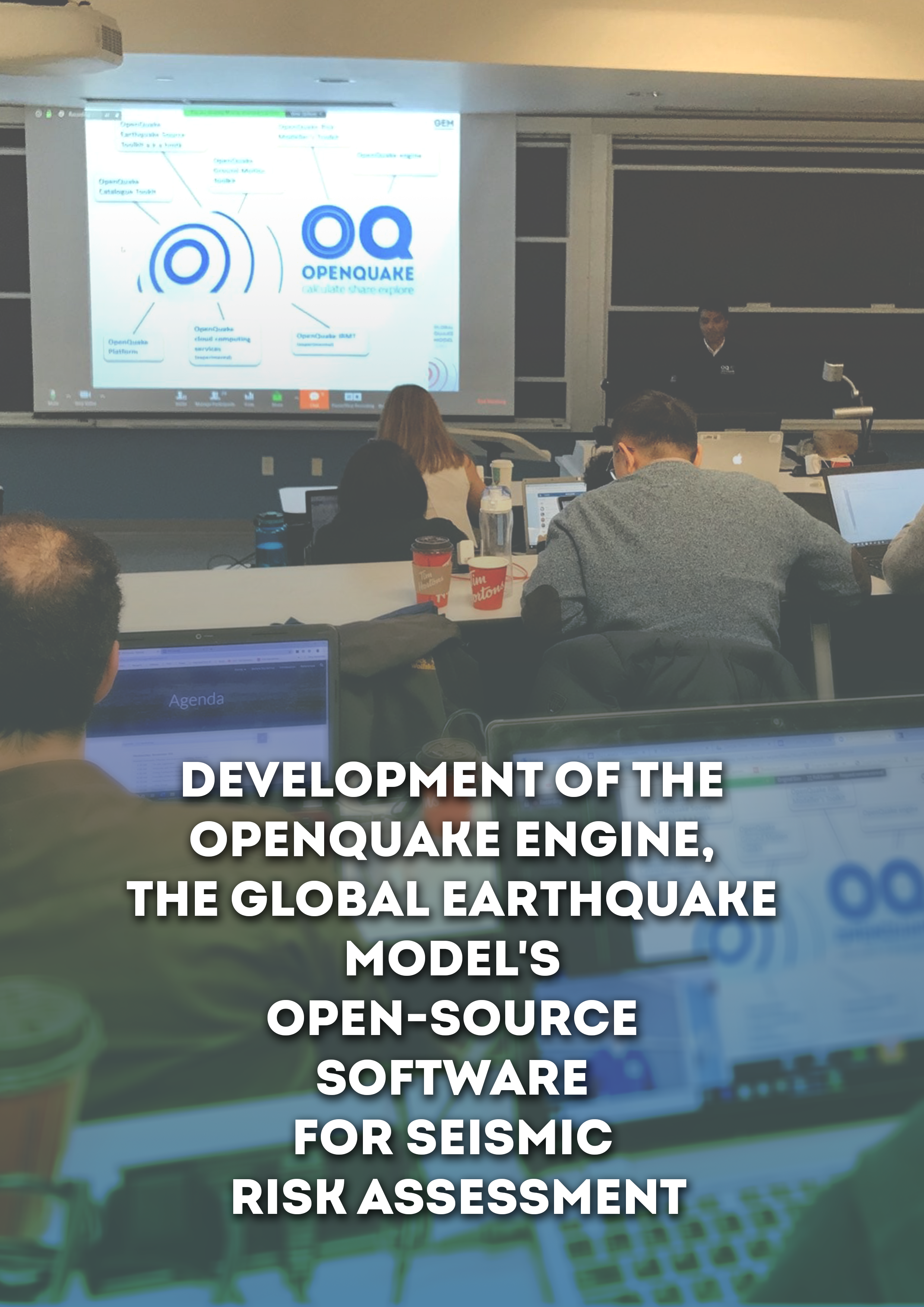
Publications Development of the OpenQuake engine, the Global Earthquake Model's open-source software for seismic risk assessment Share Facebook LinkedIn Download 2013 | Peer-reviewed The Global Earthquake Model aims to combine the main features of state-of-the-art science, global collaboration and buy-in, transparency and openness in an initiative to calculate and communicate earthquake risk worldwide. One of the first steps towards this objective has been the open-source development and release of software for seismic hazard and risk assessment called the OpenQuake engine. This software comprises a set of calculators capable of computing human or economic losses for a collection of assets, caused by a given scenario event, or by considering the probability of all possible events that might happen within a region within a certain time span. This paper provides an insight into the current status of the development of this tool and presents a comprehensive description of each calculator, with example results.
- A summary of hazard datasets and guidelines supported by the Global Earthquake Model during the first implementation phase | GEM Foundation
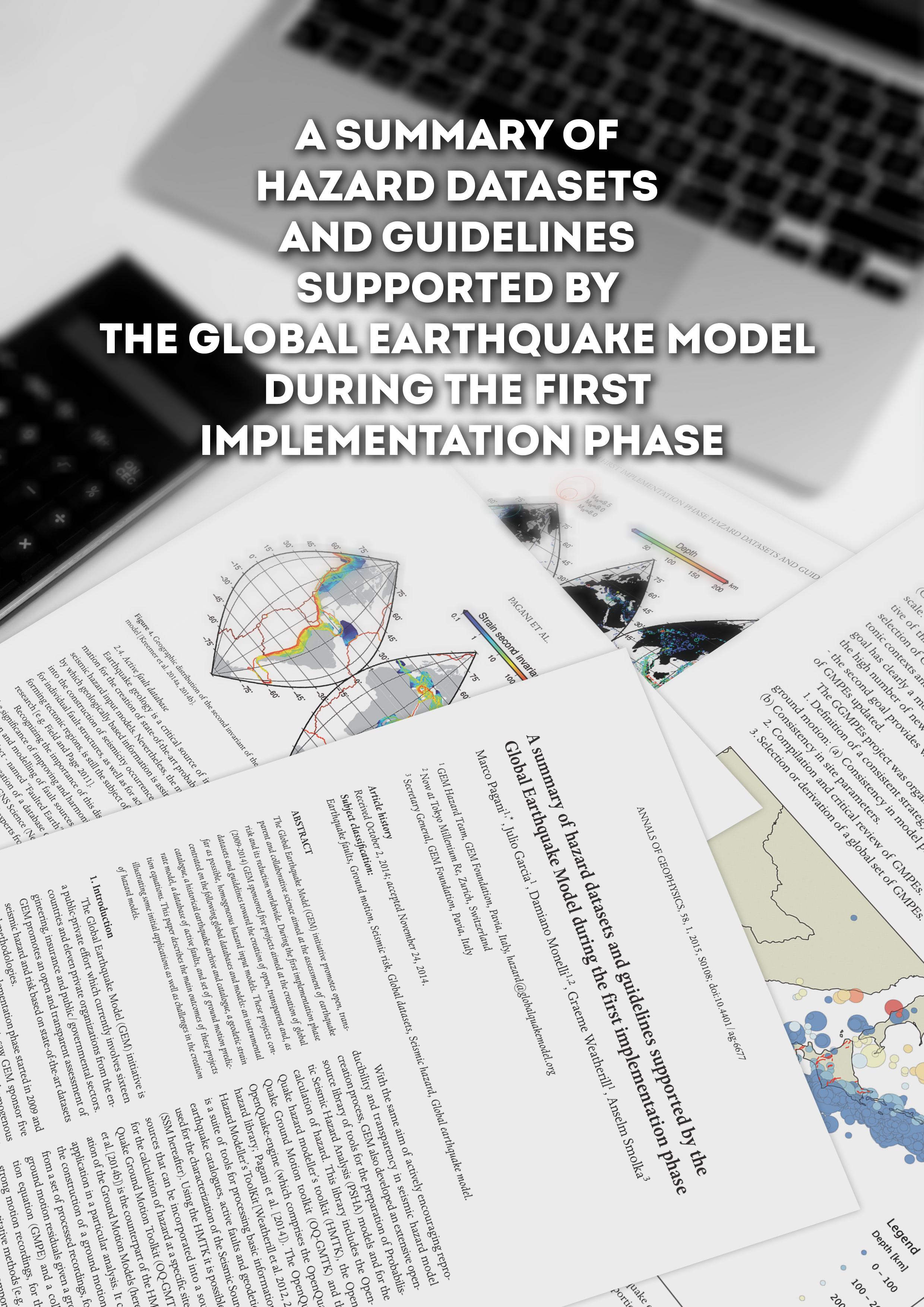
Publications A summary of hazard datasets and guidelines supported by the Global Earthquake Model during the first implementation phase Share Facebook LinkedIn Download 2015 | Peer-reviewed The Global Earthquake Model (GEM) initiative promotes open, transparent and collaborative science aimed at the assessment of earthquake risk and its reduction worldwide. During the first implementation phase (2009-2014) GEM sponsored five projects aimed at the creation of global datasets and guidelines toward the creation of open, transparent and, as far as possible, homogeneous hazard input models. These projects concentrated on the following global databases and models: an instrumental catalogue, a historical earthquake archive and catalogue, a geodetic strain rate model, a database of active faults, and set of ground motion prediction equations. This paper describes the main outcomes of these projects illustrating some initial applications as well as challenges in the creation of hazard models.