Thanks for submitting!
You will be contacted as soon as possible


QUICK LINKS


PROFILES
PUBLICATIONS
EXPOSURE
VULNERABILTY
SOFTWARE
EQ MODELS
Search Results
Search this site
1170 results found with an empty search
- Central Asia Exposure | Global EarthQuake Model Foundation
Repository with the inventory of residential, commercial and industrial buildings in Central Asia Products Central Asia Exposure Repository with the inventory of residential, commercial and industrial buildings in Central Asia Share Facebook LinkedIn Description The Global Exposure Model is a mosaic of local and regional models with information regarding the residential, commercial, and industrial building stock at the smallest available administrative division of each country and includes details about the number of buildings, number of occupants, vulnerability characteristics, average built-up area, and average replacement cost. The dataset is developed and maintained by the GEM Foundation, using a bottom-up approach at the global scale, using national statistics, socio-economic data, and local datasets. This model allows the identification of the most common types of construction worldwide, regions with large fractions of informal construction, and areas prone to natural disasters with a high concentration of population and building stock. The Central Asia region of the model includes the information pertaining the following countries/territories: Kazakhstan, Kyrgyzstan, Tajikistan, Turkmenistan, Uzbekistan How to cite this work If you make use of this work, please cite both the publication and the data. Publication: Yepes-Estrada, C., Calderon, A., Costa, C., Crowley, H., Dabbeek, J., Hoyos, M., Martins, L., Paul, N., Rao, A., Silva, V. (2023). Global Building Exposure Model for Earthquake Risk Assessment. Earthquake Spectra. doi:10.1177/87552930231194048 Data: Yepes-Estrada, C., Calderon, A., Costa, C., Crowley, H., Rao, A., Paul, N., & Silva, V. (2026). Global Exposure Model (2026.0.0). Zenodo. https://doi.org/10.5281/zenodo.8117363. Available Versions An open version (v2026.1) of the model, agreggated at Administrative Level 1, is available for direct download under a CC BY-NC-SA 4.0 license. Users interested in this version can click the "Open Repository" button in the right panel to access the information. The full version for any country/territory, at the highest resolution available, can be requested by clicking on the "License Request", where a specific license will be provided, depending on the use case. License information The open version is available under a Creative Commons CC BY-NC-SA 4.0 license, which requires: Attribution (you must give appropriate credit, provide a link to the license, and indicate if changes were made) Non-commercial (you may not use the material for commercial purposes) ShareAlike (derivatives created must be made available under the same license as the original) Any deviation from these terms incur in license infringement. For commercial use of the model, a specific license agreement must be made tailored to your use case, in such instance please click on "License Request". Facebook LinkedIn Share Latest Version v2026.0 License CC BY-NC-SA 4.0 Available resources Open Repository License Request text Map View Search Popup title Close Country/Region Available Resources Afghanistan Exposure Africa Exposure Alaska Exposure Country/Region Available Resources Afghanistan Vulnerability Africa Vulnerability Alaska Vulnerability Country/Region Resource Url Afghanistan Risk Profile Africa Risk Profile Alaska Risk Profile Search Found Country/Region Resource Url Afghanistan Exposure Africa Exposure Alaska Exposure Preview Preview is not available. Search Found Country/Region Resource Url Afghanistan Vulnerability Africa Vulnerability Alaska Vulnerability Preview Preview is not available. Search Found Country/Region Resource Url Afghanistan Risk Profile Africa Risk Profile Alaska Risk Profile Preview Preview is not available. Related products GEM Building Taxonomy Global Seismic Embodied Carbon Risk Global Seismic Hazard Map Global Liquefaction Hazard Global Exposure Model Global Vulnerability Model Global Map of Road Exposure to Ground Shaking and Liquefaction Global Seismic Risk Map Country-Territory Seismic Risk Profiles Related publications For downloading or accessing detailed product information like PNG/PDF maps, datasets, license request, shapefiles and more, please switch to a desktop or laptop computer. Thank you for your understanding.
- A summary of hazard datasets and guidelines supported by the Global Earthquake Model during the first implementation phase | GEM Foundation
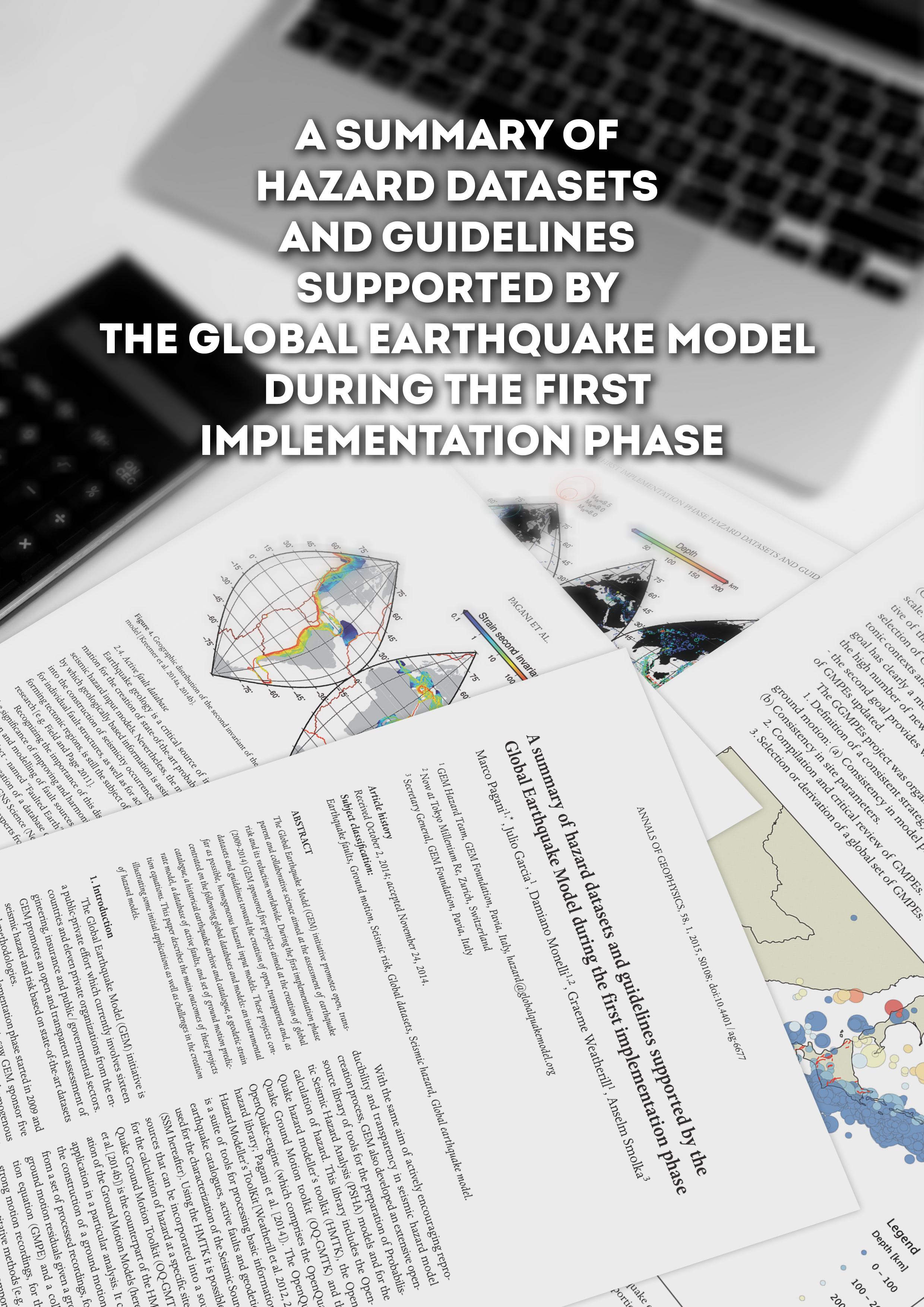
Publications A summary of hazard datasets and guidelines supported by the Global Earthquake Model during the first implementation phase Share Facebook LinkedIn Download 2015 | Peer-reviewed The Global Earthquake Model (GEM) initiative promotes open, transparent and collaborative science aimed at the assessment of earthquake risk and its reduction worldwide. During the first implementation phase (2009-2014) GEM sponsored five projects aimed at the creation of global datasets and guidelines toward the creation of open, transparent and, as far as possible, homogeneous hazard input models. These projects concentrated on the following global databases and models: an instrumental catalogue, a historical earthquake archive and catalogue, a geodetic strain rate model, a database of active faults, and set of ground motion prediction equations. This paper describes the main outcomes of these projects illustrating some initial applications as well as challenges in the creation of hazard models.
- Global EarthquakE ScEnarios (GEESE) | GEM Foundation
License Request Form You have chosen to get more information about: Global EarthquakE ScEnarios (GEESE) Hazard Please check the link below to see if this product already meets your your requirements before submitting your request for a license. Thank you. DOWNLOAD THE OPEN VERSION Summary of steps to obtain a license for the requested product. Fill in the application form below. Click Submit. Please check your email Inbox or Spam folder for the summary of your request. You will then be contacted by the GEM Product Manager with either a request for more information, or a request to sign the license. If you do not hear from us within 2 weeks, please send an email to product@globalquakemodel.org . REQUEST DETAILS A. Requesting party information First Name Last Name Role/Job Email Business type Business type Other business Sector Sector Other sector B. License agreement signatory information The signatory must be someone who is authorised to sign license agreements on your behalf such as your immediate supervisor, manager or legal officer. If you’re a PhD student, the signatory must be your adviser or a university officer in charge of license agreements or similar legal documents. Full Name of Signatory Position Company Email of Signatory Organisation name Complete Address C. Purpose of request GEM is able to offer products for free because of the support of our project partners, national collaborators and institutional sponsors. All of GEM’s products are freely available for public good, non-commercial use, but with different license restrictions. In most cases we release products under an open license (e.g., CC BY-SA or CC BY-NC-SA), which permits (re)distribution. In this case, we are granting access under a more restricted license that forbids distribution or disclosure and requires signing by GEM and the licensee in order to better assure accountability for the confidentiality of the information. In order for GEM to properly assess your request, please answer the following questions below. 1. Explain briefly how will the GEM product be used e.g. project, research including the expected results and the foreseen public benefit. Minimum 60 words. 2. Will you be able to share the results of your work with GEM? YES NO 3. Will you be able to provide feedback to GEM on the quality and usefulness of this product via a survey? YES NO D. Privacy Policy By submitting this form, you consent to the processing of your personal data in accordance with our Privacy Policy and the EU General Data Protection Regulation (GDPR). We are committed to safeguarding your information and ensuring it is only used for the purpose outlined in this form. You have the right to access, rectify, or delete your data at any time. For more information, please refer to our Privacy Policy. I agree Words: 0 Email us at product@globalquakemodel.org if you're experiencing problems submitting your application. Thank you. Submit Thanks for submitting! You will be contacted as soon as possible Incomplete data. Please fill in all required fields. Thank you.
- OpenQuake Engine | GEM Foundation
License Request Form You have chosen to get more information about: OpenQuake Engine All Please check the link below to see if this product already meets your your requirements before submitting your request for a license. Thank you. DOWNLOAD THE OPEN VERSION Summary of steps to obtain a license for the requested product. Fill in the application form below. Click Submit. Please check your email Inbox or Spam folder for the summary of your request. You will then be contacted by the GEM Product Manager with either a request for more information, or a request to sign the license. If you do not hear from us within 2 weeks, please send an email to product@globalquakemodel.org . REQUEST DETAILS A. Requesting party information First Name Last Name Role/Job Email Business type Business type Other business Sector Sector Other sector B. License agreement signatory information The signatory must be someone who is authorised to sign license agreements on your behalf such as your immediate supervisor, manager or legal officer. If you’re a PhD student, the signatory must be your adviser or a university officer in charge of license agreements or similar legal documents. Full Name of Signatory Position Company Email of Signatory Organisation name Complete Address C. Purpose of request GEM is able to offer products for free because of the support of our project partners, national collaborators and institutional sponsors. All of GEM’s products are freely available for public good, non-commercial use, but with different license restrictions. In most cases we release products under an open license (e.g., CC BY-SA or CC BY-NC-SA), which permits (re)distribution. In this case, we are granting access under a more restricted license that forbids distribution or disclosure and requires signing by GEM and the licensee in order to better assure accountability for the confidentiality of the information. In order for GEM to properly assess your request, please answer the following questions below. 1. Explain briefly how will the GEM product be used e.g. project, research including the expected results and the foreseen public benefit. Minimum 60 words. 2. Will you be able to share the results of your work with GEM? YES NO 3. Will you be able to provide feedback to GEM on the quality and usefulness of this product via a survey? YES NO D. Privacy Policy By submitting this form, you consent to the processing of your personal data in accordance with our Privacy Policy and the EU General Data Protection Regulation (GDPR). We are committed to safeguarding your information and ensuring it is only used for the purpose outlined in this form. You have the right to access, rectify, or delete your data at any time. For more information, please refer to our Privacy Policy. I agree Words: 0 Email us at product@globalquakemodel.org if you're experiencing problems submitting your application. Thank you. Submit Thanks for submitting! You will be contacted as soon as possible Incomplete data. Please fill in all required fields. Thank you.
- 100 Resilient Cities CoLab Workshop in Cali, Colombia - GEM Foundation
News 100 Resilient Cities CoLab Workshop in Cali, Colombia By: Jul 2, 2018 Share Facebook LinkedIn 100 Resilient Cities – pioneered by the Rockefeller Foundation (100RC), held a collaborative workshop (CoLab) in Cali, Colombia from 20-22 February on the resilience of school infrastructure. Cali is located in the southwestern part of the country and is Colombia’s third largest city, with a metropolitan population of about 2-1/2 million people. Cali is at very high at risk from earthquake, as well as flood and landslide hazards. John Schneider, GEM Secretary General was invited to attend the CoLab workshop on behalf of GEM as a prospective partner in 100RC, potentially to work with Cali and other cities in the 100RC network to improve understanding of earthquake risks. He said “the 100RC CoLab workshop was a great way to meet 100RC partners, city officials and other stakeholders committed to developing resilient cities, and to see how reducing risks to disasters such as earthquakes can play an important part in the process.” The CoLab was attended by about 50 people, the majority from the Municipality of Cali (Mayor’s office as well as departments of education, risk management, and planning), and the remainder from the 100RC team (led by Vivian Argueta Bernal, Cali Chief Resilience Officer), together with international partners including AIR Worldwide (Alvaro Farias); International Code Council (Alberto Herrera); Build Change (Anna Pavan); Geohazards International (Janise Rodgers); and World Bank (Fernando Ramirez and Fred Krimgold). The workshop focused on Cali’s ambitious USD 170 million dollar program called “My Community, My School” which seeks to improve the quality of Cali’s public educational system. The aim is to fund improvements to about 150 schools over the next several years, including improving physical infrastructure (e.g., new construction and seismic retrofit), as well as making qualitative improvements in school programs. Some of the key discussion points in the workshop were to consider how to design (or redesign) schools to be centers of their local communities, to be safe and sustainable, and to be the foundations for a resilient Cali. Cali Mayor Maurice Armitage said, “Cuando hablo de resiliencia, que es una palabra rara en Colombia, me refiero a buscar que esos colegios que estamos remodelando o que estamos construyendo se conviertan en los establecimientos donde la gente se puede refugiar." (When I speak of resilience, which is a rare word in Colombia, I mean to look for those schools that we are remodeling or that we are building to become the establishments where people can take refuge.)(Source: http://www.cali.gov.co/resiliencia/publicaciones/139149/colab-es-una-gran-oportunidad-para-invertir-de-manera-resiliente-en-educacion-armitage/ ) The workshop promoted interaction between local and international experts to exchange ideas about the design of safe and sustainable schools, and the importance of schools as part of a resilient community. The workshop also produced a set of recommendations for projects for consideration by the Mayor as part of a master plan for the development and maintenance of the school system. As part of the visit to Cali, John also met with Hans Jürgen Meyer and Cristina Rosales of Corporación OSSO, a non-profit and public-good organization based in Cali and devoted to natural hazard and risk research and applications to society. OSSO works closely with the Department of Planning in Cali to develop flood, earthquake and landslide hazard maps. GEM is now assisting OSSO to use the OpenQuake suite of tools for earthquake hazard and risk assessment, which has resulted in a pilot study of earthquake risk in Cali. OSSO has also contributed improvements to GEM’s IDC tools, including a Spanish version of the mobile app. GEM looks forward to working with OSSO in the future on urban risk assessment issues. No images found. GALLERY 1/0 VIDEO RELATED CONTENTS
- Methods and Tools Innovation for Seismic Risk Assessment project - GEM Foundation
News Methods and Tools Innovation for Seismic Risk Assessment project By: Jul 26, 2020 Share Facebook LinkedIn GEM is set to start a 3- year project called METIS or Methods and Tools Innovation for Seismic Risk Assessment funded by the European Commission. The project is part of the program. Electricite De France (EDF), a GEM technical collaborator, is coordinating the project which will be implemented in collaboration with 14 other organizations. The project will start in September 2020 and end in August 2024. The objective of is to translate research into practice through rigorous and efficient methodologies and tools to assess seismic safety of NPP (nuclear power plants). It also aims to innovate current practice by combining simulation with experimental data. The research will develop methods to improve the ability to define safety limits for extremely rare events, which go beyond current design analyses (i.e. design extension for earthquakes). The refined seismic PSA (probabilistic safety assessment) is expected to provide meaningful support in defining regulations for safe design of NPP, as well as for assessing plant safety in real-time in case of temporary unavailability of relevant safety equipment or structures. GEM will contribute to the task on seismic hazard assessment and the one on PSA Tools and Methodology. In the hazard task, GEM will implement into the OQ Engine methods such as vector-valued probabilistic seismic hazard analysis (PSHA), cluster-based PSHA as well as new methods to propagate epistemic uncertainties. Research will also be carried out in the context of processing earthquake catalogues to remove aftershocks and foreshocks and on testing PSHA models. GEM’s contribution to the PSA Tools and Methodology will concentrate on testing risk results. The participation of GEM in this high-level program will not only enhance GEM’s scientific advancement of earthquake hazard analysis using the OpenQuake engine, but will also promote a two-way sharing of knowledge and skills with other project collaborators for the advancement of earthquake hazard assessment to critical infrastructure such as nuclear power plants. The results of this project will help nuclear operators in their periodic safety reviews and to respond to the high-level EU-wide safety objectives of the amended EURATOM nuclear safety directive (stress tests). The considered accident scenarios will provide input for updating severe accident management guidelines (SAMG). No images found. GALLERY 1/2 Gallery VIDEO RELATED CONTENTS
- India and surroundings Hazard | Global EarthQuake Model Foundation
OpenQuake engine input model to perform hazard calculations for India and surrounding territories Products India and surroundings Hazard OpenQuake engine input model to perform hazard calculations for India and surrounding territories Share Facebook LinkedIn Description Coverage of the Indian subcontinent is with the hazard model developed by Nath and Thingbaijam (2012). This model covers India, Bangladesh, Bhutan and Nepal. The model was first updated and translated from its original format into the OpenQuake engine in collaboration with Natural Resources Canada, and more recently major changes to the source models in the Himalayas have been implemented as part of the USAID funded FORCE project leading to v2012.4.0. How to cite this work Nath, S. K. and Thingbaijam, K. K. S. (2012). Probabilistic seismic hazard assessment of India. Seismological Research Letters, 83(1):135–149 Available Versions An open version (v2012.4.0) is available for direct download under a CC BY-NC-SA 4.0 license. Users interested in this version can click the "Open Version Download" button in the right panel to access the information. If your use case does not comply with the license terms, a license can be requested by clicking on the "License Request", where a specific agreement will be provided, depending on the use case. License information The open version is available under a Creative Commons CC BY-NC-SA 4.0 license, which requires: Attribution (you must give appropriate credit, provide a link to the license, and indicate if changes were made) Non-commercial (you may not use the material for commercial purposes) ShareAlike (derivatives created must be made available under the same license as the original) Any deviation from these terms incur in license infringement. For commercial use of the model, a specific license agreement must be made tailored to your use case, in such instance please click on "License Request". Facebook LinkedIn Share Latest Version v2012.4.0 License CC BY-NC-SA 4.0 Available resources Open Version Download Documentation License Request text Map View Search Popup title Close Country/Region Available Resources Afghanistan Exposure Africa Exposure Alaska Exposure Country/Region Available Resources Afghanistan Vulnerability Africa Vulnerability Alaska Vulnerability Country/Region Resource Url Afghanistan Risk Profile Africa Risk Profile Alaska Risk Profile Search Found Country/Region Resource Url Afghanistan Exposure Africa Exposure Alaska Exposure Preview Preview is not available. Search Found Country/Region Resource Url Afghanistan Vulnerability Africa Vulnerability Alaska Vulnerability Preview Preview is not available. Search Found Country/Region Resource Url Afghanistan Risk Profile Africa Risk Profile Alaska Risk Profile Preview Preview is not available. Related products Global Liquefaction Hazard Global Exposure Model Global Vulnerability Model Global Seismic Embodied Carbon Risk Global Seismic Risk Map Country-Territory Seismic Risk Profiles Model Builder's Toolkit (oq-mbtk) Global Seismic Hazard Map Related publications Seismic Risk Assessment in Nepal Read More For downloading or accessing detailed product information like PNG/PDF maps, datasets, license request, shapefiles and more, please switch to a desktop or laptop computer. Thank you for your understanding.
- OQ Engine certified user S Vishal Gupta | GEM Foundation
OpenQuake Engine certified user page This is to certify that S Vishal Gupta has successfully completed the requirements to become a Certified OpenQuake Engine User for Scenario Assessment demonstrating the required knowledge and skills as assessed by the Global Earthquake Model (GEM) Foundation. GEM Foundation Secretary General Helen Crowley (signed) Date of Completion: Valid until: September 12, 2025 September 11, 2028
- Scenario selection for representative earthquakes in Quito, Cali and Santiago de los Caballeros | GEM Foundation
Publications Scenario selection for representative earthquakes in Quito, Cali and Santiago de los Caballeros Share Facebook LinkedIn Download 2022 | Report The objective of a selection based on hazard is to identify events with destructive potential based on their contribution to the seismic hazard. In turn such events can be modelled to inform the risk management offices about their potential impact and support in disaster preparedness.
- OpenQuake Survey results: Toward innovation in 2021 and beyond - GEM Foundation
News OpenQuake Survey results: Toward innovation in 2021 and beyond By: Jan 23, 2021 Share Facebook LinkedIn The GEM Foundation completed an online survey of 83 OpenQuake users from 32 countries in December 2020. The aim of the survey was to understand the way users currently use OpenQuake, and to use the feedback as input for product development and for improving overall user experience. To date, the OpenQuake engine - GEM’s state-of-the-art, open source software for seismic hazard and risk analysis - has been cited in peer-reviewed publications for earthquake hazard and risk studies in 16 regions and 58 countries. No doubt, the actual number of studies is far greater. Overall, OpenQuake is rated as the best open source software for both earthquake hazard and risk analysis by most of the respondents. The OpenQuake engine is mostly used for hazard analysis purposes (2:1 ratio against risk), and current features that were rated high were mostly related to hazard. However, these could be a limitation of the survey i.e. depends on who participated. The expertise level of most OpenQuake users responding was mainly in the beginner to intermediate range. Most beginner users found it not user friendly, which is not surprising given the complexity of the analysis process and the level of knowledge required to use the software effectively. This result suggests there is an opportunity for GEM to expand its training activities in the future, and potentially get additional income from this service. Future improvements pointed out by the users focused mainly on thorough documentation including all configuration parameters, while in terms of future development, the preference (64%) is to further develop OpenQuake’s hazard and risk modelling capabilities with additional tool kits for developing the required input models (e.g. source model, ground motion selection, exposure model, vulnerability model), testing, visualization, and extended toolkits. Overall, about 70% of the respondents gave high satisfaction ratings for OpenQuake. Below are some of the positive feedback from the users. (see gallery image: Overall OQ Engine Rating) “Thank you for your great work. There is always a lot that can be done, but OQ is already an awesomely useful tool.” “In general, it is an amazing tool and I really enjoy working with it and all the support I have received from the team.” “Lots of great improvements are being made with each release and sometimes it is hard to keep up without having insider knowledge! I don't know what the solution is - the What's New is very well done, but I suppose I feel it is not always translated to the manual?” “Having started to work with OQ only recently, I personally have to say that I value all of your development and I appreciate your great support and help while setting things up (more technical stuff, really). Good product, good work. Thank you!” “I really appreciate the collaborative nature of the GEM Development Team. I find they are excellent at responding to queries both in a timely manner but also with good detail. Keep up the great work!” In 2021 the plan is to revamp the GEM website’s Products download system and incorporate an automated email invitation to provide feedback after 1-2 months after the download. The feedback form will also be modified to make it shorter and more aligned with GEM’s: short- and long-term plans for the OpenQuake Engine; and with customer support and satisfaction. If you have ideas for how to improve OpenQuake or want more information, please send an email to or join the . We also love to hear about how you have used OpenQuake in your research or in hazard or risk assessment applications. Send us your publications and reports at and we will be happy to promote them through our newsletter and website. No images found. GALLERY Overall OQ Engine Rating Overall OQ Engine Rating 1/4 Gallery VIDEO RELATED CONTENTS