Thanks for submitting!
You will be contacted as soon as possible


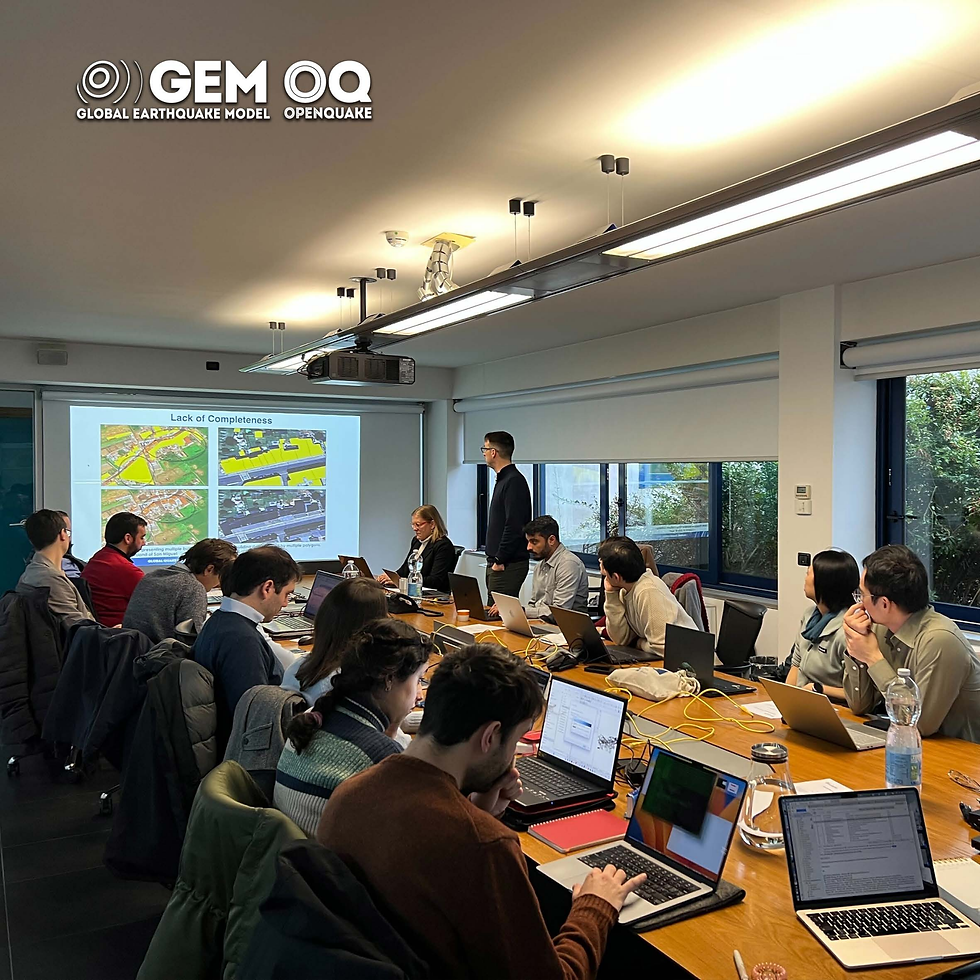
GEM hosted a one-day Global Exposure Modelling Workshop in Pavia in February 2026, bringing together experts from Humanitarian OpenStreetMap Team, Overture Maps Foundation, the Joint Research Centre (JRC), German Aerospace Centre (DLR), Meta, Technical University of Munich, Oak Ridge National Laboratory and the U.S. Geological Survey, alongside the GEM exposure modelling team.
The workshop focused on a central challenge in global risk modelling: how to build consistent exposure information that can describe buildings and infrastructure across countries while remaining useful for hazard, vulnerability and loss analysis. In GEM’s broader modelling framework, exposure data are a core component of risk assessment, providing information on building stock, occupancy, replacement cost and related characteristics needed to estimate potential impacts.


GEM’s existing Global Exposure Model is a mosaic of national models covering residential, commercial and industrial building stock worldwide. The model includes information at the smallest available administrative level for each country or territory and is designed to support global and regional risk assessment. The workshop in Pavia built on this foundation by exploring how newer sources and methods could help move toward more detailed, individual building-level exposure information at a global scale.
Participants contributed perspectives ranging from crowd-sourced mapping and open geospatial datasets to Earth observation, AI-based classification and building-level exposure models.
Across the day, discussions moved from global imagery and map sources to the practical requirements of integrating detailed building information into multi-hazard risk models. A final roundtable considered shared priorities and possible frameworks for collaboration toward a building-level global exposure model, including the need for consistency, interoperability and open methodologies.
The workshop highlighted how global exposure modelling increasingly depends on collaboration across communities that do not always work together directly, including geospatial data providers, Earth observation specialists and risk scientists. By convening these perspectives in one setting, GEM used the event not only to review current approaches, but also to help define the next steps in strengthening the exposure component of global risk modelling.
No images found.
GALLERY
VIDEO

RELATED CONTENTS
