Thanks for submitting!
You will be contacted as soon as possible


GEM participated in a series of conferences, workshops and learning events during the quarter, presenting its latest work on global earthquake risk and contributing to discussions on infrastructure, multi-hazard assessment, exposure modelling and resilience.
Secretary General Helen Crowley delivered the keynote “Expanding the Boundaries of Global Earthquake Risk” at three events: the NHERI Computational Symposium, the XII National Congress on Earthquake Engineering in Bogotá, and ICONHIC 2026.
Drawing on GEM’s 2026 global releases, Helen explained how earthquake risk assessment is expanding beyond estimates of ground shaking and economic loss. The work includes a fully global hazard framework covering onshore and offshore seismic sources, earthquake-triggered liquefaction and its effects on infrastructure, embodied carbon loss, and projections of how exposure and vulnerability could change through to 2065.
Although the three events had different audiences, the presentations addressed a common question: what information will be needed to understand earthquake risk in a future shaped by changing cities, infrastructure systems and interconnected hazards?
At ICONHIC, GEM Postdoctoral Researcher Astha Poudel also presented two studies developed with GEM Infrastructure Risk Lead Catarina Costa through the Portuguese-funded SafeNet project. The studies examined the seismic risk of transportation networks, including secondary hazards, urban road systems and approaches for improving infrastructure resilience.
Astha also joined the REUNATECH Summer School in Thessaloniki as a guest lecturer. Her session focused on systemic multi-hazard risk assessment and prompted discussion on how the OpenQuake Engine could be used to analyse multiple hazards and interdependencies.

In Tallinn, Physical Vulnerability Lead Al Mouayed Bellah Nafeh participated in the third RENOMIZE consortium meeting. GEM contributed to work on structural simulations, seismic actions and performance assessment within an EU-funded project developing automated and industrialised approaches to building renovation.


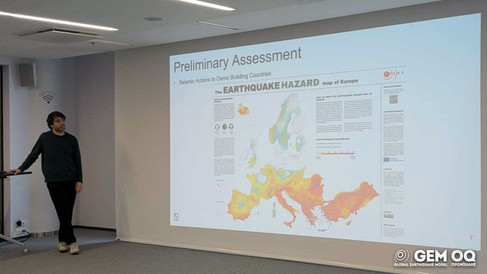
The future of European seismic risk modelling was discussed at the EPOS–EFEHR workshop at the University of Aveiro. Vitor Silva, Marco Baiguera, Daniel Gomez and Catarina Costa joined 53 participants from 26 institutions to review national risk models, exposure and vulnerability modelling, artificial intelligence applications and the future development of the European Seismic Risk Model.





GEM also contributed to two interdisciplinary events. In a Royal Geographical Society webinar, Anirudh Rao explained how national datasets, local surveys and Earth observation can be combined to represent geographic differences in exposure, drawing on work in Türkiye and Bangladesh.
At the NEXT-GEN Spring School in Pavia, Helen, Vitor and Anirudh presented GEM’s global risk work and the OpenQuake Engine within a programme covering climate change, natural hazards and community resilience.



##
No images found.
GALLERY


VIDEO

RELATED CONTENTS
