Thanks for submitting!
You will be contacted as soon as possible


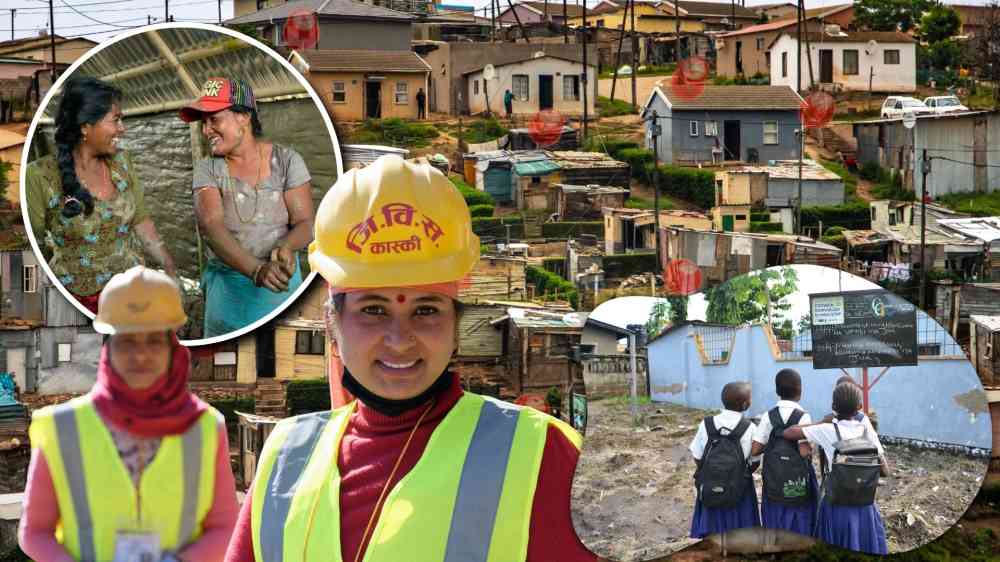
Image credit: UNDRR
The Global Earthquake Model (GEM) Foundation's 2026 global seismic risk assessment reports that unreinforced masonry and earthen construction account for more than half of the buildings estimated to be destroyed by earthquake shaking in an average year worldwide. This is an estimate based on averaging many possible earthquakes, not a prediction for any particular year. The finding highlights the importance of building design and construction in reducing earthquake risk, a concern at the heart of this year's International Day for Disaster Risk Reduction (IDDRR) on 13 October, under the theme “Resilience Starts at Home.”
GEM Global Exposure and Seismic Risk Models, 2026 (v2026.1)

In eastern Afghanistan, mudbrick and stone have long been used to build homes from locally available materials suited to the region's climate. When a magnitude 6.0 earthquake struck on 31 August 2025, a UN-led assessment recorded 1,992 deaths and more than 8,300 homes damaged or destroyed. UNICEF documented extensive damage to traditional housing, with shallow shaking and landslide-prone terrain contributing to the destruction.
Earthquake performance of buildings depends on structural details as well as materials. Wall-to-roof connections, reinforcement, roof weight and construction quality influence how a home withstands shaking. UNDP has documented efforts in some parts of Afghanistan to improve the earthquake resistance of traditional earthen housing.
“A masonry building described as mudbrick or cement block can have very different behaviour under strong shaking depending on how it is built. Information on its structural system, connections and condition helps us assess its vulnerability and estimate the potential impact of earthquakes considering local construction practices,” said Catalina Yepes-Estrada, GEM's Exposure Development Lead.
Cata also noted that GEM's 2026 assessment estimates that fewer than 10% of buildings worldwide meet modern building codes and have moderate-to-high ductility. She stressed the importance of applying earthquake-resistant design standards to new construction while strengthening existing buildings through methods suited to local practices.
Research involving GEM scientists in Central America shows how seismic risk modelling can be used to compare strengthening options before investments are made. A 2022 study by Hoyos and Silva found that retrofitting adobe (sun-dried mudbrick) and unreinforced masonry buildings could be economically viable along the region's western coast over 50 years. A 2025 study by Orihuela and colleagues on earthquake early warning (EEW) systems cited that research, noting that modelled retrofitting could reduce average annual fatalities by nearly 90% compared with leaving buildings unstrengthened, with estimated benefit–cost ratios (BCRs) reaching 6:1 in Guatemala and El Salvador, or up to six dollars in benefits for every dollar invested in retrofitting. They used GEM models to show that EEW on the other hand can reduce fatalities by 10-15% at a very low cost and with rapid implementation, thus providing a more immediate risk mitigation strategy to be considered alongside a longer-term plan for retrofitting.
These findings give practical context to UNDRR's call for governments to enforce risk-informed planning and building standards, and for developers, builders and financiers to invest in safer housing. Households also have a role in understanding local risks and participating in planning decisions, although many need technical and financial support.
Risk models cannot strengthen homes on their own. Their value lies in guiding decisions about safer construction and affordable improvements that respect local building traditions.
Further information: International Day for Disaster Risk Reduction 2026 – Resilience Starts at Home
##END##
No images found.
GALLERY
VIDEO

RELATED CONTENTS
