top of page
Thanks for submitting!
You will be contacted as soon as possible


Featured Publications

Development of a global seismic risk model

GEM Strategic Plan and Roadmap to 2030

Improving Post-Disaster Damage Data Collection to Inform Decision-Making Final Report
Anchor 1
Publications List

0
Sort by Title:

Download
Back to Normal report
Type:
Report
Year:
2017
Given the high level of earthquake risk in California, all communities need to be prepared to respond to and recover from the impacts of a potentially devastating earthquake. Although there has been significant research on the estimation of direct economic losses immediately after an earthquake, there has not been enough research about long-term recovery, and even less in the development and application of computer simulation models. This is to some extent because data on building repair and recovery times from past earthquakes have not been systematically documented (Comerio M. , 2006). Moreover, the models developed so far have not successfully captured the complexity of the recovery process. Recovery depends on many factors (such as the socio-economic conditions of the affected area) that are usually difficult to measure, understand and apply to predicting or modelling the recovery process.

Download
Beyond Button Pushing report
Type:
Report
Year:
2017
According to the Working Group on California Earthquake Probabilities, the likelihood of magnitude 6.7 and larger earthquakes occurring somewhere in California in the next 30 years is near certainty. Given the high level of earthquake risk in California, it is crucial to develop policies for risk mitigation, emergency preparedness, risk transfer and insurance, and buildings and infrastructure design that are informed by the best available science on earthquakes. Consequently, there is a need for improved understanding of the seismic risk in the State, including a better characterization of elements that comprise the risk: hazard, exposure, and vulnerability.


Download
Data Interchange Formats for the Global Earthquake Model (GEM)
Type:
Report
Year:
2010
Sixteen draft data interchange formats and 7 terminology standards (collectively referred to here as DIFs) are proposed here for use in GEM1. This initial draft includes several DIFs for hazard output (to be used as input to risk analyses), exposure (i.e., values exposed to seismic risk), vulnerability, and fragility. Samples are provided of each DIF, and in each case, each parameter is explained, assigned a variable type (e.g., integer, text string, double-precision floating point, etc.) and any constraints are specified (e.g., probabilities between 0 and 1). The proposed data standards in this draft draw primarily on OpenSHA, OpenRisk, PAGER, and to a limited extent HAZUS-MH, EMS-98, and the World Housing Encyclopedia. The DIFs presented in this draft are entirely human-readable, plain-text flat files (commas-and-quotes); no attempt has been made yet to define XML formats. The emphasis in these DIFs is on simplicity and universality over storage efficiency. It is not intended that these DIFs represent a complete or exhaustive set of what GEM1 will require. Later drafts may add XML format and DIFs for other I/O needs. GEM1 participants are encouraged to contact the authors to recommend additions, modifications, and clarification.
Download
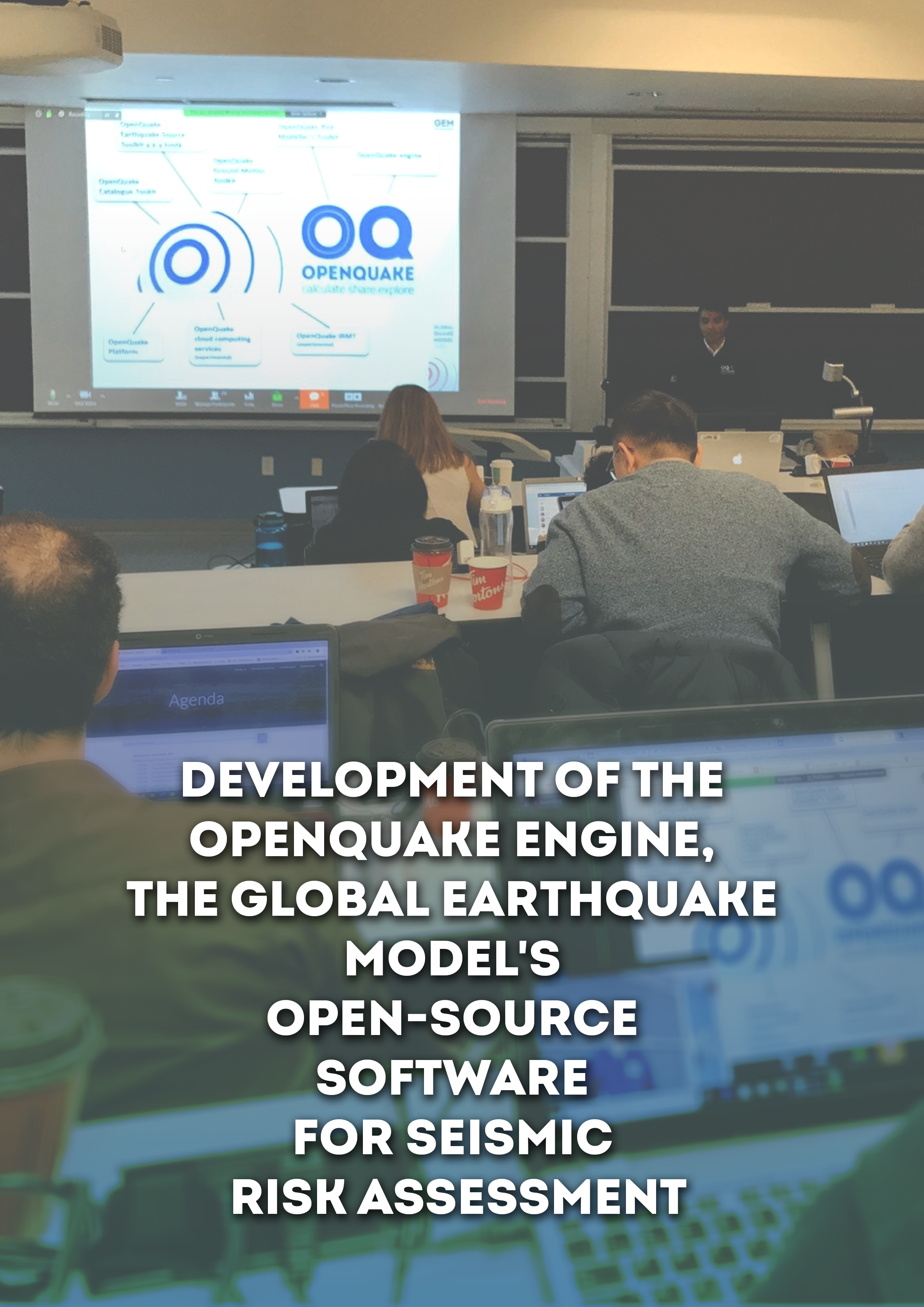
Development of the OpenQuake engine, the Global Earthquake Model's open-source software for seismic risk assessment
Type:
Peer-reviewed
Year:
2013
The Global Earthquake Model aims to combine the main features of state-of-the-art science, global collaboration and buy-in, transparency and openness in an initiative to calculate and communicate earthquake risk worldwide. One of the first steps towards this objective has been the open-source development and release of software for seismic hazard and risk assessment called the OpenQuake engine. This software comprises a set of calculators capable of computing human or economic losses for a collection of assets, caused by a given scenario event, or by considering the probability of all possible events that might happen within a region within a certain time span. This paper provides an insight into the current status of the development of this tool and presents a comprehensive description of each calculator, with example results.
Download
Earthquake Model for the European-Mediterranean Region for the purpose of GEM1
Type:
Report
Year:
2010
This is an external report, produced within the scope of the GEM1 project. GEM1 was a focused pilot project of the Global Earthquake Model initiative, which ran from January 1st 2009 to March 31st 2010 and was aimed at generating GEM’s first products and developing GEM’s initial IT infrastructure. The technical achievements of GEM1 have been summarised in a series of 10 reports; 6 internal and 4 external GEM1 reports. The internal reports are based on the achievements of the GEM1 team, the external reports are written by external experts who had been awarded a subcontract to carry out a specific task. In addition to reading this external reports, it is suggested to also read the rest of the GEM1 reports and in particular the GEM1 Executive Summary.

Download
End-to-end demonstration of the inventory data capture tools (IDCT)
Type:
User manual
Year:
2014
TheGlobalEarthquakeModel(GEM)aimstoprovideasetoftoolsandmodelsforhazardandriskanalysis. ThefundamentalaimoftheGEMInventoryDataCaptureTools(IDCT)riskglobalcomponentistoprovidea set of software and accompanying user protocols toenable users to collect andmodify buildingexposure information, which can be input into the Global Exposure Database (GED) and the Global Earthquake ConsequencesDatabase.
Download
Exploring earthquake databases for the creation of magnitude-homogeneous catalogues: tools for application on a regional and global scale
Type:
Peer-reviewed
Year:
2016
The creation of a magnitude-homogenized catalogue is often one of the most fundamental steps in seismic hazard analysis. The process of homogenizing multiple catalogues of earthquakes into a single unified catalogue typically requires careful appraisal of available bulletins, identification of common events within multiple bulletins and the development and application of empirical models to convert from each catalogue's native scale into the required target. The database of the International Seismological Center (ISC) provides the most exhaustive compilation of records from local bulletins, in addition to its reviewed global bulletin. New open-source tools are developed that can utilize this, or any other compiled database, to explore the relations between earthquake solutions provided by different recording networks, and to build and apply empirical models in order to harmonize magnitude scales for the purpose of creating magnitude-homogeneous earthquake catalogues. These tools are described and their application illustrated in two different contexts. The first is a simple application in the Sub-Saharan Africa region where the spatial coverage and magnitude scales for different local recording networks are compared, and their relation to global magnitude scales explored. In the second application the tools are used on a global scale for the purpose of creating an extended magnitude-homogeneous global earthquake catalogue. Several existing high-quality earthquake databases, such as the ISC-GEM and the ISC Reviewed Bulletins, are harmonized into moment magnitude to form a catalogue of more than 562 840 events. This extended catalogue, while not an appropriate substitute for a locally calibrated analysis, can help in studying global patterns in seismicity and hazard, and is therefore released with the accompanying software.

Download
GEM building taxonomy version 2.0
Type:
Report
Year:
2013
This report documents the development and applications of the Building Taxonomy for the Global Earthquake Model (GEM). The purpose of the GEM Building Taxonomy is to describe and classify buildings in a uniform manner as a key step towards assessing their seismic risk. Criteria for development of the GEM Building Taxonomy were that the Taxonomy be relevant to seismic performance of different construction types; be comprehensive yet simple; be collapsible; adhere to principles that are familiar to the range of users; and ultimately be extensible to non-buildings and other hazards. The taxonomy was developed in conjunction with other GEM researchers and builds on the knowledge base from other taxonomies, including the EERI and IAEE World Housing Encyclopedia, PAGER-STR, and HAZUS.
Download
GEM IT Review 2010
Type:
Report
Year:
2013
The primary (IT) goal of GEM is to extend the scope, but not necessarily the state-of-the-art, of risk and hazard calculation, as related to earthquakes. In order to achieve this, we expect our IT architecture to be: • Open (Data, Source, Protocols, Standards, etc.) • Pluggable (Modular, Loosely-Coupled) • Dynamic (Fault-tolerant, Distributed, Constantly Updated)
Title | Year | Type | Topic | Journal |
|---|---|---|---|---|
Back to Normal report | 2017 | Report | CSSC Project | |
Beyond Button Pushing report | 2017 | Report | CSSC Project | |
Celebrating achievements and way forward | 2013 | Brochure | GEM | |
Data Interchange Formats for the Global Earthquake Model (GEM) | 2010 | Report | GEM1 | |
Development of the OpenQuake engine, the Global Earthquake Model's open-source software for seismic risk assessment | 2013 | Peer-reviewed | OpenQuake | Natural Hazards |
Earthquake Model for the European-Mediterranean Region for the purpose of GEM1 | 2010 | Report | GEM1 | |
End-to-end demonstration of the inventory data capture tools (IDCT) | 2014 | User manual | Global Components (2009-2013) | |
Exploring earthquake databases for the creation of magnitude-homogeneous catalogues: tools for application on a regional and global scale | 2016 | Peer-reviewed | Hazard | Geophysical Journal International |
GEM building taxonomy version 2.0 | 2013 | Report | Global Components (2009-2013) | |
GEM IT Review 2010 | 2013 | Report | GEM1 |
bottom of page